
Amadeus
Overview
Peter Shaffer’s Amadeus is a historical drama about Wolfgang Amadeus Mozart and Antonio Salieri, first performed in 1979 and published in 1980. Set in the musical and courtly world of late eighteenth-century Vienna, it turns a celebrated but largely legendary rivalry into a theatrical inquiry into genius, envy, faith, and artistic creation. Rather than presenting events as an impersonal historical record, Shaffer gives the story to an older Salieri, who looks back on his life and addresses the audience directly. His account is both confession and performance: spectators must decide how much to believe a narrator who has reason to shape the story in his own favor.
Plot and dramatic design
The play opens in 1825, with Salieri recalling his former standing as a respected court composer. His memories return to the years when Mozart arrived in Vienna and astonished him. Salieri believes that devotion, discipline, and moral conduct should earn a person recognition. Hearing Mozart’s music, however, convinces him that he has encountered a level of inspiration beyond anything he can achieve. His admiration turns into resentment: the music seems almost divine, yet its creator appears to Salieri to be irreverent, childish, and socially undisciplined.
Mozart’s artistic gifts do not protect him from professional difficulties or from the expectations of the court. Salieri, meanwhile, is able to work within its conventions. He presents himself as a colleague while covertly undermining Mozart’s prospects and reputation. Their conflict is not simply a contest between virtue and villainy. Salieri is neither talentless nor powerless; his anguish comes from recognizing that diligence and status cannot reproduce Mozart’s inspiration. The play builds toward the story of the Requiem commission and Mozart’s decline, presenting Salieri’s role in increasingly theatrical terms. The supposed poisoning of Mozart belongs to the enduring legend dramatized by the play, not to a proven historical account. In the final frame, the aged Salieri remains alive to tell his story, and the audience becomes the judge of both his confession and his claim on posterity.
Themes and origins
Jealousy is the play’s driving force, but Shaffer connects it to larger questions. Salieri’s envy becomes an accusation against God: why should sublime music come through a man whose behavior seems so unworthy of it? The contrast between Mozart’s extraordinary compositions and his seemingly immature, vulgar manner fascinated Shaffer and became one of the work’s central dramatic ideas. Amadeus asks whether a work of art can be separated from its maker, whether effort and moral discipline deserve artistic reward, and whether an observer can admire genius without wanting to possess or destroy it. Salieri’s narration also makes the audience consider how people turn failure into a story that preserves their dignity.
Shaffer drew inspiration from Alexander Pushkin’s 1830 play Mozart and Salieri, supplemented that influence with historical research, and brought to the subject a longstanding interest in classical music. His achievement is not a documentary reconstruction but a theatrical meditation built from history, rumor, and invention. The framing narration, direct address, and musical contrasts give the play a grand, self-conscious theatricality while keeping the reliability of its central storyteller in question.
Reception and legacy
Amadeus became one of Shaffer’s best-known plays, attracting audiences at London’s National Theatre and later on Broadway; it won the Tony Award for Best Play. Its influence widened dramatically through the 1984 film directed by Miloš Forman, for which Shaffer wrote the screenplay. The film won eight Academy Awards, including Best Picture. Together, the stage and screen versions made the imagined rivalry familiar to generations of viewers and readers. The work’s continuing appeal lies partly in its spectacle and musical subject, but also in its unsettled boundary between history and myth. It invites audiences to enjoy the drama of a rivalry while asking what is lost when a compelling story is mistaken for established fact. Amadeus remains a major modern drama about artistic inspiration, human inadequacy, and the destructive cost of envy.
About the Author
Early life and education
Sir Peter Levin Shaffer was born in Liverpool, England, on 15 May 1926, into a Jewish family. His twin brother, Anthony Shaffer, also became a successful playwright. During the Second World War, Peter worked in coal mining. In 1947 he entered Trinity College, Cambridge, where he studied history. After his education he held a variety of jobs, including work at the New York Public Library and for a music publisher. He also worked in bookselling and publishing and wrote literary and music criticism. These experiences placed him close to both the world of books and the world of music, interests that would remain important throughout his writing life.
Plays and career
Shaffer first collaborated with Anthony on detective fiction, using the shared pen name Peter Antony. He then established himself in the theatre with Five Finger Exercise, his first staged play, in 1958. Its tightly shaped domestic conflict brought him early recognition. In 1962 he presented the one-act plays The Private Ear and The Public Eye, which explored intimacy, misunderstanding, and the performances people make in social life.
The Royal Hunt of the Sun (1964) turned historical encounter and conquest into a drama of power and cultural difference. Black Comedy (1965), by contrast, demonstrated Shaffer’s flair for theatrical farce and carefully controlled stage effects. He was a writer of considerable range, moving between comedy, historical drama, and the portrayal of psychological anguish. Equus, first staged in 1973, examines the troubled relationship between a boy and horses, bringing psychological disturbance, desire, religious imagery, and social convention into a disturbing dramatic structure. Shaffer later adapted the play for the screen, extending its reach beyond the theatre.
His best-known plays are Equus and Amadeus. First performed in 1979, Amadeus imagines a rivalry between Mozart and the court composer Antonio Salieri. Through Salieri’s retrospective account, Shaffer explores artistic inspiration, envy, faith, and the gulf between a creator’s work and personal character. The play drew inspiration from Alexander Pushkin’s 1830 work Mozart and Salieri, as well as from Shaffer’s interest in classical music and historical research. Its theatrical version is a work of dramatic invention, not a reliable account of a proven rivalry or murder. Shaffer wrote the screenplay for Miloš Forman’s 1984 film adaptation, which won eight Academy Awards, including Best Picture. Both Equus and Amadeus won the Tony Award for Best Play, confirming Shaffer’s standing on the international stage.
Reputation and legacy
Shaffer’s writing combines intellectual questions with vivid theatrical design. His plays ask how people understand talent, morality, desire, and suffering, while giving those ideas an immediate life in performance. His work was not universally admired: some critics praised its theatrical imagination and emotional force, while others questioned whether its showmanship sometimes outweighed its ideas. Yet the debate reflects the distinctive scale and ambition of his drama. He was knighted and remained widely associated with the postwar British theatre, particularly through Equus and Amadeus. The latter’s success on stage and screen carried his work to a worldwide audience and helped make its fictionalized Mozart–Salieri story part of popular culture. Shaffer died in Curraheen, County Cork, Ireland, on 6 June 2016, aged 90. His lasting reputation rests on his ability to turn philosophical and ethical conflicts into compelling theatrical experiences, and on the enduring influence of two plays that continue to provoke discussion and adaptation.
StoryFlow

Salieri’s Bargain for Greatness
This flow traces how Antonio Salieri’s childhood bargain with God turns his ambition into a lifelong crisis of faith.

Mozart’s Arrival and Courtly Promise
This flow follows Wolfgang Amadeus Mozart’s arrival in Vienna as opportunity gives way to unstable court favor.
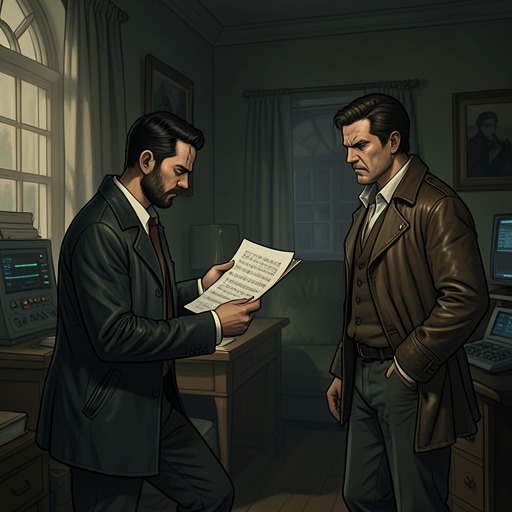
The Rivalry’s Escalation
This flow traces how Salieri’s recognition of Mozart’s superiority turns competition into deliberate sabotage.
