Wolfgang Amadeus Mozart and Leopold Mozart’s Father-Son Relationship
AmadeusWolfgang Amadeus Mozart and Leopold Mozart’s Father-Son Relationship is a bond of authority, rebellion, dependence, and remorse. Wolfgang challenges his father’s judgment and chooses a life Leopold opposes, yet comes to understand Leopold as the person who had watched over him and warned him about dangers he could not perceive. The play makes this contradiction tangible: Leopold’s predictions of poverty seem fulfilled, his death releases Wolfgang’s buried guilt, and the father’s presence is transformed into the terrifying ghost of Don Giovanni.
Paternal Authority and Wolfgang’s Independence
Leopold’s influence appears first as a powerful presence in Wolfgang’s decisions, even when he is not onstage. Constanze argues that Wolfgang would not act without fear of his father and recalls Leopold’s warning that marrying her would leave Wolfgang and their children destitute. Her account presents Leopold as someone whose judgment reaches into the couple’s future before their marriage has even taken place. Wolfgang’s impulsive proposal to Constanze follows this challenge, while her reply dismisses it as foolish; the exchange places his romantic resolve beside the paternal pressure he has not yet escaped.
Later, when Salieri asks when the couple will marry, Wolfgang says that they must obtain his father’s permission. At twenty-six, he describes Leopold as excellent and wonderful, though stubborn in certain matters. His answer shows that the relationship cannot be reduced to simple rejection: Wolfgang still acknowledges his father’s standing and speaks affectionately of him, even while anticipating resistance. The need for permission remains important enough to name, and the mild qualification about stubbornness hints at the conflict between the son’s adult choices and the authority he continues to grant his father.
Rebellion, Resentment, and Separation
In a private conversation with Salieri, Wolfgang describes his estrangement through a mixture of hurt and accusation. He says that he asked Leopold to keep his child for a few months so he could go to London, and that Leopold refused. Wolfgang explains that he has a wife and child but no money, making the proposed journey impossible under his circumstances. His account turns the refusal into a decisive example of feeling betrayed by the person he believed loved him most.
Wolfgang also contrasts their lives. He recalls that Leopold took him around Europe as a child, when audiences adored him, while Leopold himself remained in Salzburg year after year. Wolfgang accuses his father of jealousy, claiming that Leopold could not forgive him for being more intelligent. These are Wolfgang’s angry conclusions, not an independent account of Leopold’s motives. The scene lets resentment speak at its most extreme: Wolfgang privately insults his father, then laughs guiltily, exposing discomfort beneath the performance of contempt.
The recollection of separation becomes sharper when Leopold’s death is announced. The Venticelli solemnly repeat Leopold’s name before declaring that he has died. Wolfgang recoils, and the announcement immediately changes the emotional direction of the scene. What had been an opportunity to vent old grievances becomes an irreversible loss; Wolfgang can no longer answer his father or revisit the choices that divided them.
Death, Guilt, and the Father’s Protection
After hearing of Leopold’s death, Wolfgang asks what he is to do. He explains that he has no one else in the world to warn him about the evil around him, because he does not recognize it himself. In this account, Leopold’s paternal role was not simply to command or criticize: he had watched over Wolfgang throughout his life and supplied a form of vigilance Wolfgang believes he lacks. The refusal to keep the child had felt like betrayal, but the death announcement brings forward the protection Wolfgang also depended on.
Wolfgang then itemizes the ways he believes he failed his father. He says he spoke against him, married against his wishes, and left him. He remembers dancing, playing billiards, and fooling around while Leopold remained alone night after night in an empty house, without a woman to care for him. The details make Wolfgang’s remorse specific: he imagines his own freedom and social life against his father’s solitude. The play does not present this recollection as a balanced resolution of their disputes; it shows Wolfgang, in grief, recasting his acts of independence as injuries for which he is responsible.
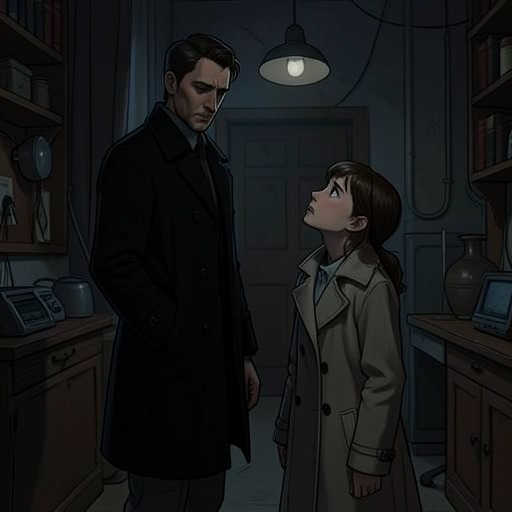
Salieri tries to comfort him, calls him by name, and opens his arms in a broad gesture of paternal benevolence. Wolfgang approaches and nearly accepts the embrace, but turns away, goes to the front of the stage, and falls to his knees, calling for his father. The almost-accepted embrace joins the two paternal figures in the scene without making them equivalent: Salieri offers support, but Wolfgang’s response is directed toward Leopold, now absent. Salieri then tells the audience that this moment gave birth to the father’s ghost in Don Giovanni. The opera’s terrifying paternal figure thus emerges from Wolfgang’s grief and guilt, while the severe opening chords and looming black silhouette give that inner inheritance a theatrical form.
Poverty, Letters, and Leopold’s Lasting Presence
Later, Wolfgang and Constanze sit in a house where they have no firewood. Constanze is cold as Wolfgang writes music wrapped in a blanket, and he says that his father was right: they have ended up as beggars, just as Leopold predicted. The scene gives the earlier warning a painful afterlife. Leopold’s forecast is no longer merely an obstacle invoked before the marriage; Wolfgang recognizes its apparent fulfillment in the couple’s immediate hardship. Yet his remark also recalls the father through the very words Wolfgang once resisted, showing how Leopold’s judgment remains part of the son’s understanding of his present.
The letters Constanze reveals deepen that continuing presence. She recalls the fire they lit the previous night because the cold had made it difficult for Wolfgang to keep the ink fluid. Wolfgang had admired the blaze and the old papers burning; Constanze explains that the papers were all of Leopold’s letters, every one he had written since the day they married. She says that they contained Leopold’s complaints that she was foolish and a bad housekeeper. The correspondence therefore carries the father’s disapproval into the couple’s home after the marriage, while its destruction takes place amid the poverty Wolfgang now associates with Leopold’s prediction.
Together, these moments keep the relationship unresolved rather than settling it into either affection or blame. Wolfgang remembers Leopold as stubborn and, at times, rejects his judgment; he also sees him as protector, solitary father, and prophetic voice. Death does not erase the conflict. Instead, it makes Leopold’s authority newly present—in Wolfgang’s remorse, in the poverty that appears to confirm his warning, in the letters that survived the marriage, and in the ghostly paternal image formed in Don Giovanni.