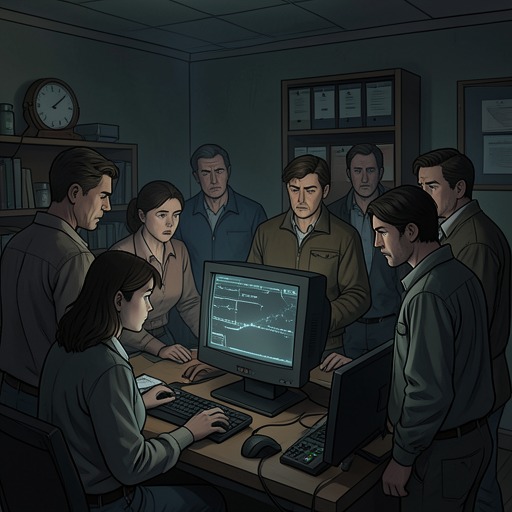
Aniara's Passage Through the Luminous Particle Cloud
AniaraAniara's Passage Through the Luminous Particle Cloud transforms an uncanny approach into a disaster inside the ship: a fog-bank brightens into a blinding cosmic storm, gravity becomes dislocated, and terror drives a crowd into a lethal crush. The Goldonder passes through the cloud, but its emergence does not undo the injuries, deaths, and changed life that follow. The event is narrated as both a physical passage through hostile matter and a collapse of the human order aboard Aniara.
Approach and sudden illumination
The account begins with entry into something like a fog-bank that thickens with each passing day. Its gradual intensification gives the danger a measured approach: the cloud does not arrive as an instantaneous flash but gathers around the ship until, on the fifth day, it begins to incandesce. The language turns a familiar atmospheric image into a cosmic threat. A fog-bank usually obscures; here the gathering substance becomes luminous, so that visibility itself will become dangerous.
The passage also follows a renewed raising of a banner before the cloud is described. The excerpt does not identify who raises it or explain its connection to the encounter, so it cannot be treated as a cause of what follows. Its placement nevertheless leaves an image of attempted assertion beside the approaching force: a human sign lifted anew, then a radiance powerful enough to daze Aniara's kingdom. The scene's scale shifts from a ship crossing space to a community exposed within it.
The cloud and the crowd
The brightening first takes on the appearance of a quasi-festival, but the spectacle is short-lived. Aniara's kingdom is dazed by the glare; then the passengers meet resistance of an unknown kind, and a typhoon of incandescent particles brings deathly terror and dread. The account does not explain the cloud's nature or identify an intelligence behind the resistance. That uncertainty matters: the danger is experienced in full, while its cause remains beyond the passengers' understanding.
The catastrophe spreads from the cosmic environment into the ship's social spaces. Dislocated gravity releases chaos waves through the passengers' souls, and the assembly halls become sites of bodily danger. People are trampled in the crush, while several thousand others are injured. The progression is not simply from calm to panic; it links a physical disturbance to collective disorientation, then to injuries produced by people caught together in confined gathering places. The ship's inhabitants encounter the cloud as an external force, but the crowd becomes one of the immediate means by which its violence is felt.
The poem sharpens that consequence in the image of a human mill, driven by human terror and pulverizing itself in maddened maelstroms. The phrase makes panic seem at once mechanical and self-consuming: the passengers are caught in a forceful collective motion, yet the terror driving it is their own. This is not an explanation that absolves the cloud or blames the crowd alone. Rather, the sequence holds together an unknown external resistance, gravity's dislocation, and the human crush, showing how a disturbance beyond ordinary control becomes destruction among those aboard.
The Goldonder's passage
Against the crowd's chaotic motion, the Goldonder is pictured as a spiral drill, driven as if by the Titans, boring into a cosmic sand-cloud. The metaphor gives the ship a forceful direction through material that is blazing and blinding, while the mythic comparison enlarges the encounter beyond routine navigation. The cloud does not merely surround the vessel: in the image, it is something the vessel penetrates. Yet that forward motion offers no protection to the passengers from the turmoil within.
The account says the blazing, blinding cloud bursts into extinction, and the crisis ends as abruptly as it began. The Goldonder dives along the loxodrome to which it clove in its fall. That ending is a change of direction rather than a return to safety or a restoration of what was lost. The poem supplies a path through and away from the cloud, but no account of a deliberate maneuver or of the ship recovering its former condition. The sudden stop in violence contrasts with the lasting human consequences that the narrative records afterward.
Aftermath and significance
The narrator places the ensuing changes in the passengers' life aboard the world that has become their own, and dates the events to the twelfth year of travel, reckoned from Dorisvale. This temporal marker gives the disaster a place within the voyage's long duration: it is neither an isolated beginning nor the end of the journey, but a rupture in an already established life in space. The account's movement from the cloud to changes in daily existence makes survival itself feel altered, not simply secured by passage through the danger.
In the subsequent account, Daisy and Yaal lie dead beside the badly hurt Chebeba. The text presents these losses and injuries in the aftermath, but does not explicitly specify that the cloud encounter caused each person's condition. They therefore register the cost of the changed life without serving as a fully explained casualty list for the passage. The distinction leaves the episode's human toll stark but not exhaustively accounted for.
The event's structure depends on a contrast between abrupt cosmic violence and the longer life that follows it. The cloud thickens over five days; terror and dislocated gravity turn the assembly halls into sites of mass injury; the Goldonder's passage ends suddenly; and the survivors continue into a changed world. No explanation resolves the unknown resistance, and no triumphal return cancels the dead or wounded. The episode makes passage itself ambiguous: the ship gets through, but its people endure the violence of crossing as a lasting break in their shared history.