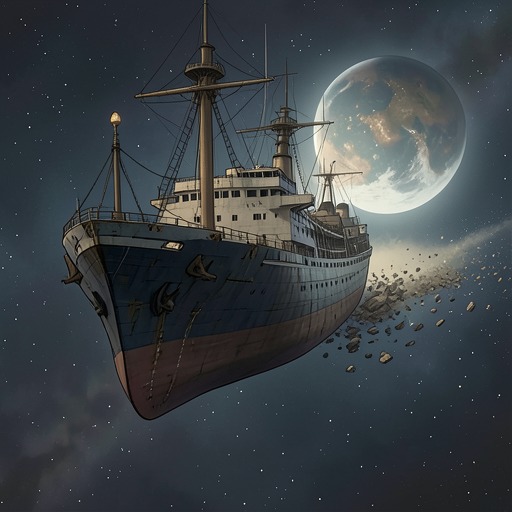
Destruction of Dorisburg
AniaraThe destruction of Dorisburg is the moment when the catastrophe unfolding on Earth reaches the drifting Aniara as testimony. The city is destroyed by a phototurb, and the event reaches the ship through the Mima’s final broadcast: an account from a man calling himself the Detonee. The report makes a distant disaster present to the Mimarobe, while confirming that the Earth from which the refugees fled is itself being lost.
Background and Place in the Voyage
The disaster belongs to a larger evacuation from an Earth made uninhabitable by radiation. The refugees aboard the Aniara are meant to travel to labor camps on Mars or Venus while the planet is detoxified. That arrangement already belongs to the past by the time of the poem’s crisis: the ship has been knocked off course by an asteroid, its steering mechanism is irreparably damaged, and its passengers cannot reach their intended destinations. They drift farther from Earth, also called Dorisvale in the account, as the planet faces its final nuclear war.
Dorisburg’s destruction therefore does not initiate the passengers’ displacement; it changes what their displacement means. Before the report, Earth remains the place left behind, the origin toward which their attention can still turn. The destruction of the city, followed by news of Doris’s death, makes that origin a site of irreversible loss. The ship is not merely separated from a home that might someday recover. The catastrophe reported from Dorisburg belongs to the destruction of the world that the voyage was supposed to leave intact long enough for its inhabitants to return.
The poem places this imagined disaster against a contemporary nuclear climate. In August 1953, the Soviet Union announced that it possessed a hydrogen bomb described in the Swedish press as far more powerful than an ordinary atomic bomb; four days after the announcement, it detonated one. The account also recalls public warnings about the accelerating danger of nuclear conflict. This context helps explain the force of the poem’s destruction of a city through a weapon named the phototurb: the event gives planetary catastrophe a particular location and a human witness rather than treating nuclear war as an abstract possibility.
The Attack and Its Witness
The account reduces the destruction to a few stark elements: a phototurb bursts, and ten square miles of the city’s ground are overturned. The scale is conveyed through the extent of the transformed urban area, not through a catalogue of damage. Dorisburg is identified as a mighty city, now described in the past tense, and the narrative moves quickly from the weapon’s detonation to the witness who tries to tell what happened.
That witness is a deaf man. His attempt to describe the worst sound he had heard is framed by a limit: the sound was beyond ordinary hearing. The poem thus makes the testimony carry a contradiction. A man associated with deafness is the source for an event whose defining sound exceeds the capacity of hearing; the catastrophe is not made fully knowable by the report, but its limits become part of what the report communicates. The emphasis falls on the failure of ordinary description before an event of overwhelming scale.
The witness calls himself the Detonee, and the Mima preserves his account. The name links the speaker to the event without supplying a fuller biography or explaining his circumstances. What reaches the Aniara is therefore testimony stripped to its essential task: to bear witness to the destruction and to convey what can still be said from the scene of catastrophe. In a narrative where the passengers are already cut off from Earth, the arrival of that testimony briefly closes the distance between the ship and the planet, even as its contents make the separation final.
The Transmission and the Mimarobe’s Response
The Mimarobe rushes to the Mima, distressed as if his distress could prevent the deed being shown. The gesture establishes the difference between witnessing and intervention: the Mima can present what has happened, but neither the Mimarobe nor the machine can undo it. She shows the event candidly, and the Mimarobe receives the images and news as events pouring down upon Earth. The broadcast is not a warning that can still alter the outcome. It arrives as an account of a destruction already under way.
The Mima’s role makes the report more than a message passed between distant points. She is the instrument through which the Mimarobe encounters the disaster, and the event is bound to her own approaching destruction. The Mima is blinded by a bluish bolt; later, the poem identifies the Detonee’s message as the final word she broadcast. The ordering gives the transmission a double consequence: it carries news of the city’s ruin, and it marks the end of the Mima’s ability to receive and transmit such news. The account is thus both testimony from Earth and the last broadcast available to the ship from that world.
The Mimarobe’s response becomes personal when he receives the news that Doris has died in far-off Dorisburg. Doris, presented as Earth personified, makes the city’s destruction more than a loss of territory: the report names the death of the figure through whom the speaker’s attachment to the world has been expressed. With the news established, he asks Daisy Doody for his only remaining comfort. The transition from the vast ruined city to a plea for comfort gives the catastrophe an intimate aftermath without suggesting that consolation can reverse it.
Significance and Form
The event is disclosed through stages: a city is struck, a witness attempts to describe the sound, the Mimarobe rushes to the Mima, and the transmission confirms Doris’s death. This mediated structure matters. The poem does not give the reader an unfiltered view of the destruction; it gives an account carried from Earth to a machine, then received by a man already living in exile. The reader shares the limits of that position. What can be known arrives belatedly, in fragments, and cannot be converted into action.
The report also binds the fate of Dorisburg to the Aniara’s altered course. The refugees’ original journey had been organized around evacuation and eventual return to a habitable Earth; the ship’s mechanical failure had already made that plan impossible. The city’s destruction removes the imagined home behind that plan as well. The passengers continue through space, but the source of their departure is no longer a recoverable destination. The disaster gives concrete form to the poem’s central reversal: a voyage that began as escape from a damaged planet becomes permanent separation from a world undergoing its final destruction.