Aniara’s launch and evacuation voyage
AniaraAniara’s launch and evacuation voyage turns an apparently ordinary departure from a damaged Earth into the beginning of permanent exile. The ship lifts away through established procedures, carrying evacuees toward off-world labor camps; only afterward does the scale of the break become clear. In the poem’s unfolding account, the journey intended to move people to safety instead carries them away from Earth and the possibility of return.
Registration and the announced evacuation
The voyage begins in a concourse where evacuees register for what appears to be a likely departure. The speaker remembers his first meeting with Doris, whose presence makes the dim setting seem briefly illuminated. While the crowd sits in tense silence, Doris fills in cards and directs people to sign. The departure announcement comes not as an explanation but as a rocket siren, making the machinery of evacuation more audible than its purpose.
The ship’s mission belongs to a larger, already familiar displacement. Radiation has made much of Earth uninhabitable, and evacuees are being transported to labor camps on Mars or Venus until the planet can be detoxified. The voyage is therefore presented as organized transport rather than a journey chosen for its own sake: people are registered, processed, and assigned destinations under the pressure of planetary disaster.
A routine launch becomes irreversible
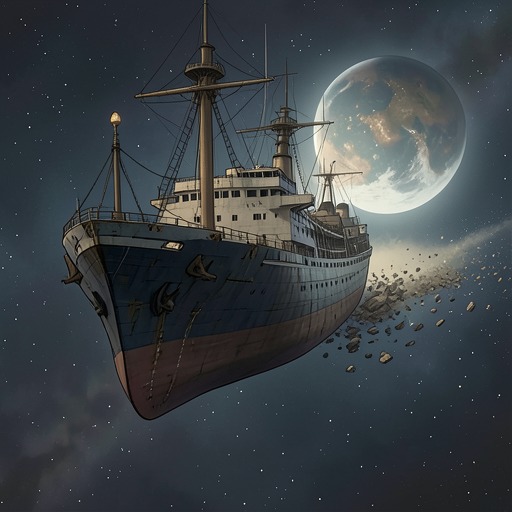
Aniara closes and departs through a standard sequence: the siren sounds, the ship is released from the field, and its gyrospinner sets it in motion. The launch is explicitly described as routine, without a mishap. Its formal normality sharpens the reversal that follows. At the moment of departure, no one could imagine that this flight would sever the passengers from the Sun and Earth, as well as from Mars and Venus.
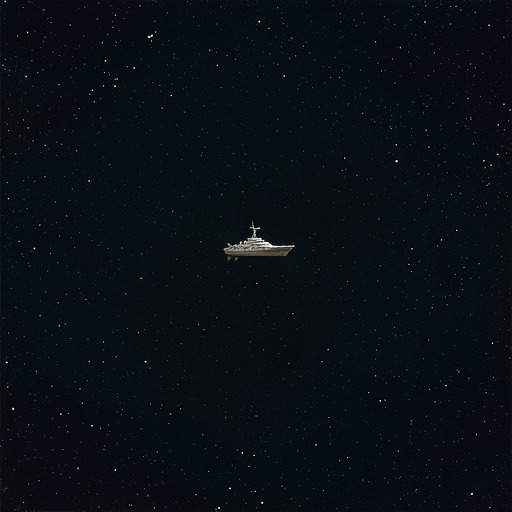
That separation is not simply a matter of distance. An asteroid knocks Aniara off course, and its steering mechanism is irreparably damaged. The ship becomes a ghost vessel, carrying its passengers and crew farther from Earth while no longer able to follow the evacuation route. The planned transfer to destinations where people might wait out Earth’s contamination is replaced by an unplanned drift with no available way back.
The machinery and human scale of evacuation
The poem’s account of displacement also includes the administrative systems that sort and move people. In the Space-hand’s tale, the transfer to Tundra Three takes nine years, while the evacuation of Gond takes ten. These durations give evacuation a scale that outlasts any single departure: relocation unfolds over years, as a repeated process of moving populations rather than one swift rescue.
In the same account, fast talk is used to settle unrest while punch cards are matched to souls identified by prior testing. The records are transferred to rapidly spinning microrolls that keep track of losses and gains; people are then lifted into the cosmic field and sent toward destinations that include a tundra settlement and Venus’s marshy shore. The procedure makes each person legible to the system as an identity to verify and a destination to assign. Its brisk administrative order stands in contrast to the uncertainty that ultimately governs Aniara’s own voyage.
Catastrophe carried aboard
The larger destruction does not remain safely behind the departing ship. Earth’s nuclear devastation reaches the voyage through reports and through the effects registered by Mima, the ship’s information-transmitting machine. The Mimarobe recounts that Mima is blinded by a bluish bolt as news of the events on Earth pours in. Elsewhere, a man described as deaf attempts to describe a sound beyond hearing. The poem conveys catastrophe through damaged channels of perception: the disaster is known aboard Aniara, but its force exceeds ordinary description.
Earth’s destruction completes the separation that the launch had begun. The ship drifts ever farther from Earth, also called Dorisvale in the account, even as Earth itself explodes in the final nuclear war. The intended labor camps on Mars and Venus remain unreachable destinations rather than places of refuge. A launch that began with forms, instructions, and a familiar routine thus becomes the opening movement of a voyage with no return and no intact home to return to.