Control Plan Three
AniaraControl Plan Three is a political program whose brief appearance in the poem is defined less by its provisions than by what follows its implementation: a new Dick rises to power, dissenting voters face punishment, and other people are sent away for years of compulsory labor. The passage gives no detailed description of the plan’s clauses or machinery. Instead, it presents the plan as a system being closely observed while its consequences become a matter of shared, grim knowledge.
Mention and immediate setting
The account places Control Plan Three at a moment of transition: the Thirty-second War has just ended, and the plan is being closely followed. The speaker addresses the outcome as something the audience already knows, moving quickly from the end of war to the new political order. This compressed delivery makes the plan feel less like a proposal under discussion than an operating framework whose results are already visible.
The phrase indicating close observance does not explain who administers the plan, what its formal rules are, or whether it began during the war. Those details remain unspecified. What the passage does establish is the sequence that matters to its portrayal: the war ends, the plan remains in force, and the result is a changed leadership accompanied by sharply unequal treatment of people according to their political position.
Leadership and political consequences
The outcome is summarized as a new Dick on top. The poem does not identify the new leader further or explain how the transfer of power occurred. Its emphasis falls instead on the immediate division that follows. People who voted nay to Dick are subjected to a period of hardship described as hot times in the cellar; the passage presents their opposition as carrying a direct cost under the new order.
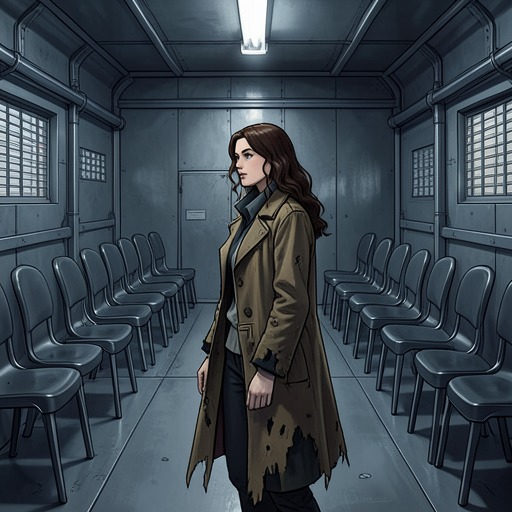
The contrast with the other group is pointed. Those people, described as already whipped to shape, receive rucksacks and are sent away aboard Prison Spacecraft Seven. Their destination is Tundra Nine, where they must spend three years gathering peat. The account specifies the duration, transport, location, and assigned labor, but does not say why this group is selected or precisely how its prior compliance was secured. The difference between punishment at home and removal to an isolated work site gives the aftermath two distinct forms: retaliation against political dissent and organized displacement into labor.
The rucksacks make the removal concrete without making it a journey of choice. A spacecraft ordinarily suggests movement beyond familiar bounds; here it serves as the vehicle of imposed exile. Likewise, the three-year term turns the sentence into a measurable span of life, while peat gathering fixes that span to labor at a named destination. The passage does not describe daily conditions at Tundra Nine, so the significance rests on the stated sentence itself: political order is enforced through transport, confinement by distance, and work assigned by authority.
The wider carceral landscape
Elsewhere, the poem depicts a broader system of confinement and surveillance that gives this episode a recognizable institutional context, though it does not explicitly attribute those scenes to Control Plan Three. It describes nations shut up in murky mines and people treated as things without a soul before rejects are expelled. The language reduces people to categories to be used, confined, and removed, echoing the plan passage’s division of populations by political standing and the allocation of destinations or punishments.
Other scenes make the machinery of control more visible. Glass-equipped surveillance ducts look into the Chambers, while a passage concerning Antalex describes rational surveillance around a cesium quarry in Penal Territory. Captives are shown struggling against stone walls; elsewhere, people are broken into cellules within a State that continues to claim them even as it uses them. These details do not establish that Control Plan Three created the mines, surveillance ducts, or quarry. They do, however, show how the poem’s political world repeatedly joins administrative classification to enclosed spaces, observation, labor, and expulsion.
This wider context also clarifies what the plan’s short appearance does not offer. It is not presented as a technical handbook, and the reader receives no complete chain of command or account of legal procedure. The surrounding episodes supply images of a coercive state, while the plan passage supplies a political result: war has ended, authority has changed hands, and the handling of people varies with their relation to the new order.
Narrative function and limits
The passage’s brisk, knowing tone is part of its force. By treating the outcome as familiar, the speaker makes the consequences sound normalized within the world being narrated. That familiarity contrasts with the severity of what is reported: dissent brings hardship, while others are transported for a fixed period of labor. The gap between matter-of-fact delivery and the fate described invites attention to how an oppressive arrangement can be presented as ordinary procedure.
Control Plan Three therefore functions in the poem as a compact name for political rule in practice, not as a fully explained doctrine. Its significance lies in the connection the passage draws between a postwar change of power and the sorting of people into different outcomes: punishment, removal, and compulsory work. The text leaves the plan’s exact contents and the fates of those sent to Tundra Nine beyond view. What it does make explicit is the cost of the new order and the use of transport and labor to impose it.