Post-radiation evacuation and quarantine policy
AniaraThe Post-radiation evacuation and quarantine policy is the system for moving people away from an Earth rendered unclean by toxic radiation and assigning them destinations on Mars or Venus. Its official rationale is protective: Earth is granted a period of calm, repose, and quarantine while the planet is detoxified. Yet the policy’s administrative promise of temporary refuge conceals a harsher reality. Evacuees are registered and sorted, journeys take years, and the destinations described in the poem include mines, confinement, and strict surveillance. The process turns planetary catastrophe into an organized migration, but not necessarily into safety or freedom.
Rationale and Registration
The evacuation is already routine by the time the poem’s speaker first encounters it. In the crowded halls, refugees are sluiced toward lift-off zones for urgent departures to the tundrasphere. The scale and repetition of this movement make departure seem less like a single emergency than an established social order. The rationale is explicit: Earth has become contaminated by toxic radiation and must be given time for recovery. The policy therefore joins quarantine of the damaged planet to the removal of its population.
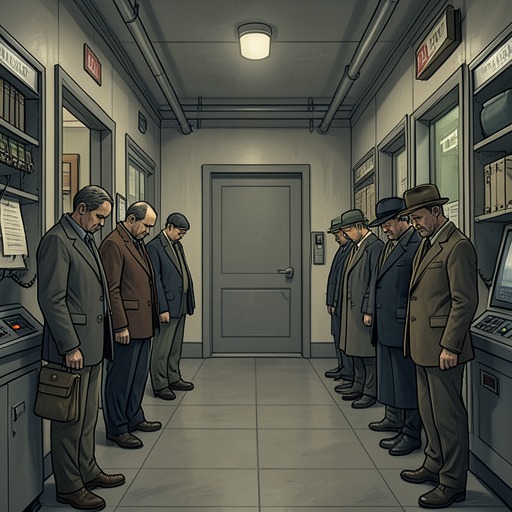
The first view of the system is an administrative one. Doris fills out cards while evacuees wait, and her five small nails glint in the concourse twilight. The form asks people to sign their names and state what they have in mind; it also asks which part of Mars they would prefer, including whether they want the tundra to the east or west. Each person is owed one jar of uncontaminated soil. That requirement makes the evacuee’s relation to Earth concrete: even while being removed from it, each is expected to carry a small, specified portion of clean ground. At the same time, the card translates a life-changing departure into fields to be completed and a preference to be recorded.
The policy’s apparent solicitude is qualified by the conditions under which the choice is made. The destinations are offered through a form, but the poem does not present the choice as control over what awaits there. The registration scene begins amid tense silence, and departures are announced not in ordinary words but by the blasts of a rocket ship’s take-off siren. Doris’s instructional language is intelligible, yet its formulas sit within a system whose larger consequences the evacuees do not fully know. The contrast between orderly paperwork and uncertain fate is present from the outset.
Allocation and Interplanetary Transit
The later account of transport shows that evacuation is a prolonged logistical operation. The transfer out to Tundra Three takes nine years, while the evacuation of Gond takes ten. The speaker says that he was aboard the eighth Goldonder, and that these vessels alternated with other spaceships. Rather than a swift passage from danger to refuge, the policy entails years of transfers organized across a succession of ships. The scale of the operation is registered in elapsed time and repeated transport, not in a single decisive departure.
Allocation continues after registration. A person’s punch-card is matched to a soul identified by prior testing, and the cards are sent into microrolls that record losses and wins. The poem’s description makes the procedure sound technical and exact, while also suggesting that people have become entries in an accounting system. Once lifted into the cosmic field, some evacuees reach the tundra kingdom; others go to Venus’s marshy shore. The offered destinations thus divide the displaced population between different planetary environments, but the poem gives little reason to believe that preference determines the final outcome. Testing and assignment remain central to the route.
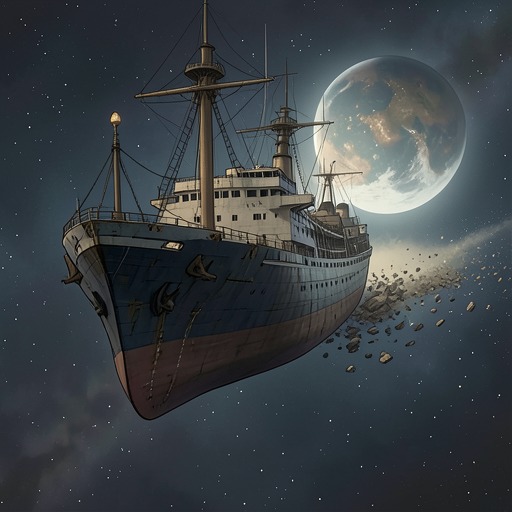
The distinction between the policy’s destinations and the transports carrying people toward them matters because the voyages themselves do not guarantee arrival at a place of safety. The larger narrative describes the Aniara as carrying refugees toward labor camps on Mars or Venus until Earth can be detoxified. An asteroid knocks the ship off course and irreparably damages its steering mechanism; its passengers and crew never reach those camps. Their fate is not the same as that of evacuees who arrive, but it exposes the fragility of the system’s underlying promise: a planned route away from Earth depends on transport that can fail, leaving those aboard without a way back.
Destinations, Labor, and Confinement
The poem sharply revises the language of refuge when it describes what awaits at both the tundra destination and Venus. In murky mines, the nations are shut up and used as if they were things without souls. The placement of whole populations in underground labor turns evacuation into compulsory work rather than uncomplicated protection. The stated interval before Earth’s detoxification may make the removal sound temporary, but the account of the destinations emphasizes extraction and confinement, not a clear process of return.
Those who are rejected face a different, equally controlled fate: they are expelled. The account also describes guarded mechanisms and glass-equipped surveillance ducts opening onto chambers. People’s movements and confinement are subject to observation, while the architecture makes watching part of the environment in which they are held. The system is therefore more than a transport program. It links sorting and destination assignment to institutions that govern the people who have been moved, including those sent to penal settings.
At Antalex, in Penal Territory, the poem places a transparent keep at the edges of a cesium quarry, with rational surveillance as its stated cause. This setting extends the policy’s punitive geography beyond the broad designation of Mars or Venus: an assigned destination can contain a watched penal landscape as well as a place of settlement. The description does not make surveillance an incidental feature. Its rational justification is built into the keep’s purpose, giving the machinery of control the appearance of orderly administration even as the displaced remain subject to it.
Consequences and Significance
The policy’s central contradiction is that it responds to environmental devastation by removing people from danger, yet it can deliver them into systems of labor, classification, and confinement. The poem does not erase the real basis for departure: Earth is polluted, and the planet is supposed to receive time for detoxification. But the language of calm and quarantine belongs to the administrative explanation, while the later account of mines and surveillance reveals the human cost attached to the destinations. Protection of a planetary environment and protection of the people displaced from it are not shown to be the same thing.
The policy also changes the meaning of choice. Evacuees are asked to record a preferred part of Mars, but later descriptions foreground testing, matching, and the division of people between destinations. The form offers a small space for stated preference inside a much larger system of organized transfer. The jar of clean soil makes this tension especially plain: a person may carry a measure of uncontaminated Earth while being assigned to an unknown future far from it.
Finally, the evacuation framework gives the Aniara’s drift its wider human context. The ship’s passengers are part of a vast movement away from a damaged home world, not travelers on a voluntary excursion. Their planned destination is tied to labor and temporary planetary quarantine, but the ship’s loss of course turns the promised transfer into permanent exile. The policy is thus both the practical background of the voyage and a measure of what has failed: it can organize departure from Earth, but it cannot ensure either a humane destination or a return.