High Command
AniaraHigh Command is the shipboard authority that tries to manage the passengers’ response to catastrophe by controlling how their predicament is described. Its representative urges them not to despair and presents their onward journey as a kind of good fortune; later, the institution can no longer conceal the approach of cataclysmic days, though it still shields the facts. Between those moments, official reassurance becomes a measure of how little language can alter the passengers’ circumstances.
Public Authority and Reassurance
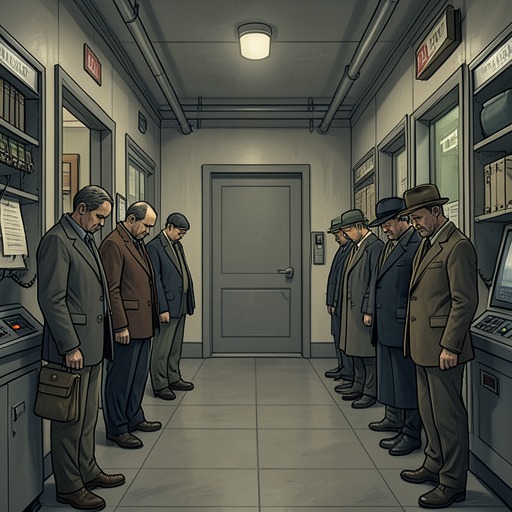
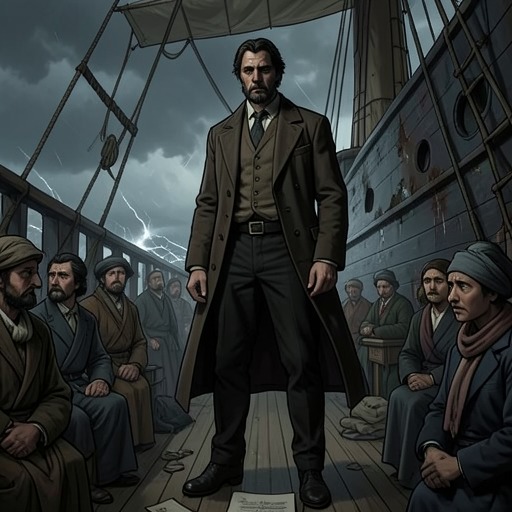
A man from High Command addresses the people in the great assembly-halls abaft the ship. His immediate appeal is emotional and practical: he pleads with them not to despair. He asks them to regard their fate as fortunate because they have not crashed onto a star or stellar satellite. Instead, he describes the voyage ahead as a lifelong journey toward an end that, in his formulation, would have come in any case. The speech does not promise rescue or a return; it attempts to make endurance seem like a favor already granted.
That argument depends on a sharp narrowing of perspective. Against the possibility of a spectacularly violent crash, continued travel can be called good fortune, even when it offers no destination within reach. High Command’s speaker treats survival from one immediate disaster as grounds for accepting the larger, indefinite disaster of the voyage. The institution’s reassuring vocabulary thus changes the description of the passengers’ condition without changing the condition itself.
Official Language and Cosmic Scale
The Mimarobe is angered by what the narrative calls High Command’s bland, newspeak-like reassurances. Their tone minimizes calamity by placing it beside something worse and presenting the comparison as comfort. The Mimarobe cannot accept that rhetorical conversion: an onward trek with no meaningful end is not made consoling merely by the fact that the ship did not strike a celestial body. The distance between the public appeal and the narrator’s desolation makes the speech an instance of denial rather than an answer to the passengers’ loss.
A different, more intellectually elaborate response to the voyage appears when the chief astronomer lectures on the limits of knowledge and the insignificance of the ship. The lecture describes knowledge as unable to grasp the Mystery’s structure and frames the Aniara as a little bubble in the glass of Godhead. The Mimarobe flees from this lecture. The passage distinguishes the astronomer’s cosmic argument from High Command’s official reassurance, but places both beside the same crisis: one reduces the voyage’s significance through speculation, while the other tries to make its consequences bearable through public language. Neither offers the Mimarobe a way out of the cul-de-sac of grief.
Power, Persecution, and the Ship’s Passengers
High Command’s comforting address exists alongside a harsher reality of authority aboard the craft. Chefone, described as its fierce lord, enters every day to vilify the Mimarobe; the narrator also reports that Chefone orders persecutions. The Mimarobe and many others are secreted in shelters at the Goldonder’s farthest-down levels. These details show that the passengers’ relation to power is not limited to being addressed and reassured: some are also subject to denunciation, persecution, and concealment within the ship.
The account does not equate Chefone’s orders with a specific decision by High Command. Rather, the juxtaposition places public appeals to composure beside coercive treatment of the Mimarobe and others. The authority that speaks to the assembly cannot be understood solely through its consoling speech; the narrative also presents a shipboard order in which people are driven into the lowest shelters and the Mimarobe is repeatedly vilified. Reassurance and vulnerability therefore occupy the same institutional world, without the former cancelling the latter.
Concealment and Narrative Significance
As catastrophe draws nearer, High Command can no longer keep the swift approach of cataclysmic days concealed. Yet the disclosure does not become full candor: the narrative says that every fact is still wrapped inside a shield. The contrast with the earlier assembly speech is consequential. At first, an official representative tries to shape how the passengers interpret their fate; later, the institution’s ability to hide the worsening situation fails, while its protective barrier around the facts remains.
High Command’s importance lies in this conflict between managing information and confronting what information cannot manage. Its speaker can call the voyage fortunate, and official communication can surround facts with a shield, but neither gesture changes the journey into a safe or purposeful one. The Mimarobe’s anger supplies the counterpoint to institutional language, while the later failure of concealment gives that counterpoint a grim confirmation: the passengers’ condition is not made less real by being redescribed, delayed, or withheld.