Cult of Light (Aniara)
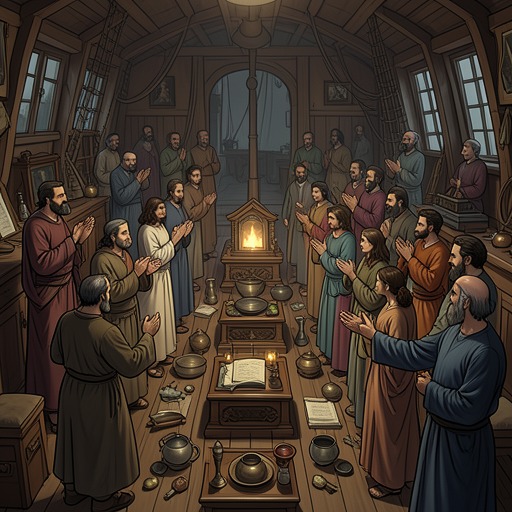
AniaraThe Cult of Light (Aniara) is a rival religion aboard Aniara, born from the strain and torment of darkness. Its worship turns Light into both an idea and a flame, but its defining image is not serene illumination: it is a blind priestess raised by a chorus, wrapped against fire, and sent to cry out for the lost ground of Rind. The cult gives collective form to longing, while its ceremonies also expose the violence that can accompany the search for transcendence.
Emergence and Belief
The narrative introduces the Cult of Light as a religious rival to The Cult. Its emergence is explicitly connected to life in darkness: the pressure and torment of that condition inspire a new faith, whose object of worship is Light understood both as a concept and as a flame. The goddess of the new cult is identified as fire. These linked images make its belief legible in more than one register: Light is an idea to be revered, a divine presence, and a physical force capable of burning.
The cult appears amid a broader revival of religious practice aboard the ship. Elsewhere, the rigors of space are said to drive people toward rites and altar-services that had scarcely been performed since the Pre-Goldondic Era. The narrator also describes worshippers bowing before an altar when Mimarobe comes to start Mima. These details establish a shipboard setting in which ritual has returned under pressure, but they do not make those practices the work of the Cult of Light itself. The new religion is distinguished by its particular devotion to Light and by the priestess through whom that devotion becomes public.
The Priestess and the Rite
The cult chooses its priestess from among the people of Rind. She is a maid whose eyes have gone dark, and the narrative connects that blindness with a terrible encounter with Light: the vision burns her, and her skin becomes her means of sight. Her condition is therefore not merely a sign of religious authority. It records bodily injury, and the text presents the worship she leads through the consequences of having beheld what the cult venerates.
At the altar, she chants songs about the god of Light and bears witness to how ill she lay after beholding it. The chorus rises around her like a storm; the congregation’s voices swell so forcefully that listeners cannot make out much of what she says. Collective sound lifts the priestess into a public, almost saintly role even as the content of her testimony becomes difficult to hear. The scene sets communal exaltation against the obscured voice of the individual who has suffered the vision.
The ceremony culminates in a strikingly material image. Amid a thousand candles, the saintly blind priestess is wrapped in a fireproof cloak made of kieselguhr and pushed toward the photophage’s wall. There she cries out for Rindish ground. The protections and the flames do not cancel one another: the cloak acknowledges danger even as the rite brings her into its presence. Her appeal for the ground of Rind gives the cult’s worship a concrete object of longing, connecting the divine Light to a home she can no longer see and that the ship’s darkness makes painfully distant.
Ritual, Devotion, and Its Limits
The scene gives the cult a clear ritual center—an altar, a priestess, a chorus, candles, and a dangerous passage toward the photophage’s wall—but offers little account of its formal organization, membership, or rules. What it does reveal is how collective participation works. The chorus raises the priestess, and shared sound makes the rite powerful while partly drowning out her words. The congregation can witness her suffering and elevate her as a sacred figure, though the text does not suggest that this communal response heals her or restores Rind.
The narrator’s response is not uncomplicated reverence. In the Memory Hall, the narrator hears recanters’ anthems and is appalled by what is described as the trampling of the self. The narrator’s concern is instead to find a cure capable of rousing Mima’s broken breath. This contrast places the cult’s ecstatic practice beside a different priority: rather than joining religious self-abandonment, Mimarobe remains oriented toward the damaged Mima. The account thus registers both the emotional force of ritual and a skeptical response to its cost; it does not reduce the ship’s religious life to a single belief or purpose.
Place in the Ship’s Religious History
The Cult of Light belongs to a wider, changing landscape of devotion rather than standing as the story’s sole religious community. The narrative moves among The Cult, the new worship of Light, altar-services, and later scenes of recantation and supplication. At a later point, supplicants stand ceaselessly practising their threnody in Mima’s hall, while swollen mouths suck blood from their divinity. That image extends the poem’s account of religious persistence into an image of bodily depletion, but it does not identify those supplicants specifically as members of the Cult of Light.
Within this landscape, the Cult of Light’s distinctiveness lies in its reversal of darkness into a worship of flame—and in the cost borne by the person who mediates that worship. The light that offers a focus for communal faith has already burned and blinded its chosen priestess. Her cries for Rind keep earthly loss inside the ceremony, so that the cult’s sacred spectacle cannot be separated from the damaged body and absent home at its center.