Martian tundra cock
AniaraThe Martian tundra cock is one of the striking inhabitants of Tundra Two, a frozen world where life is sparse and the vegetation has been hardened by extreme conditions. Starved and gaunt yet widely worshipped, it is at once a creature shaped by deprivation and a presence with a place in the planet’s imaginative life. Its hoarse crow carries through the tundra, while its capacity to digest leaves that other life cannot manage makes it an essential part of the landscape’s small ecology. The bird is not merely scenery: its body and feeding habits register what survival on this plain requires.
Identity and Habitat
The bird appears in a description of Martian spring, when Nobia hopes to go browsing in a contamination-free environment. Black frigitulips grow there, tempered to the planetary freeze, and the crow of the tundra cock is heard among the few amenities the plain can offer. The bleakness is not absolute, but the signs of life are sparse and adapted to cold. The cock’s call stands out in that setting as one of the few audible claims of presence.
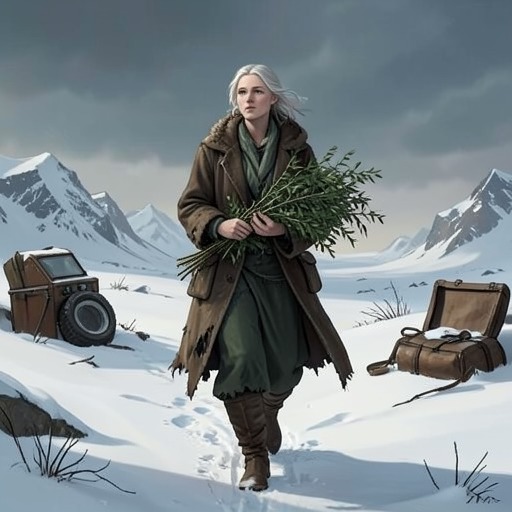
The surrounding vegetation gives the bird’s condition its context. Arctic willows are among the plants able to prosper on the plain; their leaves trail in a camellia-like form, but are hard as ironware and blackened, nearly inedible. The description emphasizes not abundance but endurance: plant life persists in forms toughened for the frozen ground, and the bird is itself described as gaunt and spare. The landscape does not offer comfort simply because life remains in it. Its living things bear the marks of the conditions they have survived.
Feeding and the Tundra’s Ecology
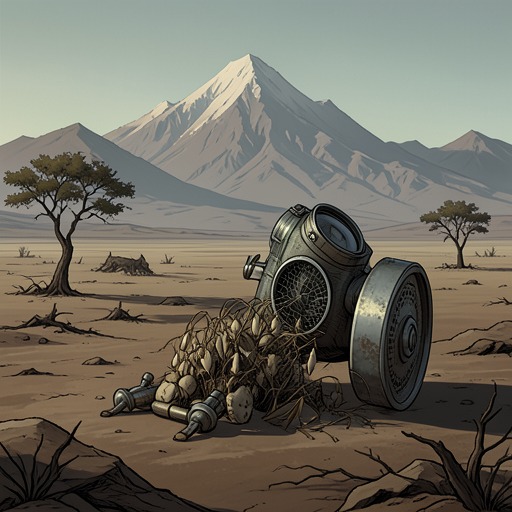
The cock can digest the willow leaves that are otherwise nearly inedible. Its craw is described as employing a chain of stomachs, a distinctive adaptation that connects the bird directly to the tundra’s harsh plant life. The account makes the bird’s survival concrete: it is not simply that the cock lives in a cold place, but that its body can make use of vegetation the plain has made difficult to consume.
This feeding detail also gives the landscape a rudimentary food relation rather than presenting it as an empty expanse. The willows prosper, their tough leaves remain unpalatable to most life, and the cock can digest them. The bird’s gauntness prevents this adaptation from seeming like abundance or ease; even a creature capable of eating the blackened foliage is described as starved and spare. Its specialized digestion is a means of persistence, not proof that the planet’s conditions have been overcome.
The poem remarks that there are no more than ten life-forms across the whole sphere. That scarcity makes the cock’s relation to the vegetation especially significant. It belongs to a narrow range of life adapted to the plain, and its feeding habits distinguish it within that limited world. The passage does not provide a full account of the planet’s ecology, but it does show how closely the bird’s life is bound to a particular, difficult source of nourishment.
Worship, Observation, and Response
The cock is called widely worshipped, though the account supplies no details about the form or practice of that worship. The contrast in the description is itself telling: reverence coexists with the bird’s visible deprivation. It is not presented as an abundant or splendid creature. Its standing comes alongside its gauntness, so that the plain’s most honored bird remains subject to the want that defines its habitat.
The scene also registers an unsettled response to the terrain and its life. The viewer follows, transfixed and shuddering, yet laughs in the same breath. This mixture of reactions suits the bird’s place in a landscape that is severe without being devoid of strange or compelling forms. The cock is neither made into a simple emblem of horror nor softened into a reassuring sign of nature’s resilience. Its presence can command attention and provoke an uneasy response at once.
Nobia and the Bluebird Transformation
Nobia is described as bound with all her soul to this terrain of stark, plain forms. Her attachment gives the bird’s setting a human point of comparison, but does not make the conditions themselves gentle. The superchilled clear air of Tundra Two is said to be preferable to another land of death, and the figure of the gaunt cockerel becomes transformed into a bright Bluebird. The change is one of perception and description: the same spare bird, encountered in the same austere world, can be seen in a newly vivid form.
The passage identifies Nobia’s ability to get something from the things around her as a masterstroke. Her pleasure in the tundra’s breath makes sense against the comparison with the land of death, and the bird’s transformation belongs to that change in valuation. The cock does not cease to be associated with cold, want, and a difficult diet; rather, the landscape and its inhabitants can become meaningful to someone who has learned to value what the setting offers. Its image of a Bluebird therefore carries the force of a changed response without erasing the bird’s hardship.
Narrative Significance
The Martian tundra cock concentrates several features of Tundra Two in one creature: scarcity, adaptation, worship, and the possibility of finding value in severe surroundings. Its chained stomachs and ability to digest tough willow leaves give it an ecological specificity, while its crow and its transformation into a Bluebird make it memorable within the poem’s account of the plain. These aspects remain in tension. The bird is revered but starved, adapted but not free of want, and bleakly observed yet capable of becoming bright in Nobia’s perception.
That tension keeps the cock from functioning only as a symbol. The poem gives it a concrete relation to the willows and a particular means of surviving, while also allowing its figure to gather meaning from the human response to the tundra. The bird’s significance rests in both registers: it is a life-form fitted to a narrow, frozen ecology, and an image through which the poem shows how a harsh place may still become an object of attachment.