Bill’s cancer
AnimalsBill’s cancer remains a threat even when no new diagnosis is being announced. For Laura Joyce, the possibility of recurrence has become the expectation behind every call from her father or mother; at the same time, his chemotherapy gives that fear a physical setting, visible marks, and a present-tense routine. The illness presses on family relationships without reducing Bill to it: in the treatment ward, jokes, old clothes, irritation, and an awkward attempt at support coexist with the gravity of the drip.
Fear of recurrence
The cancer’s hold on Laura is clearest in her response to a voicemail from Bill. On a train, crowded into a window seat and feeling hot, thirsty, and heavy, she hears him say, “They’ve found it, Laura.” Before she can establish what he means, her stomach drops. There is only one “it” that matters when her father is concerned: the cancer. The message exposes the expectation she carries into contact with her parents—that a call may announce the disease’s return, whether through a negative check-up or rogue cells appearing as a shadow on an X-ray.
Her reaction shows how illness can continue to govern attention between medical updates. The voicemail does not need to say that the cancer has returned for Laura’s body to prepare for that news. She calls Bill back immediately, and he answers before the phone has even rung. The brief exchange leaves the fear in the foreground: her first question begins with “When,” as she tries to understand what he has found. The scene makes uncertainty itself consequential; recurrence is not confirmed in this moment, but the prospect has become part of how Laura hears her father’s voice.
Treatment and its visible marks
At the hospital, Bill is receiving treatment through a drip. Earlier treatments have left red tracks along his hairy, freckled arm, running from wrist to elbow like the footprints of a tiny devil. The image gives the illness a bodily history: chemotherapy is not an abstract medical fact but a process already inscribed on his skin. A nurse holds his arm to insert the needle, connects the tube from a pouch marked with a yellow disposal warning, and adjusts the drip before leaving him with the call button nearby.
Bill treats the ward’s routine with humor. He asks the nurse for his usual drink and pork scratchings, and later requests a pint of Guinness; the nurse responds with smiles and laughter that Laura experiences as forced. He calls the treatment his “last blast,” suggesting that this course is approaching its end, though the scene does not establish that the cancer itself has been cured or that recurrence is no longer possible. His jokes do not erase the procedure’s seriousness. Instead, they sit beside it: the needle, the marked arm, and the bag of treatment remain in view while Bill keeps up his familiar banter.
Family support under pressure
Laura’s relationship to the illness also appears in an earlier argument, where she knowingly invokes what she calls “The Dying Dad Card.” She protests that she has taken a rare holiday with a friend, that it did not even turn out especially well, and that she is deeply worried about her father. Naming the appeal as a card makes her use of Bill’s illness self-conscious: she recognizes that his condition gives her grievance emotional force, even as the worry behind it is real. Jim answers that her concern is partly why they are moving so quickly with their plans, showing how Bill’s cancer influences decisions beyond the treatment room.
At the ward, Laura’s support feels less certain to her than her earlier appeal might suggest. She thinks that her parents had not wanted her to come and that her belated presence looks like a “half-arsed support act” beneath the strip-lights. Her mother pulls the curtain around Bill’s chair, then walks away down the row of seats; Bill notes that she is still furious with him. The excerpt does not explain the cause of that anger, but it places marital strain inside the treatment scene, rather than allowing illness to suspend the family’s other conflicts.
Laura notices the details through which care and discomfort become inseparable. Bill wears a faintly striped pink shirt she recognizes from her childhood. Because it has lasted so long, she wonders whether it might serve as a talisman, and whether it had once been a present from her and Melanie. Its freshness matters: he has put on a newly ironed shirt and looks smart, and that effort hurts Laura. The familiar garment connects the treatment room to her childhood while making the present illness more immediate; her attention to what he wears becomes a way of registering how much she wants this day to matter.
The ward and the limits of reassurance
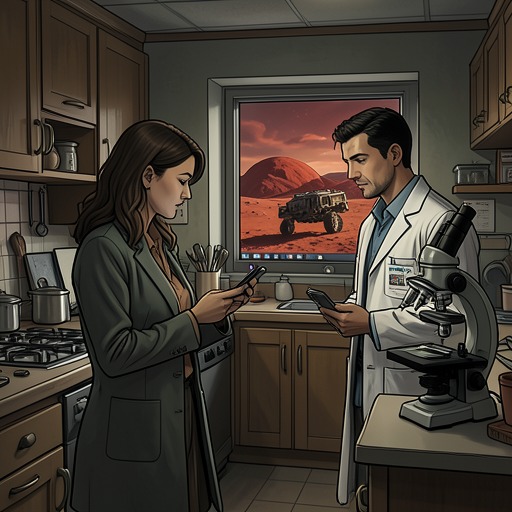
The treatment takes place in a long, thin room divided by curtains, with another patient several metres away. Sunlight enters through the blinds, but Laura reflects that the weather sometimes has no idea. Dust hangs in the sunbeams while the nurse connects Bill’s drip; on a wall-mounted television, the rover Curiosity is about to land on Mars. The juxtaposition sets an event of distant exploration against the intimate, repetitive labor of treatment. The room holds both possibilities at once, but neither the bright weather nor the wider world offers an answer about Bill’s future.
Bill’s remark that this is his last blast gives the scene a provisional endpoint, not a definitive resolution. Laura remains beside him in a visitor’s chair, aware of the tube, the needle, and the history marked on his arm. After the nurse leaves, she asks how he is doing; Bill repeats the question before she confirms it. That small exchange leaves room for the difficulty of answering. The cancer’s narrative significance lies partly in this gap between a treatment milestone and the continuing fear of return: even as Bill faces what may be his final treatment, Laura’s expectation of bad news has not been quieted.