1973 Third-Year Class 3 graduation photograph
AnotherThe 1973 Third-Year Class 3 graduation photograph is the crucial archival object through which the story’s central impossibility becomes visible. Dated March 16, 1973, it records the graduating class that included the fifteen-year-old Ritsuko Sakakibara, yet it also appears to contain Misaki Yomiyama, a boy who had already died. The photograph therefore does more than preserve a past class: it materializes the contradiction at the heart of the Yomiyama phenomenon, allowing an apparently absent person to occupy the evidence of a communal memory.
Discovery and Provenance
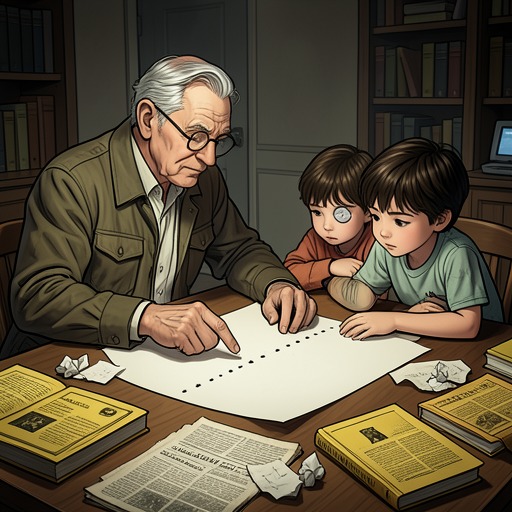
The photograph is found in a small box left behind by Ritsuko Sakakibara. The box contains four photographs, and one of them is identified as the class photograph being sought. A penciled note on its back reads “March 16, 1973” and “All my friends in third-year Class 3,” giving the object a precise date and personal provenance. It is not an anonymous image from an old archive but a photograph connected directly to Ritsuko’s school life and to the family history that Koichi Sakakibara is trying to understand.
The photograph’s importance is reinforced by its location within the narrative’s network of restricted and uncertain spaces. Information about the old third-year Class 3 classroom is verified through Tomohiko Kazami, while the Secondary Library preserves the school’s documentary memory under the supervision of Tatsuji Chibiki. The photograph crosses these spaces: it begins as a family-kept object, becomes an item of investigation, and is then examined against the school’s suppressed history. Its evidentiary force depends on that movement between private memory and institutional testimony.
Composition and the Extra Presence
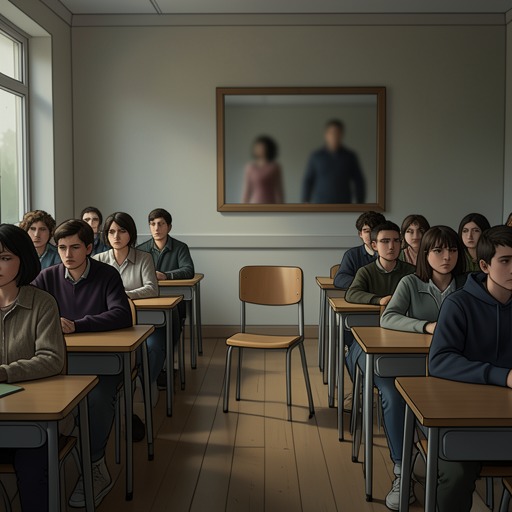
The students are arranged before a blackboard in the conventional graduation-photo formation. Those in the first row lean forward with their hands on their knees, those in the second row stand upright, and those in the third row stand on the teacher’s platform. Tatsuji Chibiki appears in the center of the second row in his younger days, with his arms folded and a smile visible chiefly in his eyes and cheeks. Ritsuko Sakakibara stands diagonally behind him in the same uniform seen in her yearbook photograph; her smile contains an almost imperceptible tension.
Misaki Yomiyama is positioned apart from the others at the far edge of the teacher’s platform. He is smiling like the rest of the class, but his posture makes him appear separate from ordinary human presence: his shoulders slope, his hands hang loosely, and he seems less to be standing than floating or hovering. The image thus supplies a visual distinction without offering a rational explanation. He is recognizable as a member of the group and simultaneously marked as someone who does not belong among the living.
Relation to the Investigation
Tatsuji Chibiki confirms that he saw the group photograph after graduation, including Misaki even though Misaki could not possibly have been there. His confirmation matters because Chibiki is presented as someone who has preserved the history of third-year Class 3 and who remains formally outside the class’s direct links. He explains that people with no direct connection to the class are relatively safe, which helps account for his ability to discuss its records and history with Mei Misaki and Koichi Sakakibara. The photograph is therefore not merely a private hallucination or an isolated family curiosity; it is an object witnessed by a knowledgeable adult whose memories, though imperfect, have been deliberately maintained.
The photograph also becomes the object Mei Misaki specifically wants to inspect. She distrusts the artificial appearance of photographs shown on television and in magazines and wants to see the real image with her own eye. Her examination is connected to her unusual eye and to her effort to determine whether the person represented in the image is genuinely present. When she looks at the photograph, Koichi identifies the isolated boy on the right as Misaki Yomiyama. The photograph’s authority comes from this convergence of direct visual inspection, family possession, Chibiki’s testimony, and the recognition of a figure whose historical identity is already known.
Memory, Records, and Narrative Significance
The photograph exposes the instability of both memory and documentation. Mei explains that while the extra person, also called the casualty, remains hidden in the class, records and memories are altered throughout the surrounding social world. Details that should be impossible are made to seem ordinary, and no one recognizes the casualty’s true identity. Tatsuji Chibiki confirms without hesitation that this tampering really occurs. The graduation photograph is the clearest surviving demonstration of that process: its composition appears to include someone whose presence contradicts the known past, while the image itself has been preserved as if nothing were wrong.
This makes the photograph a model for the later 1998 crisis. The class attempts to counter the disaster by treating Mei Misaki and Koichi Sakakibara as if they were not there. When adding a second absent person produces no effect, the class gradually abandons the tactic, and after Mr. Kubodera’s death the students begin acknowledging Mei as an actual participant. The photograph establishes why such social recognition is not a simple matter of courtesy: in this world, whether someone is visible, remembered, and counted can affect the structure of reality itself.
The object’s force is finally inseparable from the spaces and rituals surrounding it. The old classroom, the Secondary Library, the Yomiyama Shrine, and the Sakitani Memorial Hall all preserve different versions of the class’s past, while the graduation photograph condenses that past into a single frame. It turns historical memory into a scene of impossible inclusion. By showing the dead among the living without explaining how the image came to be, it gives the mystery its most durable form: the extra person is not merely rumored, remembered, or feared, but photographed.