Third-Year Class 3 class-list binder
AnotherThe Third-Year Class 3 class-list binder is a black-covered archival file kept by Tatsuji Chibiki in the Secondary Library. Containing twenty-seven years of Third-Year Class 3 rosters, from 1972 through 1998, it serves both as a record of the class’s recurring disasters and as evidence of the Yomiyama phenomenon’s ability to corrupt records that should be stable. The binder does not simply reveal the truth: its changing pages show how the phenomenon makes an impossible presence appear administratively and collectively normal.
Physical Form and Custody
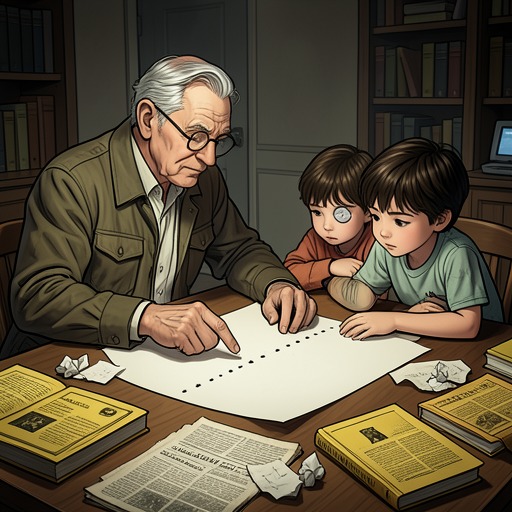
Tatsuji Chibiki removes the binder from a drawer built into the library counter after deciding that showing the records will explain the situation more quickly than further verbal description. The object has a dark black cover and is handled as something both ordinary and consequential. Chibiki keeps copies of the Third-Year Class 3 class lists in it, arranged chronologically with the newest lists on top, so that the years run backward as the pages are turned. The file therefore gives the Yomiyama phenomenon a physical sequence: each class year becomes a page in a continuing institutional archive.
The 1998 list appears first. It identifies Mr. Kubodera as head teacher and Ms. Mikami as assistant teacher, followed by the students’ surnames. Koichi Sakakibara’s name has been handwritten in the final row because he joined the class late as a transfer student. This small material irregularity distinguishes him from the original roster while also placing him inside the same document whose marks record the class’s deaths and disappearances.
Recorded Deaths and the 1998 Class
The binder’s most immediately disturbing features are the red X marks and explanatory notes beside names. In the 1998 list, red Xs stand beside Yukari Sakuragi and Ikuo Takabayashi. Sakuragi’s entry records a May 26 accident at school and, on the same day, a car accident involving her mother, Mieko. Takabayashi’s entry records illness on June 6. A separate note beside Takeru Mizuno’s row records the June 3 workplace accident involving his older sister, Sanae. The roster thus expands beyond student membership: it also tracks deaths among blood relatives connected to the class.
The binder makes the disasters appear as an administrative pattern rather than isolated misfortune. Tatsuji Chibiki uses the accumulated lists to infer that the disasters reach class members and blood relatives within two degrees—parents, grandparents, and siblings—but not relatives without blood ties, such as stepparents or stepsiblings. The file therefore supports both chronology and classification. Its entries allow Chibiki, who identifies himself as an observer, to formulate the Geographic-Range Rule and the Two-Degree Blood-Relation Rule from repeated recorded outcomes.
Mami Asakura and the Corrupted Archive
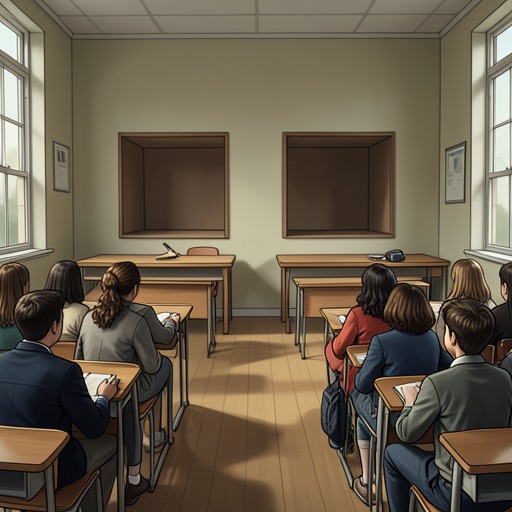
The most revealing page concerns the 1996 class, the last on year before the current one. There, Mami Asakura’s name appears as though she had belonged to Third-Year Class 3 from the beginning of April through the graduation ceremony the following March. Chibiki identifies her as that year’s casualty: a student who could not possibly have been present, yet whose presence was accepted by everyone. The binder gives the impossible identity a bureaucratic surface. A name on a roster seems to settle the question of belonging even while the larger history contradicts it.
The apparent certainty of the 1996 page is later exposed as temporary. Chibiki remembers that in April 1996 Mami Asakura’s name should have been present because she was participating in the class, while her name had not been in its proper place on the 1993 list. He concludes that the name, the red X, and the note recording her death had disappeared. In reality, Mami Asakura had died at fourteen in October 1993, yet during 1996 everyone accepted the false reality that she was beginning her third year. The binder consequently contains not one fixed account but successive states of an account: disappearance during the phenomenon, apparent consistency while the casualty is embedded in the class, and restoration afterward.
Records as Instruments of the Phenomenon
Chibiki explains that the alteration is not limited to class lists. While the phenomenon is active, school records, official documents, diaries, notes, photographs, videotapes, and computer data can all be tampered with or corrupted in ways that conceal contradictions. The binder is therefore representative of a much wider informational disturbance. It makes the impossible look ordinary by adjusting details that should conflict until they appear to match.
The same process affects memory. Even Chibiki, despite serving as an observer, had not suspected Mami Asakura’s presence. Her family, friends, teachers, and classmates had forgotten that she had died. When the casualty vanished after graduation, memories and records returned to their proper forms, while those closest to Mami lost the memory that she had ever appeared as the casualty. The binder’s significance lies in this correspondence between material archive and human recollection: neither independently guarantees continuity, because both are rewritten together.
Historical Comparison and Narrative Significance
The binder also preserves earlier examples against which the 1998 events can be measured. Chibiki opens it to 1983, where red Xs identify several deaths and notes specify their dates and causes. He counts seven victims apart from Ritsuko Mikami, whose death he had not discovered in the file; including her, the total becomes eight. The deaths occurred in April, May, June, July, and August, with none recorded after September. The 1983 page therefore allows Chibiki to identify a disaster that stopped partway through the year, making the binder a comparative instrument for recognizing recurrence as well as anomaly.
Its evidentiary authority is deliberately unstable. The object appears to offer a way out of rumor and uncertainty, yet the phenomenon can remove a name, erase a death, and revise the memories that would otherwise challenge the page. It stands in sharp contrast to the “not there” strategy, which is a conscious social tactic imposed by the class, and to the casualty’s status, which is hidden through involuntary corruption of records and memories. The binder makes both mechanisms visible: it records the consequences of deaths and the presence of social rules, while its own altered history demonstrates why ordinary verification fails.
As an object, the binder gives material form to the struggle between archival evidence and supernatural revision. Its pages help characters investigate the Yomiyama phenomenon, but they also teach them that searching harder cannot by itself overcome a system in which every medium may be rewritten. The black file is thus both an archive of Third-Year Class 3 and a record of the archive’s defeat: the place where the truth is sought, and where the phenomenon shows how easily truth can be made to look consistent with a lie.