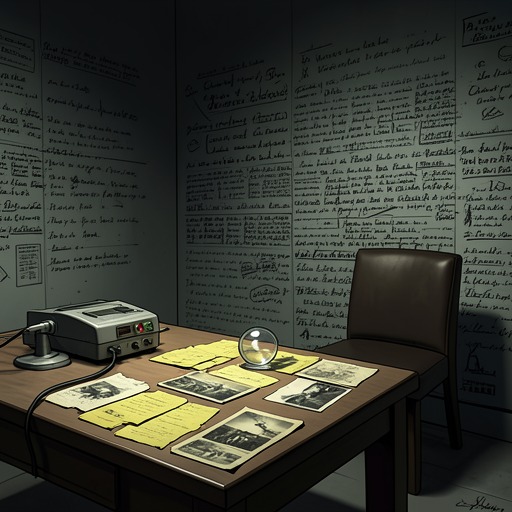
Katsumi Matsunaga's cassette tape
AnotherKatsumi Matsunaga's cassette tape is both an archival object and a delayed warning from the 1983 third-year Class 3. Hidden for future students who might suffer the same disasters, it preserves Katsumi Matsunaga's account of a class whose records, memories, and shared reality have been distorted. Its decisive significance lies in the confession recorded at its end: Matsunaga killed the person he believed to be the extra person, and he concludes that the casualty must be returned to Death to restore order and stop the disasters.
Discovery and Physical Form
The tape is found inside the restricted old classroom after the students search for evidence about the disasters. Its container is not presented as an elaborate relic. It is a completely ordinary TDK sixty-minute audiocassette, still at the beginning of the reel, wrapped in packing tape and hidden in a closet. Red writing on the brown tape addresses students who may come after the original class and may themselves be afflicted by disasters that defy explanation. The plainness of the object contrasts with the extraordinary burden placed upon it: an everyday recording medium becomes the surviving carrier of a suppressed history.
Teshigawara recognizes the handwriting as Katsumi Matsunaga's. After the packing tape is painstakingly removed, the students take the cassette from the restricted area and return to the art club room after five o'clock in the afternoon. The sequence gives the tape a material history before its contents are heard. It has been concealed, physically sealed, and almost overlooked; its recovery depends on inspection and manual effort rather than on an official record or an intact public memory.
Matsunaga's Recorded Testimony
The recording opens with Katsumi Matsunaga identifying himself as a student in the 1983 third-year Class 3 at Yomiyama North Middle School. He records it alone in his room after eleven o'clock on the night of August 20, with roughly ten days remaining before summer break ends. He explains that he intends to hide the tape somewhere in the classroom so that a future third-year Class 3 might discover it. The intended listeners are not abstract historians but possible successors who could be frightened by the same senseless disasters that afflicted his class.
The tape therefore carries testimony across the recurring boundary between one third-year Class 3 and another. Matsunaga does not know when the cassette will be found, or whether anyone will find it at all, but he imagines that its listeners may be students following in his footsteps. The act of recording creates continuity where the phenomenon creates erasure: a voice remains available even when ordinary documents and memories can no longer be trusted.
Confession and Explanation
The crucial revelation comes when Matsunaga recounts the aftermath of killing a classmate. He checked the number of students on the trip and was told that there had been nineteen, not twenty. The official account implied that the person he had killed had never existed in the first place. Matsunaga consequently concludes that the victim must have been the extra person hiding in the class that year. The tape thus links a private act of violence to the class's larger supernatural contradiction: someone can be present in the group while records and recollections deny that the person ever existed.
The confession does not arrive as a detached historical report. The recording cuts off abruptly on the A side immediately after Matsunaga's conclusion, leaving the listeners shocked and temporarily speechless. When the B side is played, Matsunaga returns to the meaning he assigns to the killing. He insists that the casualty must be returned to Death and that the extra person has to be killed, as he did, because this is the only way to stop the disasters once they have begun. The cassette consequently changes from warning to prescription, offering a violent solution whose authority rests on Matsunaga's experience rather than on proof that the solution is morally or practically secure.
Relation to the 1998 Class 3
The tape becomes especially important because the 1998 third-year Class 3 has already been organized around concealment and exclusion. The class's “not there” strategy attempted to increase the number of students treated as absent by ignoring both Mei Misaki and Koichi Sakakibara, but the attempt had no effect and was abandoned after Mr. Kubodera's death. Mei Misaki was then treated by those around her as someone who was “there,” a reversal that exposed how unstable the class's rules had become. Matsunaga's testimony offers an earlier precedent for responding to the phenomenon through direct violence rather than through collective denial.
The tape also illuminates why the students cannot rely on ordinary investigation. Mr. Chibiki explains that, while the phenomenon is in effect, records and memories are tampered with so that contradictions disappear. Class lists, official documents, diaries, notes, photographs, videotapes, and computer data may all be corrupted, while people involved forget what should have been obvious. The 1996 class list, for example, eventually failed to preserve the evidence that Mami Asakura had belonged to the class and had died in October 1993. Against this systematic corruption, Matsunaga's voice is valuable precisely because it is a deliberately hidden, personal record—but its existence does not make every conclusion within it reliable.
Narrative and Thematic Significance
As an object, the cassette tape opposes two forms of disappearance. The phenomenon removes a person from the apparent coherence of communal life, while the tape attempts to preserve a witness to that removal. Its analog form matters: unlike the changing class list or the vulnerable official archive, the recording is a single physical item sealed away by its maker and carried forward until someone deliberately uncovers it. Yet the abrupt break between the A and B sides also makes the archive incomplete and fractured. It preserves evidence while dramatizing the instability of evidence.
The tape's message deepens the conflict between knowledge and action. The students learn that another class faced the same structure of impossible presence, memory failure, and disaster, but the historical precedent does not simply solve their problem. Matsunaga's conclusion converts uncertainty into a command to kill. That conversion is the cassette's most dangerous legacy: it gives the living a framework for interpreting the casualty, while also tempting them to reproduce an act whose justification depends on a reality that the phenomenon itself continually falsifies. The object therefore functions not merely as a clue but as a test of whether inherited testimony will be treated as proof, warning, or incitement.