Mei Misaki's doll
AnotherMei Misaki's doll is the uncanny centerpiece of the basement gallery: a doll that looks exactly like Mei Misaki, lies inside a black hexagonal coffin, and becomes the material form of a family history that ordinary language cannot initially explain. It is not merely a likeness or decoration. Through its placement, resemblance, and explanation, the doll turns Mei's identity into a visible question of halves, absent children, and selves made from another person's longing.
Appearance and Setting
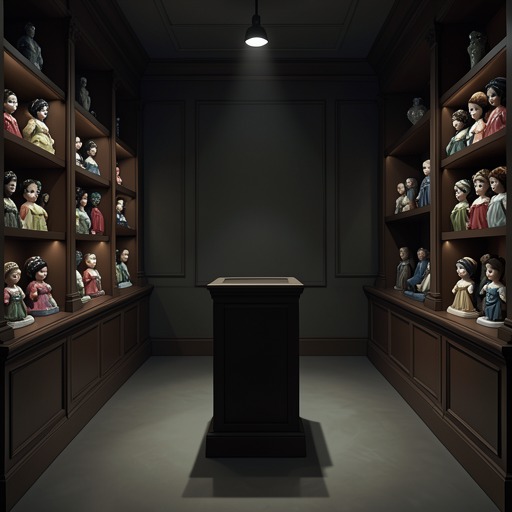
The doll is displayed at the back of the gallery's crypt-like basement, behind a deep red curtain and inside a black hexagonal coffin. The room is cold and sunken, filled with dolls arranged among their separate parts, while a gloomy string melody plays through the gallery. In this setting, the coffin doll is both an exhibit and a presence that seems to await recognition. Its physical details are deliberately simple but loaded: the closed coffin, the curtain behind it, and its exact resemblance to Mei make the object difficult to regard as an ordinary crafted figure.
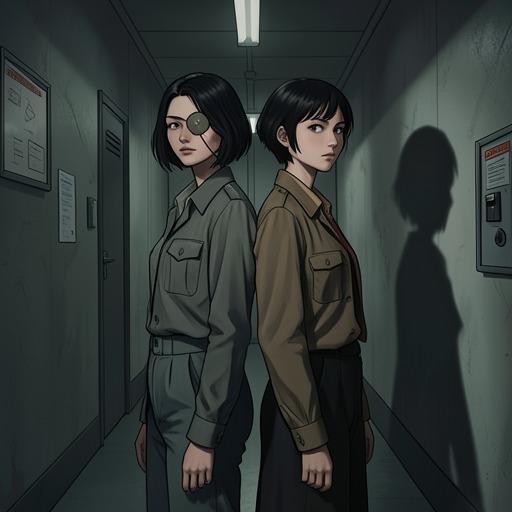
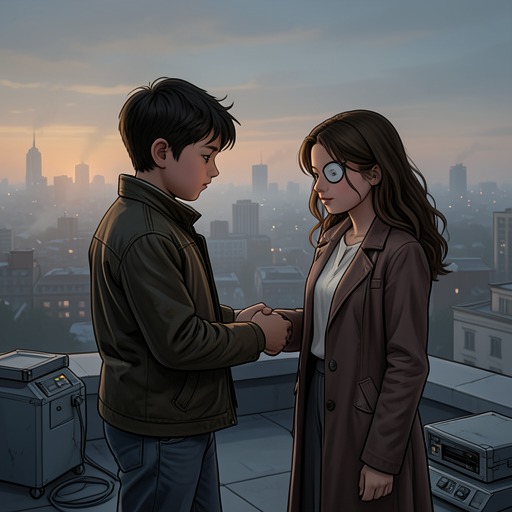
The arrangement also governs what can be seen. When Mei leads Koichi Sakakibara to the coffin, she stands so that her body hides the doll from his view. She then touches the eye patch over her left eye and recalls that she once removed it for him in the same basement. The scene makes Mei and the doll occupy a shared visual field while preventing them from being seen together at first. The doll therefore operates through delayed recognition: its likeness is present before its meaning is available.
Mei's Resemblance and the Question of Halfness
Koichi eventually asks whether the doll was modeled on Mei and recalls Mei's earlier statement that it was only half of her. Mei answers that it may not even be half. The answer refuses to reduce the doll to a straightforward portrait. Its resemblance is real, but the correspondence between person and image is incomplete from the beginning.
Mei explains that the doll's maker, Kirika Misaki, did use Mei as a model, but that Kirika made it while thinking of her own child. The child was one Kirika had been unable to bring into the world. Mei consequently describes herself as only half of the doll, perhaps even less, and says that she is one of Kirika's dolls. The statement reverses the expected hierarchy between original and copy. Mei is not simply the living original represented by the exhibit; she is also part of the emotional design that produced it, while the doll contains an imagined child who never came into existence.
Kirika Misaki and the Absent Child
The doll's decisive secret is revealed when Mei identifies the girl inside the coffin as the child her mother bore thirteen years earlier. Koichi asks whether Kirika is therefore Mei's little sister, although Mei had previously denied having sisters. The apparent contradiction depends on the difference between past and present: the child exists in the history embodied by the doll, but not as an ordinary present-tense sibling relationship.
This disclosure gives the doll a double status. It is a portrait of Mei's visible form and a memorial to the child Kirika could not bring into the world. Its identity is therefore divided between the person who served as its model and the absent child who supplied its deepest imaginative subject. The doll preserves a maternal desire while also exposing its failure to become ordinary family life. Mei's phrase about being only part of it is consequently both a comment on artistic representation and a description of her place within Kirika's unresolved maternity.
Function in the Narrative
The coffin doll connects the gallery's atmosphere to the novel's larger concern with unstable identity. Around it, objects do not remain transparent tools or neutral displays. The doll suddenly becomes conspicuous as a material thing because it resembles a living girl, occupies a coffin, and carries a history that the people around it cannot immediately classify. Its physical presence forces Koichi to confront the difference between appearance and origin: seeing Mei in the doll does not explain who the doll is, and learning what the doll represents does not make Mei whole.
The object also belongs to a network of abandoned or restricted spaces. Mei and Koichi avoid eating in the classroom because they are both treated as not there, and they move instead through the art club room in Building Zero and the empty secondary library. The old third-year Class 3 classroom is likewise unused and marked by grime, damage, dust, and abandonment. Against these institutional spaces, the gallery offers a more intimate archive of identities, but its basement is no less unsettling. The coffin doll gives material shape to the same unease that these places contain: what has been excluded or denied remains present in altered form.
Symbolic and Emotional Significance
Mei Misaki's doll is significant because it makes division visible without resolving it. Mei is modeled by the doll, yet the doll is not simply Mei; Kirika's imagined child is inside its meaning, yet that child cannot be recovered as an ordinary sister. The object thus gathers likeness, absence, maternity, artistic creation, and the limits of memory into one encounter.
Its power comes from the gap between what can be seen and what can be known. At first, the doll is an exact double hidden behind Mei's body. Later, it becomes the vessel for a family revelation, but even that revelation leaves the relation between Mei, Kirika, and the child fractured rather than neatly explained. The black coffin makes the exhibit resemble a preserved death, while the doll's resemblance to Mei keeps it tied to living identity. It stands at the boundary between person and image, child and invention, presence and absence—the boundary through which the gallery's horror becomes personal.