The Building Zero Second-Floor Prohibition
AnotherThe Building Zero Second-Floor Prohibition bars students from entering the second floor of Building Zero, the old school building. In practice, the rule does more than regulate movement: it isolates the former third-year Class 3 classroom, conceals the place connected with the desk for the one who is “not there,” and makes the forbidden floor a material boundary around the class’s buried history.
Definition and Setting
The prohibition concerns the second floor of Building Zero, an old structure whose first floor still contains ordinary school facilities. The art club room occupies a former classroom at the western end of that floor, divided in half and reduced to roughly half its original size; the neighboring room bears a placard identifying it as the Local Historical Society. The secondary library is another accessible school space, but the contrast is important: students can enter it normally, while the second floor above the old building remains institutionally closed.
The forbidden area contains the former classroom used by Yomiyama North Middle School Third-Year Class 3. The room is the third from the western end. Its location matters because, at the start of May, Tomohiko Kazami, Izumi Akazawa, and others went there to retrieve the desk and chair assigned to the student who was “not there.” The prohibition therefore surrounds not an anonymous abandoned room but a site directly involved in the class’s attempt to manage the Yomiyama phenomenon.
Enforcement and Transgression
The rule is stated plainly: students are not allowed to go upstairs in Building Zero. During summer break, however, Koichi Sakakibara, Mei Misaki, and Naoya Teshigawara decide to investigate the old classroom because the ordinary search for the extra person has failed to resolve the danger. They choose a time when the building is unlikely to contain anyone, acknowledging that they might find nothing but concluding that the attempt is necessary.
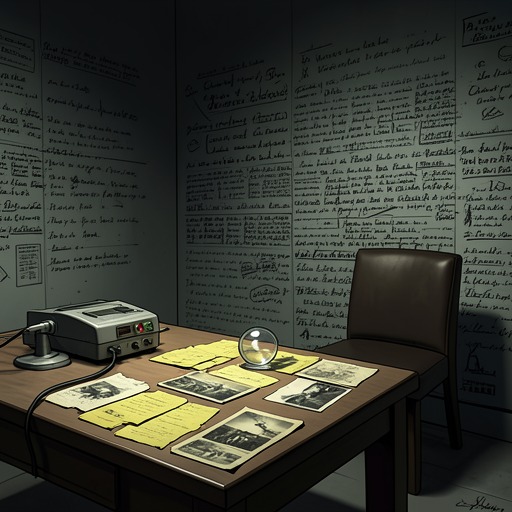
The prohibition is enforced physically as well as verbally. Ropes are stretched across the entrances to the stairwells at both the east and west ends of the building, and a piece of cardboard hanging from the rope carries the stark warning “Do Not Enter.” The three students check that no one is nearby, slip under the barrier one after another, and climb the normally unused stairs. Their movement converts the rule from background school policy into an immediate act of trespass.
The Abandoned Second Floor
Once they reach the second floor, the students find a hallway brightened by light through the north-facing windows, yet marked everywhere by long abandonment. Grime and damage remain visible, dust has accumulated across the floor, and a stagnant odor reinforces the sense that the area has been unused for years. The brightness does not dispel the prohibition; instead, it makes the neglect more legible, exposing a space preserved outside ordinary school life.
The old third-year Class 3 classroom is consequently both identifiable and estranged. Its precise position has been confirmed through information supplied by Tomohiko Kazami, but the room itself belongs to an earlier arrangement of the class and to the history that the present class is trying to reconstruct. The ban keeps that historical space physically separate while the “not there” strategy keeps certain people socially and informationally separate.
Relation to Class Rules and Concealment
The prohibition operates within a wider system of exceptional rules surrounding Yomiyama North Middle School Third-Year Class 3. Tatsuji Chibiki explains that people with no direct link to the class are comparatively safe, while records, official documents, diaries, notes, photographs, videotapes, and computer data can all be tampered with when the extra person is present. Memories are altered as well, allowing contradictions to pass unnoticed. Under those conditions, a locked or forbidden room becomes more than a storage site: it is one of the places where the class’s missing history can remain inaccessible.
The same logic appears in the treatment of Mei Misaki and Koichi Sakakibara. Because increasing the number of students treated as “not there” from one to two has no effect, the class gradually abandons the attempt to ignore both of them after Mr. Kubodera’s death. The change is not announced as a formal decision; it emerges in altered behavior, such as Naoya Teshigawara speaking to Mei as though she truly exists. The second-floor ban provides a spatial counterpart to that social tactic: both depend on collective behavior, concealment, and the controlled recognition of people or places.
Narrative and Thematic Significance
The Building Zero Second-Floor Prohibition creates a threshold between the functioning school and its repressed institutional past. Its rope, cardboard warning, dust, damaged surfaces, and unused classroom give physical form to the story’s recurring concern with boundaries: who may be acknowledged, what may be recorded, and which contradictions may be approached. The rule appears administrative, but its force comes from the mystery accumulated behind it.
The students’ decision to cross the barrier also reveals the limits of rule-bound safety. The class has already developed tactics intended to prevent the phenomenon from producing further deaths, yet those tactics cannot answer the question of where the extra person is or how the past has been concealed. Investigation therefore requires entering the very space that collective discipline has declared inaccessible. The prohibition’s decisive narrative function is to make knowledge spatial: the truth is not merely unknown but placed behind a marked boundary, and crossing that boundary becomes an essential step in confronting the class’s hidden disaster.