Yomiyama North Middle School Art Club
AnotherThe Yomiyama North Middle School Art Club is a student organization at Yomiyama North Middle School whose interrupted history gives it unusual importance in the narrative. It is associated with Mei Misaki’s earlier school life, Yuya Mochizuki’s continuing membership, and the classrooms and improvised meeting places through which students attempt to live around the “not there” condition. Although it is ostensibly an ordinary extracurricular club, its rooms repeatedly function as spaces where the school’s suppressed history, present exclusions, and dangerous investigations intersect.
History and Institutional Status
The club was part of Mei Misaki’s life during her first year at Yomiyama North Middle School. She had known Yuya Mochizuki since that period, when both were connected with the club. The club’s organization depended partly on its faculty sponsors: Ms. Mikami, who is also associated with Mei’s first year, served alongside another art teacher who acted as the principal sponsor. When that teacher transferred to another school during the students’ second year, the club went on hiatus.
The suspension lasted through the following school year until Ms. Mikami eventually decided to assume sole responsibility for sponsoring it. The club resumed in April, but its revival was fragile. Mei attended several times that month and then stopped going once May began, when she had become “not there.” Her disappearance from ordinary participation makes the club’s institutional history parallel the larger pattern of presence and absence surrounding the class: activities can be restored administratively, but the social conditions required for normal membership remain unstable.
Rooms and Material Organization
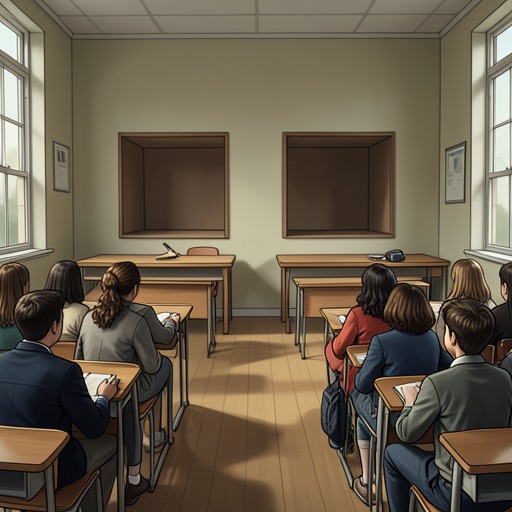
The art club room occupies the western end of the first floor of Building Zero. The space was originally a regular classroom, later divided in half so that only part of its former area served the club. The adjoining room belonged to the culture club and carried a placard identifying it as the Local Historical Society. This arrangement places the Art Club within a cluster of student spaces that preserve and reorganize older school functions rather than presenting a purpose-built institutional environment.
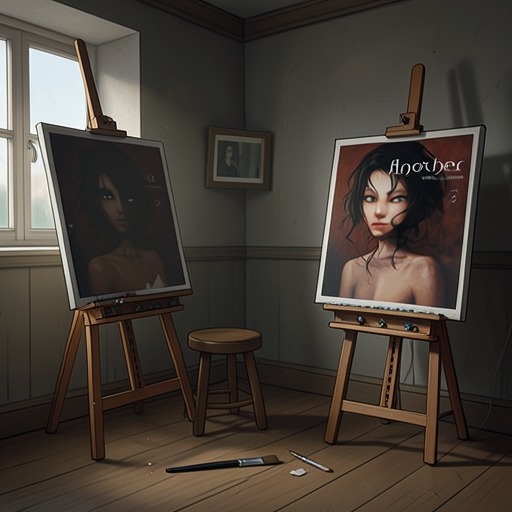
Inside, the room is more orderly than expected. Two large worktables stand in the middle, several easels are arranged around the room, lockers line one wall, and large steel shelves on the opposite wall hold art supplies and other materials. The neatness gives the club a practical, maintained character, even though its history includes a year-long closure and Mei’s withdrawal from attendance. The room therefore embodies a tension between continuity and interruption: its objects remain arranged for collective work while the membership and the school’s ordinary routines are repeatedly fractured.
Members and Artistic Practice
Mei’s connection to the club is partly historical rather than current. She recalls belonging to it in her first year and remembers Mochizuki from that time, but her attendance ends after only a few appearances in April following the return of the club. Her status as “not there” prevents her from participating openly with the other students, and the club becomes one of the places where the limits of that status are visible without being formally explained.
Yuya Mochizuki remains an active member. When Mei and Koichi Sakakibara enter the room, she observes that Mochizuki has not changed. One easel holds his version of Edvard Munch’s The Scream, not an exact copy: the background differs from the original, and the central figure resembles Mochizuki, with his hands over his ears. The painting turns the room’s ordinary artistic exercise into an oblique portrait of its member, linking the club’s visual practice with the pressure and alarm that characterize the students’ circumstances. Mochizuki arrives immediately afterward and addresses Mei as an older student, confirming the continuity of their earlier association.
The club also becomes part of the relationship between Mei and Koichi. In conversation, Koichi mentions that Mei is no longer attending, while she explains the club’s suspension and revival. The exchange places an apparently casual question about extracurricular activity beside the concealed social fact that she has been removed from ordinary recognition. The club’s history thus provides Koichi with a concrete route into understanding how the “not there” strategy operates in daily school life.
Refuge and Operational Base
During a day of pouring rain, Mei and Koichi avoid eating in the classroom with everyone else because both are “not there.” They leave immediately after fourth period and go to the Art Club room. The club is not merely a remembered affiliation at this point; it is a usable refuge where the two excluded students can remain apart from the class’s managed public arrangement. Its location on the first floor of Building Zero makes it accessible, while its partial conversion from a classroom retains the atmosphere of a school space that has been repurposed for selective access.
The room later serves as the meeting point for Koichi, Mei, and Mochizuki before their search of the old third-year Class 3 classroom. The group gathers there on July 30, and Mochizuki opens the room in advance because he belongs to the club. They wear their uniforms so as not to attract attention and agree to claim that the Art Club is holding a meeting if a teacher questions them. This plan turns the club’s ordinary institutional identity into cover for an unauthorized investigation. The same organization that shelters students from unwanted notice also supplies a plausible explanation for their presence in Building Zero.
Relation to the School’s Dangerous Spaces
The Art Club’s position in Building Zero contrasts with the old third-year Class 3 classroom on the second floor. After the group leaves the club room and reaches the unused floor, they find grime, damage, accumulated dust, and a stagnant odor that make the abandoned classroom feel radically different from the maintained clubroom below. The old classroom is the third room from the western end, a location verified by Tomohiko Kazami and passed on through Naoya Teshigawara. The Art Club is therefore the threshold from which the students move from an active, organized present into a sealed past.
That movement gives the club a structural role in the narrative’s geography. It is not itself presented as the site of the later violence at Sakitani Memorial Hall, but it belongs to the same network of spaces through which the students navigate danger: the Art Club room offers shelter and a cover story, the abandoned classroom offers evidence and historical menace, and Sakitani Memorial Hall culminates the movement into a publicized yet hazardous setting. In this network, ordinary institutional rooms are never neutral. Their formal purpose can be repurposed by exclusion, secrecy, investigation, or catastrophe.
The contrast becomes especially stark when the students later confront the consequences of violence elsewhere. At Sakitani Memorial Hall, a Western-style building standing in the forest at the foot of the mountain and donated to the school by alumnus Sakitani, six people are killed in circumstances involving stabbing, a fall, and fire. The Art Club’s controlled tables, shelves, lockers, and easels belong to the opposite pole of that scene: a fragile image of supervised student activity. Yet the club’s role in enabling secret movement shows how quickly an ordinary school structure can become entangled with concealed histories and lethal events.
Narrative Significance
The Yomiyama North Middle School Art Club is significant less because of a single decisive action than because its institutional interruptions and spatial uses reproduce the novel’s central instability. Its year-long hiatus follows a faculty transfer; its revival depends on one teacher’s assumption of sole sponsorship; Mei’s participation ends when she becomes “not there”; and Mochizuki’s membership later makes the room available for a covert search. Each change transforms the same organization without entirely erasing its previous identity.
As a result, the Art Club serves as both a social archive and a practical threshold. It preserves relationships formed in an earlier school year, displays Mochizuki’s artistic self-image, gives Mei and Koichi a place outside the classroom’s public order, and provides the cover under which they approach the school’s buried past. Its apparent normality is precisely what makes it useful: a club meeting is believable because the club exists, even when the students are actually preparing to violate the school’s restrictions. The organization’s quiet continuity thus carries the narrative from everyday school life toward investigation, abandonment, and the violence waiting beyond the maintained rooms.