Yomiyama North Middle School Third-Year Class 3
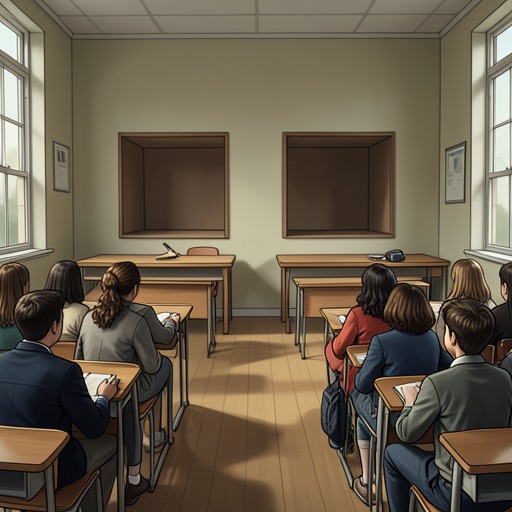
AnotherYomiyama North Middle School Third-Year Class 3 is the institutional center of the Yomiyama phenomenon, a school group whose ordinary structure is repeatedly distorted by the appearance of an “extra person” among its members. The class is not merely a roster of students and teachers: it is a shifting social reality maintained through records, memory, shared decisions, and deliberate exclusion. Because the class’s boundaries determine who is exposed to the disasters, its organization becomes the principal mechanism through which the supernatural crisis is experienced and managed.
Definition and Institutional Boundaries
Yomiyama North Middle School Third-Year Class 3 includes its students, its head teacher, and its assistant teacher. The danger does not extend equally to everyone at the school. Tatsuji Chibiki explains that people directly linked to the class are within the phenomenon’s range, while teachers who only supervise classes are outside it. A head teacher or assistant teacher is therefore treated as a genuine member of the class and may die along with the students, whereas an unrelated supervising teacher is considered safe. This distinction turns an apparently administrative role into a condition of physical risk.
The class’s institutional boundary also governs the status of those who are deliberately treated as absent. In 1998, the class attempts to increase the number of students considered “not there” by ignoring both Mei Misaki and Koichi Sakakibara. The tactic is not presented as a private dislike or an ordinary disciplinary measure; it is a collective attempt to alter the class’s social composition and prevent the phenomenon from recognizing an additional member. Once Mr. Kubodera dies, however, the class gradually stops maintaining the tactic. The students do not formally announce its end, but their conduct changes: Naoya Teshigawara begins behaving as though Mei genuinely exists and addresses her directly. The class thus demonstrates that recognition and nonrecognition are active organizational practices with immediate consequences.
Historical Recurrence and the “Extra Person”
The history of Yomiyama North Middle School Third-Year Class 3 is preserved through twenty-seven years of class lists, extending from 1972 through the current year. The binder held by Tatsuji Chibiki places the newest lists on top and arranges the years backward, making the record a physical archive of repeated membership and repeated disaster. The lists appear to offer stable evidence, yet the phenomenon undermines precisely the confidence that such records normally provide: when the extra person is present, records and memories are altered so that contradictions appear normal and the casualty’s identity remains hidden.
Tatsuji Chibiki’s account traces the crisis to the class twenty-six years earlier, when the death of a popular student and the response of the students and teachers became the trigger that opened what he calls the school’s “doors to death.” He later took charge of the class in 1976, an “on year,” after the preceding year had been an “off year” and he had hoped the disasters might have ended. That decision produced fourteen deaths in one year: five students from Third-Year Class 3 and nine members of their immediate families. The deaths took different forms, including accident, illness, suicide, and murder, so the class’s danger cannot be reduced to one recurring method or a single kind of incident.
Changing classrooms did not stop the disasters. After the summer break, the class was moved in the hope that the room itself was cursed, but the deaths continued through the remaining months. The extra person vanished after the graduation ceremony, when the class’s hidden contradiction could finally be resolved. Tatsuji Chibiki subsequently concluded that the extra person was not simply an invented member or an arbitrary intruder, but a casualty selected at random from people who had died in disasters caused by the phenomenon in earlier years. In this model, the class is invaded by its own accumulated dead: history returns as a living membership problem.
Teachers, Students, and Collective Administration
The class’s adults occupy unusually dangerous and morally complicated positions. Tatsuji Chibiki once served as a teacher and directly experienced an earlier disaster. He left teaching partly because of guilt over his conduct and partly from fear that becoming head teacher of Third-Year Class 3 again would place him within reach of the next death. He remained at the school as librarian, a position that allowed him to preserve knowledge while avoiding direct membership in the class. As librarian of the secondary library, he can interact with Mei Misaki and Koichi Sakakibara without supposedly increasing the danger because he has no direct link to the class.
The class’s current staff are bound to the group in different ways. Mr. Kubodera is its head teacher, while Reiko Mikami is its assistant teacher. Reiko’s position is especially difficult because she is also Koichi’s aunt and lives with him outside school. The Fourth North Yomi Fundamental requires them to treat one another as separate people in different settings: at school she calls him Sakakibara, the transfer student, while at home they are aunt and nephew. Mr. Kubodera and most of the class know this truth. During the decision to ignore Mei and Koichi, he refers to Reiko’s “difficult position,” meaning that she must disregard her nephew at school as though he were not there. The class’s survival tactics therefore require the suppression of ordinary family recognition as well as the management of supernatural uncertainty.
The class also attempts to act through organized prevention. Reiko announces a camping trip to the same location and on the same dates as the trip taken by Third-Year Class 3 fifteen years earlier, with a visit to Yomiyama Shrine as a possible means of stopping that year’s disasters. Her visibly tense and vacant expression suggests the burden placed on the teacher who must turn a terrifying theory into a school activity. Tatsuji Chibiki later joins the trip and openly acknowledges that he understands the peculiar circumstances surrounding the class. His statement freezes the atmosphere because it brings the hidden institutional crisis into public view before the students have established any secure solution.
Spaces Produced by the Class
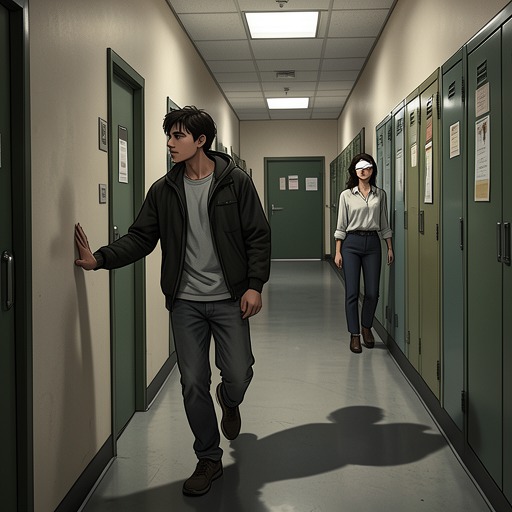
Although the class is an organization, its identity is repeatedly materialized through particular school spaces. During a rainy school day, Mei and Koichi leave their classroom rather than eat with everyone else. They go to the art club room on the first floor of Building Zero, at the western end of the building. The former classroom has been divided in two, leaving the art club with half its original size; the neighboring room bears a placard identifying it as the Local Historical Society. This repurposed architecture reflects the class’s unstable relation to ordinary school functions: rooms are divided, reassigned, or given new meanings as students search for spaces outside the group’s gaze.
The secondary library offers another kind of refuge. When Mei and Koichi eat there, no one else is present and the librarian is absent. Mei reads The Lonely Crowd, a book borrowed from the main library whose title seems to speak to her. The scene places the two students in a quiet institutional space where information about the class can be gathered without the direct pressure of their classmates. Tatsuji Chibiki’s presence there later transforms the library from a shelter into an archive and testimony room, where the history and operating rules of Third-Year Class 3 are disclosed.
The class’s older classroom is even more charged. The former Third-Year Class 3 room lies on the second floor, third from the western end, in a corridor that has been unused and off-limits for years. Dust, grime, damage, and a stagnant odor mark it as abandoned. Tomohiko Kazami, acting as a tactical officer with Izumi Akazawa and others, has retrieved a desk and chair from this room for the person who is “not there.” The abandoned classroom therefore becomes a material extension of the class’s hidden logic: it stores the furniture needed to represent an absent member while preserving the physical trace of earlier disasters.
The same spatial network reaches beyond the school. The Sakitani Memorial Hall stands in a forest at the foot of the mountain. It is a Western-style building with a slightly classical appearance, donated to the school by an alumnus and local celebrity whose name it bears. The school has little idea how to use it, yet the building becomes part of the class’s off-campus environment. Even a darkened foyer and a slightly open dining-hall door acquire threat because the class’s social crisis has spread into spaces that were meant to host ordinary communal activity.
Violence, Exposure, and Narrative Significance
The class’s exceptional status is most visibly demonstrated by the violence that erupts within and around it. Mr. Kubodera, a member of the class as its head teacher, withdraws his right hand from a bag on his desk and reveals a sharp-bladed object, apparently a hunting knife or kitchen knife, in front of the watching students. His classroom suicide makes the threat concrete and marks the point at which the attempt to maintain two students as “not there” begins to collapse. The death is not merely another casualty; it changes the class’s social behavior and forces recognition back into everyday interactions.
The crisis also encourages members of the class to interpret one another as possible sources of danger. Naoya Teshigawara secretly investigates Tomohiko Kazami by asking about childhood memories. When Kazami fails to remember their river hideout or a planned bicycle trip toward the ocean, Teshigawara treats the missing memories as evidence that Kazami may be the extra person and attacks him. The class’s rules have converted an ordinary lapse of memory into a mortal accusation. In this way, the organization produces both solidarity and suspicion: its members cooperate to identify the threat, but the same procedure can turn friendship into violence.
Yomiyama North Middle School Third-Year Class 3 is therefore a community organized around an impossible contradiction. It must preserve the appearance of an ordinary class while accepting that its records, memories, staff roles, spaces, and relationships may all be altered by an unseen casualty. Its strategies depend on collective agreement, yet the phenomenon can erase the very evidence on which agreement rests. The class’s recurring disasters expose the limits of institutional order: a roster cannot contain the dead, a classroom cannot remain merely a classroom, and recognition itself can become either a defense or the means by which danger is admitted.