doll's eye
AnotherThe doll's eye is Mei Misaki's special artificial left eye, a blue glass eye made by her mother after a malignant tumor forced the surgical removal of Mei's eye when she was four. Its decisive significance lies in the way it joins bodily loss, maternal care, uncanny perception, and the novel's recurring language of death: the eye is visibly artificial, yet it allows Mei to see something that ordinary vision cannot register.
Origin and Physical Form
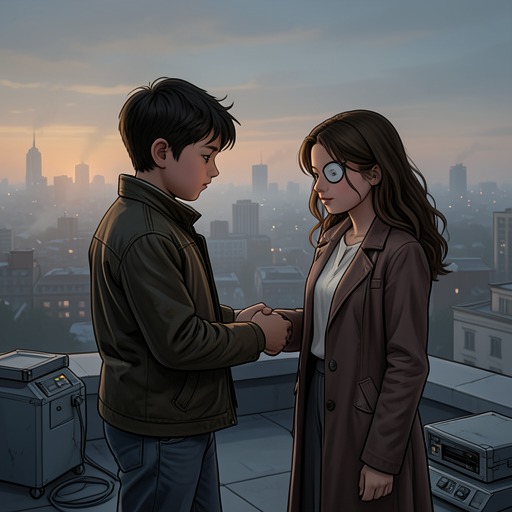
The eye exists because Mei lost her left eye in childhood. A malignant tumor formed in the eyeball, and after surgery she woke to find the eye gone. Ordinary artificial eyes were initially used to fill the empty socket, but Mei's mother rejected them as insufficiently attractive and made a special eye for her instead. The result is a glass prosthesis with a blue iris and an artificial spark, set beneath the eye patch Mei normally wears.
The eye's appearance is repeatedly associated with dolls. It is described as a blue eye that is empty to everyone else, and its doll-like quality makes the prosthesis both intimate and unsettling. It is not a neutral replacement that disappears into ordinary appearance. When Mei removes the patch, the eye becomes conspicuous: a crafted object takes the place of an absent organ, and the boundary between living body and manufactured thing becomes impossible to ignore.
The Eye as a Perceptual Instrument
The doll's eye is connected to Mei's ability to perceive the color of death. She gradually learned that this color appears when death is present, including in the face of a dead man trapped in the driver's seat of a crushed car. The perception first appeared in connection with a dead person's face and later became a recurring means by which Mei interprets dangerous or supernatural circumstances.
This ability changes the meaning of the prosthesis. The eye is not merely a sign of what Mei lacks; within the story it is also the means by which she detects what others cannot see. Medical language explains the loss of the original eye through tumor and surgery, while the narrative gives the replacement an uncanny function that medicine does not explain. The same object therefore holds two registers at once: it records a concrete history of illness and disability, yet it also mediates Mei's contact with the novel's supernatural death-sign.
Recognition of the Extra Person
The doll's eye becomes crucial when Mei examines the class photograph and senses the color of death on Misaki Yomiyama. She identifies this as the first time she has perceived that color in a photograph described as paranormal, making the image a decisive confirmation that something abnormal is present in the class's history.
Later, Mei exposes the eye while facing Koichi Sakakibara and tells him that the doll's eye has shown her that he is not the extra person. The statement gives the object an evidentiary role: it does not simply produce fear or atmosphere, but supports a judgment about identity. At the crisis involving the suspected extra person, Mei holds a pickax and refuses to proceed with killing because the person has the color of death. The doll's eye thus helps her distinguish between a living suspect and someone already marked by death, even though that distinction does not by itself resolve the danger.
Symbolic and Narrative Significance
The doll's eye concentrates the story's tension between appearance and reality. To ordinary observers it is an artificial blue eye, a carefully made substitute for an organ that can never return. For Mei, however, it is also a way of reading concealed conditions in faces, photographs, and people. Its apparent emptiness becomes a paradoxical form of vision: what looks vacant to others is the source of knowledge for her.
The object also prevents Mei's disability from being treated as a purely abstract metaphor. Its origin is tied to a tumor, surgery, artificial replacements, and her mother's aesthetic care. At the same time, the narrative makes the prosthesis carry supernatural information, so that bodily difference becomes entangled with the class's death-centered crisis. The eye is both a lived material fact and a narrative device, and its power comes from the unresolved friction between those functions.
When Mei uncovers it, the scene turns looking into an act with consequences. The blue eye is not presented as a comforting restoration of normal sight; it remains visibly made, doll-like, and separate from the ordinary eye. Yet it is precisely this altered form of seeing that enables Mei to confront the extra person and the color of death. The doll's eye therefore stands at the intersection of absence and perception, care and fear, human vulnerability and the demand to recognize death before it claims another victim.