Artemis’s vow of chastity
ArtemisArtemis’s vow of chastity begins as a defining condition of the goddess’s identity, but the story makes it more than a private promise: it becomes a rule shared with her nymphs and a measure against which her relationship with Callisto is tested. Zeus grants Artemis eternal chastity while allowing her to change her mind, a qualification that sits uneasily beside the solemn vow she later requires of her companions.
Origin and Terms
When Artemis asks Zeus for six wishes, she first requests that she remain a maiden and virgin always. Her wish is part of a larger effort to establish an identity distinct from her twin brother, Apollo: she also seeks many names, her own victories, a hunting tunic and hounds, and the title Light Bringer. Zeus promises that she will remain a virgin and be the pride of the nymphs. He names her Phaesporia, or Light Bringer, and says that her achievements will distinguish her from Apollo.
Artemis’s other requests define the life the vow is meant to accompany. She wants a silver bow and arrows, a chariot, a court of sixty daughters of Oceanus, and twenty handmaidens. She asks for the mountains and a forest domain, and says she will visit cities when women suffering the pangs of childbirth call for help. Artemis connects this role to her own birth: she says she was ordained to assist women because her mother suffered no pain in bearing her. The vow thus belongs to a broader self-definition as huntress, mistress of wild places, and potential helper in childbirth, rather than standing alone as a prohibition.
Zeus grants the requests, calling eternal chastity a gift but adding that Artemis may change her mind about it at any time. The permission to revise the vow qualifies its apparent permanence. Yet later events emphasize the vow’s binding, public character: Artemis treats it as solemn, and her companions are expected to take it too.
A Rule Shared with the Retinue
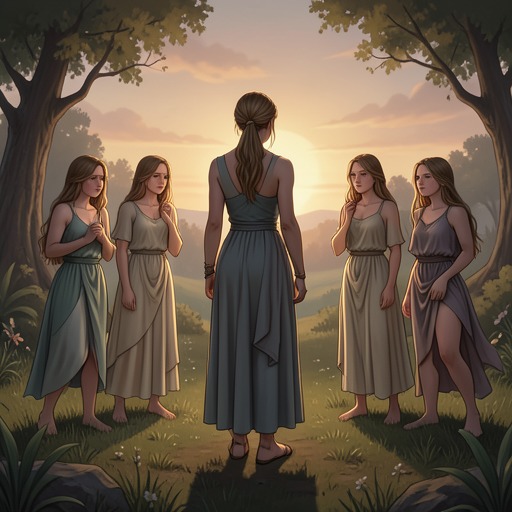
Artemis tells Callisto that she has sworn an oath to remain a virgin. Callisto already understands the vow’s reach: she knows that Artemis has required all her immortal nymphs to make the same solemn promise. The oath therefore structures not only Artemis’s own identity but also the terms on which members of her retinue belong to her.
Callisto says that she chose purity in order to remain Artemis’s companion forever. Her answer presents the oath as a chosen commitment and as a bond of loyalty. When Artemis asks whether a virgin can fall in love and remain pure, the question exposes a tension the rule does not resolve: emotional attachment and chastity are not presented as identical, but the possibility of love within the vow has become pressing for both women.
The retinue’s expectations are not uniform in practice. Euneica tells Callisto that Naiads may find a vow never to sleep with a man difficult to follow, while suggesting other ways of satisfying desire. Callisto is confused by their counsel and leaves, saying that Artemis may wake and need her assistance. The exchange shows the oath being interpreted within a community whose members have different relationships to its demands; it does not, by itself, establish that Callisto has broken her promise.
Love and the Vow’s Ambiguity
As Artemis takes less delight in hunting, Callisto voices concern that the animal kingdom still needs its patron. Artemis responds by asking whether Callisto regrets taking the vow with her. Callisto denies regret and explains that she chose purity to remain Artemis’s companion. Artemis then asks whether a virgin can fall in love and still stay pure, bringing the vow into direct contact with the affection between them.
The relationship develops through an explicit appeal to the vow’s possibility rather than a simple rejection of it. Artemis tells Callisto that she wants to know she is not alone, and that she can be loved while still keeping her solemn promise. Callisto takes her hand, and the two go together to a cave. In this moment, the vow is presented as something Artemis hopes to preserve alongside intimacy: she seeks affection without relinquishing the identity and commitment she has claimed.
The story also gives the relationship an unresolved, troubling dimension. During a later intimate encounter, Callisto feels an unexplained fullness and pain, mentions that she can feel something, and is told by Artemis not to worry. These details place Callisto’s changing bodily experience beside the language of trust and the vow, without clarifying it to her at the time. The contrast matters because Callisto has chosen the oath as a condition of companionship, yet the story later reveals a circumstance she says she did not understand.
Discovery, Accusation, and Consequences
The vow becomes the focus of open conflict when Artemis and her companions hear Callisto cry out. Opis and Loxo hold Callisto as the other nymphs bring her forward. Artemis sees that Callisto’s belly is swollen and realizes that she is pregnant. The discovery overturns Artemis’s understanding of their relationship; she reacts with anger and accuses Callisto of breaking her oath, making love to her, and lying despite having been favored.
Callisto disputes the accusation that she betrayed Artemis with someone else. She says that she had lain with Artemis and insists that the encounter was not intentional on her part. Artemis rejects the account, saying she could not have caused the pregnancy, and demands to know who did. Callisto then recalls an encounter months earlier, while she was gathering olives in the woods: she says that she saw Artemis come to her and make love to her, felt a searing pain that became pleasure, and only afterward realized that her purity had been broken. She insists that this was not her intention.
The scene leaves the vow caught between rule, attachment, and accusation. Artemis treats its breach as a betrayal of trust and says she will punish those who break her commands; Callisto describes her own experience as something she did not mean to choose. The earlier permission from Zeus that Artemis could change her mind does not resolve this conflict, because the immediate dispute concerns Callisto’s oath, the cause of her pregnancy, and what happened in the encounter she recalls. In the story, chastity is therefore both a chosen ideal and a source of authority over the retinue, while the pregnancy exposes how little the vow alone can settle about consent, responsibility, or the truth of their intimacy.