The winter at Plas Mold
AsylumThe winter at Plas Mold is the season in which the Raphaels’ new home becomes a measure of their private distress: rain-bound and isolated, Stella withdraws from family life as the consequences of her affair and Edgar Stark’s escape remain unsettled. Against the gray routine, small changes in the sky and in her relations with Charlie briefly suggest the possibility of renewal, but the family’s underlying tensions persist.
Setting and Seasonal Conditions
Winter arrives early and harshly in North Wales. Max Raphael drives Charlie to school in the morning and continues on to the hospital, leaving Stella without the car unless she rises with them. She is awake much of the night and sleeps late; rain falls for days, and gray clouds move across the valley above the house. The weather is not merely scenery: it encloses Stella in a routine from which she has little energy to escape.
A black-and-white sheepdog kept chained at a kennel across the house belongs to Trevor Williams, a neighbor. Stella and Charlie go to look at it, and its furious lunging makes plain the danger of approaching. Charlie is upset by the animal’s confinement and tries to befriend it, but repeated barking and bared teeth eventually frighten him away. The dog’s chained, inaccessible life gives the winter landscape a persistent point of unease, though the episode also reveals Charlie’s concern for a creature whose circumstances he cannot change.
When the rain pauses, Stella walks up the lane behind the house to the hilltop. From there she can see scattered farmhouses and a distant quarry across the next valley. Sheep gather beyond the clipped hedges, while water rushes through the ditches and fallen leaves collect in wet masses beside the drains. She wears Wellington boots that blister her heels and a long gray raincoat; weeks have passed since she had her hair done, and she has little expectation of meeting anyone. The landscape gives her a solitary route outward, but not an escape from her isolation.
Stella’s Withdrawal
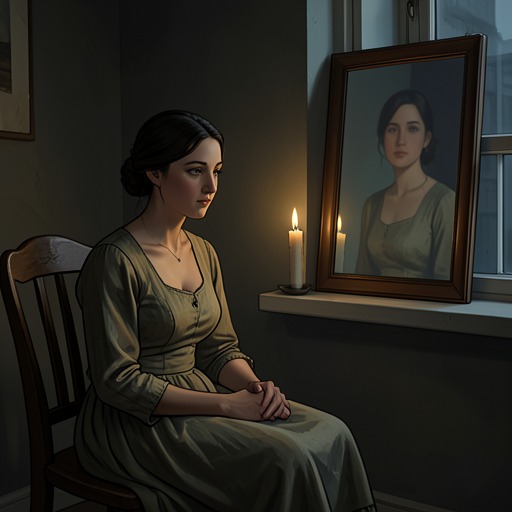
Stella experiences the days as if nothing happens. Keeping the house clean and making supper become efforts; she gains weight without caring, eats irregularly, and spends long stretches looking through the kitchen window at rain over the fields. When she comes out of these reveries, she sometimes cannot remember what she had been thinking about. Her detachment is thus shown through the erosion of ordinary activity and attention, rather than through a single dramatic crisis.
She continues, however, to imagine Edgar somewhere beyond the valley, drawing closer and coming for her. That expectation persists alongside the blankness of her days: the person who is physically absent remains central to the story she tells herself. The contrast makes the walks particularly charged. She passes a farmer now and then, and Trevor Williams sometimes nods from his rusty, mud-caked Land Rover without stopping; otherwise the hill offers distance and solitude, not contact.
Weekends make the house feel more crowded. The three Raphaels shop together on Saturdays, but Stella dislikes the noise, the extra meals, and the expectation that she will cook. She looks forward to Monday, when Max and Charlie have left the house quiet again. Mair sometimes joins her for tea in the kitchen, and neither feels obliged to fill the silence with conversation. Domestic life continues, but its routines no longer reliably produce warmth or connection.
Family Strain and the Unresolved Past
The household’s difficulties are sharpened by what remains unspoken about Edgar. He has escaped the hospital in Max’s clothes, and Max’s delay in reporting the escape gave him time to get away. Max had hidden knowledge of the danger and of his own part in the interval before the alarm; by the first two weeks of February, he continues to keep from the family that Edgar may be heading in their direction. The winter’s apparent stillness therefore contains a threat that Stella imagines romantically while Max privately understands as a practical danger.
Stella’s relationship with Charlie also registers the strain. His teacher, Hugh Griffin, sends a polite letter apologizing for upsetting Stella and asking whether she and Max will meet to discuss concern about Charlie. Stella crumples the letter and throws it away. Later, Max tells her that she has no cause to hate Charlie as well. The exchange suggests that the adults’ conflict is reaching their son, even as Stella resists an outside invitation to address his welfare.
Christmas deepens the separation within the family. Stella spends it alone at Plas Mold and says she gets drunk, while Max and Charlie go to stay with Brenda Raphael for three days. Max returns unsettled; Brenda has evidently urged him to leave Stella, but he does not act on it, and the household resumes its established routine. Stella hears nothing further from Hugh Griffin, though she suspects he may have written to Max at the hospital. The season’s family gatherings thus occur elsewhere, while Stella remains at home with her suspicions and unresolved distress.
A Brief Turn Toward Spring
After months of rain, one windy day is dry. Stella watches white clouds move across the sun, lighting one hill while leaving another in shadow. Newly erected electricity pylons march across the valley and crackle overhead when she walks beneath them; smoke rises from the brickworks to the east. With the sun higher and the first hint of spring in the air, she feels something stir that might be hope. The moment does not erase the winter’s loneliness, but it marks a change in her capacity to imagine a future beyond it.
That evening, Stella suggests that Max look for work in London. She sees pleasure in his face, but he tells her that he intends to remain at Cledwyn for at least two more years and that she will have to get used to it. Her offer and his refusal expose a difference between their possible futures: she proposes leaving, while he asserts a commitment to stay. The brightening sky accompanies not a reconciliation between them but the appearance of a hope that their plans cannot yet share.
Significance
The winter’s movement from relentless rain toward the first sign of spring gives the period a quiet seasonal structure, but it offers no simple recovery. Stella’s domestic and emotional withdrawal, Charlie’s unhappiness, Max’s professional dissatisfaction, and the family’s uncertainty about Edgar all develop within the same constricted setting. Even the routines that remain—school journeys, meals, shopping, and tea—show how little ease they provide.
Plas Mold is both a home and a place of enforced waiting. Stella’s hilltop walks open a view across the valley, yet her anticipation remains fixed on Edgar; Max’s decision to stay fixes the family more firmly to the place; and Charlie’s retreat into silence registers the cost of their unresolved adult conflict. The brief spring light matters precisely because it is only a possibility. The winter ends not with the household’s tensions resolved, but with a fragile prospect of change set against Max’s decision to remain.