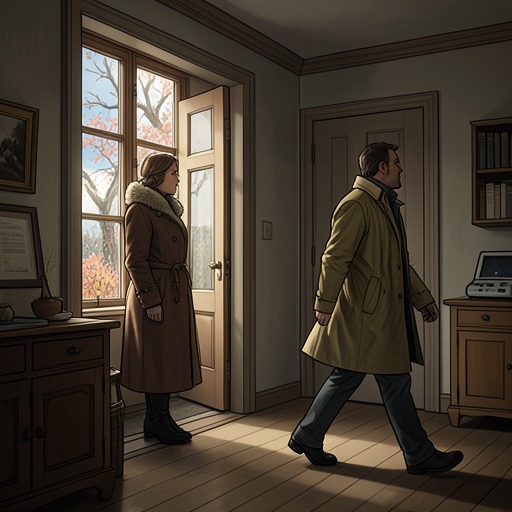
Summer of 1959
AsylumSummer of 1959 marks the Raphaels’ arrival at the hospital and the beginning of the chain of events that draws Stella Raphael toward Edgar Stark. Against a newly changed mental-health system and the imposing order of a walled institution, the summer turns ordinary routines—work in a garden, a family home, patients’ supervised outings—into the setting for a dangerous private attachment.
Arrival and Setting
The Raphaels came to the hospital in the summer of 1959, just after the Mental Health Act had become law. Max Raphael, a forensic psychiatrist then living in London, had applied to be deputy superintendent. He impressed the board and Jack Straffen, the superintendent, who offered him the position despite Peter Cleave’s advice against it. Stella arrived with Max and their ten-year-old son, Charlie Raphael. She had married Max while barely out of her teens; her parents were dead, and her father, a diplomat, had been disgraced in a scandal years earlier.
The hospital’s physical arrangement gave the summer its particular tension. It was a maximum-security complex on a high ridge, with pine forest to the north and west and marshland to the south. Its Victorian wings and barred windows imposed discipline and surveillance, while terraces and gardens softened the grounds without removing the enclosing perimeter wall. The Deputy superintendent’s house stood among pine trees about a hundred yards from the Main Gate. It was oversized and had been empty for years, its garden neglected. Max set about restoring it, cleaning and restocking the goldfish pond and cutting back the rhododendrons until they flowered. The family’s domestic setting was therefore part of the hospital estate, close to the institution and its patients rather than apart from them.
The Garden and the Affair’s Beginnings
That summer, supervised groups of parole patients left through the Main Gate to maintain the estate. Dressed in baggy yellow corduroy trousers and blue shirts, with white canvas jackets over their shoulders, they worked under attendants’ supervision. Edgar was assigned to the Raphael garden, under John Archer, a senior attendant. The arrangement brought him into Stella’s everyday orbit: she saw him while picking vegetables or flowers, and, when Archer was not in view, sometimes sat with Edgar and talked.
Stella later acknowledged that she was attracted to Edgar almost from the beginning. She tried to disregard the feeling, but his regular presence gave her repeated opportunities to seek him out. She justified the contact to herself as harmless friendship with a patient. Cleave’s account places these encounters within the longer pattern of Stella’s frustration and romantic imagination: she recast her experience with Edgar as a melodrama of lovers defying the world for passion. The summer’s ordinary garden conversations thus became the opening movement of an affair whose consequences would reach far beyond the garden.
Edgar’s History and the Institution’s Risk
The apparent normality of Edgar’s work concealed the reason he remained at the hospital. He had been a working sculptor, but about a year before his admission he became convinced that his wife, Ruth Stark, was having an affair. His accusations strained the marriage, and after a drunken quarrel he killed her with a hammer. In the aftermath, he showed no grief or guilt that Cleave could detect; after a few weeks he regained his equilibrium and joined hospital activities.
Edgar was intelligent and otherwise appeared to have recovered his sanity, but he remained fixed in the belief that Ruth’s infidelity had justified the murder. His supposed evidence consisted of trivial incidents—among them a flushing toilet, a stain, or a box of washing powder placed on a windowsill—which he interpreted as signs of betrayal. In interviews, Cleave also recorded examples such as a window opened as a motorbike passed, a crease in a pillow, and a stain on a skirt. Edgar conceded that the killing should not have happened and regretted drinking, yet continued to blame Ruth’s alleged taunts and insults. The persistence and absurdity of this delusion led Cleave and the other staff to oppose his release, despite his high level of functioning. The summer’s supervised work placed a man still considered unsafe within the grounds of the deputy superintendent’s home.
Escape and the Summer’s Aftermath
The arrangement ended when Edgar absconded. The hospital’s reconstruction was that he told John Archer he was wanted in the chaplain’s garden, went off alone, retrieved Max’s clothes that he had hidden in the woods at the end of the Raphael garden, and escaped wearing them. He kept away from the road until clear of the estate, then apparently made his way to London by hitchhiking or public transport. His disappearance exposed the lax security of the outside work parties.
The delay in raising the alarm compounded the failure. Max spent almost three hours between the discovery that his clothes were missing and the discovery that Edgar was gone. He searched Edgar’s room and ward but did not immediately establish whether Edgar was in the chaplain’s garden; he then returned to the hospital and waited before contacting Jack. By the time the alarm was raised, John Archer had already found his patient missing. The clothes made the escape especially humiliating for Max, who had to tell Jack that the fugitive was wearing his own.
The escape revived public attention to Edgar’s case. At his trial, two psychiatrists testified that he suffered from paranoid psychosis, and the court accepted the insanity defense; Cleave admitted him to the hospital the following day. The press then questioned why a man with Edgar’s history had been allowed to leave the grounds to work in the gardens. The summer therefore begins as a period of domestic arrival and supervised routine, but those same routines reveal the closeness of family life to institutional risk. Stella’s attraction develops in a setting that has already failed to resolve Edgar’s delusions, and his escape turns the private relationship into a public scandal.