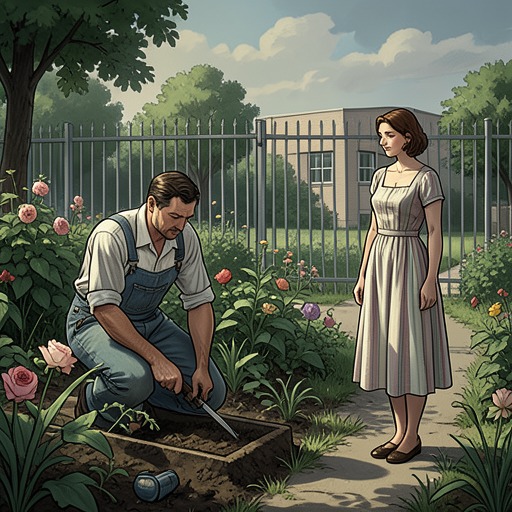
Event 1
Edgar and Stella dance at the hospital ball
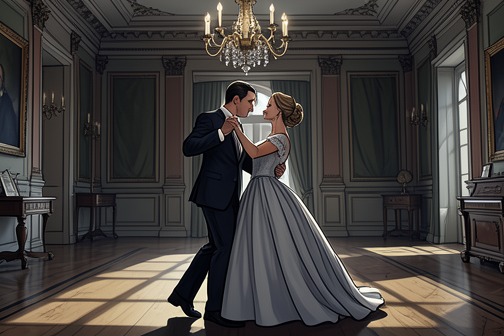
[Edgar and Stella dance at the hospital ball](entity:event-recall-event-ca48b3ec6ef3) in a scene that converts a formal evening of shared recreation into a public, bodily declaration of desire. For [Peter Cleave](entity:character-recall-character-peter-cleave-800f090e5315), watching from the hall’s shadows, their brisk dance first appears as a disturbing but unexplained breach of decorum; Stella’s later account reveals the mutual recognition at its center and makes the moment a turning point in their relationship.
## Setting and Circumstances
The dance took place about a year after the Raphaels arrived at [the hospital](entity:location-recall-location-the-hospital-6035d1cc8f6a) and only three weeks after Edgar began working for [Max Raphael](entity:character-recall-character-max-raphael-4221b1f25955) in the garden, around the beginning of June. The annual dances were major events in the hospital calendar. Patients on parole from the male and female wings attended alongside staff, and for one evening the institution presented them as an extended family without distinctions of rank or status.
That ideal sat uneasily beside the reality Peter Cleave observed. Many patients moved awkwardly, affected both by their illnesses and by their medication; their eccentric dress and movement made the festivities poignant to him. The Central Hall, in the Administration Block, offered a carefully arranged stage for the occasion: a high ceiling, pillars down the center, casement windows opening onto the top terrace, trestle tables with sandwiches and soft drinks, and a band onstage. Peter watched from behind a pillar at the rear.
Edgar’s presence there carried a particular clinical and institutional charge. He was a parole patient whom Peter had treated for five years, intelligent and socially capable but still fixed in the delusion that had led him to murder his wife, [Ruth Stark](entity:character-recall-character-ruth-stark-9160d92f6b38). Though Edgar had regained much of his functioning, he continued to maintain that the killing had been justified, and Peter did not consider him ready for release. Stella, meanwhile, was the deputy superintendent’s wife. Their encounter therefore crossed not only the boundary between patient and staff family, but the boundaries of Edgar’s parole and Peter’s work with him.
## The Dance
Peter saw Edgar approach Stella and watched her accept his invitation. As the band began a quick Latin number, she moved away with him into the dance. They crossed the floor briskly, passing directly in front of the superintendent’s table. Stella became slightly flushed, but her outward composure held; Peter recognized only later how conspicuous and reckless their passage had been.
The morning afterward, Stella sat at the kitchen table with tea and a newspaper, still unsettled by what had happened. In her account to Peter, the dance’s decisive instant was physical before it was fully understood: she felt Edgar’s erection pressing against her through his trousers, and first recoiled, ready to protest. Then she read his expression as abashed helplessness, as though he could not control what his body had disclosed. Her response shifted from outrage to sympathy and attraction; she returned his pressure.
They continued dancing in close contact. Edgar beamed, while Stella gazed into the middle distance with a demure, unreadable expression. She did not lose her composure, either during the dance or afterward. When the music stopped, she was almost sorry; Edgar turned abruptly and went back to the other side of the room. The scene’s outward restraint thus concealed an intimate exchange that neither the other dancers nor Peter could read accurately at the time.
## What Peter Did Not Know
Peter’s initial observation and Stella’s later testimony form two different accounts of the same event. He saw her flush and the pair moving boldly across the hall, but he did not know what she had felt or how she had responded. He later understood that the dance had not been simply an indecorous advance by Edgar: Stella had recognized his desire and knowingly reciprocated it.
The next day, the sensation remained vivid to Stella. She took several baths, and each time she undressed she remembered the pressure against her groin. Until the dance, she had treated her sexual interest in Edgar as a private indulgence and had not considered that he might return it. The encounter changed that assumption. His daily presence in the vegetable garden, where she had found pretexts to speak with him, consequently became a problem rather than an innocent routine.
## Consequences and Significance
The dance exposed the gap between the hospital’s formal aspiration to erase rank for an evening and the unequal relationships that remained in force. Edgar was a patient under Peter’s care; Stella was married to Max, the deputy superintendent, and Edgar had recently begun working on the Raphaels’ grounds. Their dance took place in full view of the institution’s senior staff, yet its most consequential meaning remained hidden from the observer who was supposed to be helping Edgar.
Peter was less troubled by the desire itself than by Edgar’s failure to tell him what had happened. Because Edgar said nothing about the dance, Peter felt that the candor needed for their work together had been compromised. The scene therefore initiates a double movement: Stella’s attraction ceases to be solely private, while Edgar’s concealment weakens the therapeutic trust on which Peter’s relationship with him depends. What appeared to be a brief social dance becomes, in retrospect, the first public sign of a dangerous intimacy developing inside the institution.
Event 2
Edgar Stark’s escape from the hospital and flight to London
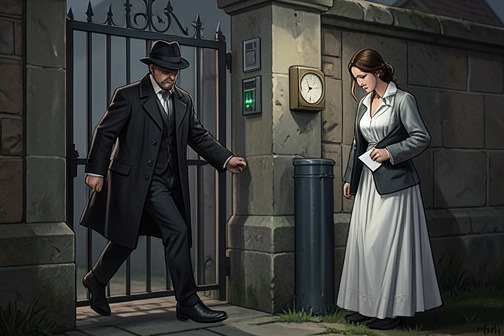
[Edgar Stark’s escape from the hospital and flight to London](entity:event-recall-event-1dd432bfbdf7) turns supervised access to the grounds into a route out of confinement. The escape depends not only on his disguise and a gap in security, but also on help concealed within the deputy superintendent’s household: [Stella Raphael](entity:character-recall-character-stella-raphael-eef4e55d673c) hides a note in [Max Raphael](entity:character-recall-character-max-raphael-4221b1f25955)’s jacket and has supplied Edgar with money. The alarm reveals how badly [the hospital](entity:location-recall-location-the-hospital-6035d1cc8f6a) has misjudged the risk posed by a patient who appeared to function well while remaining fixed in a dangerous delusion.
## Background and Opportunity
In the summer of [1959](entity:time-recall-time-1959-43ffb2b0d1c1), Edgar had been at the hospital for five years. He was intelligent and had otherwise recovered his sanity, but he still insisted that his murder of [Ruth Stark](entity:character-recall-character-ruth-stark-9160d92f6b38) was justified. Asked to support his claim that Ruth had been unfaithful, he interpreted ordinary details—a flushing toilet, a stain on the floor, a box of washing powder on a windowsill—as proof. He regretted drinking, and agreed that the killing should not have happened, yet continued to blame Ruth’s supposed taunts and insults. Because he showed no insight into why he had killed her, [Peter Cleave](entity:character-recall-character-peter-cleave-800f090e5315) and the hospital’s staff did not consider him ready for release; Cleave expected he might remain for another five years.
Edgar nevertheless had access to the estate through supervised work parties. Each morning, parole patients went out under an attendant’s supervision to maintain the grounds. Edgar was assigned to the garden of the deputy superintendent’s house, where Stella often encountered him while picking vegetables or flowers. Their conversations began when the senior attendant, [John Archer](entity:character-recall-character-john-archer-bb6f696f7d45), was not present. Stella was attracted to Edgar and found reasons to see him, telling herself that befriending a patient could do no harm. She had also given him cash on more than one occasion—enough, in the hospital’s later estimation, to help him get to [London](entity:location-recall-location-london-420923d4a60a).
## The Disguise and Escape
The immediate opportunity involved [Max’s clothes](entity:object-recall-object-max-109dc35e473d). Stella found Max troubled by the disappearance of a shirt, trousers, and a linen jacket containing the estate keys. She went through the vegetable garden to the [Conservatory](entity:location-recall-location-1f4494549673), where Edgar’s white jacket hung by the door. On an empty seed packet, using a stub of pencil, she wrote him a note and put it in the jacket pocket, leaving it protruding so he would notice it. The working party appeared at the end of the drive as she returned to the house; she could do no more than hope Edgar would see the message and find a chance to dispose of the clothes.
The hospital’s later reconstruction was that Edgar told John Archer he was wanted in the chaplain’s garden, then went there alone. He retrieved Max’s clothes from where he had hidden them in the woods at the end of the Raphaels’ garden and put them on. Keeping away from the road until he was clear of the estate, he made his way onward by whatever means he could find—hitchhiking, bus, or train—and reached London. The clothes provided his disguise; Stella’s money supplied the other resource the staff believed an escaping patient needed.
## Discovery and Search
Max’s clothes had gone missing before the hospital established that Edgar himself was absent. Almost three hours passed between the discovery of the missing clothes and the discovery of the escape. Max returned to the hospital, checked with staff in Block 3, went to his office, and waited another half-hour before calling [Jack Straffen](entity:character-recall-character-jack-straffen-c535305f92b8). By then the working parties were due back, and John Archer had already found that his patient was missing. Max’s delay meant the search began later than it might have; had Edgar’s absence been checked promptly, the hospital believed it could have raised the alarm sooner and caught him more quickly. Max also had to tell Jack that the escaped patient was wearing his own clothes, a fact Cleave understood as a source of humiliation for him.
When Max finally announced that Edgar had absconded, the siren sounded. Cleave’s account also describes an initial effort by Jack and Cleave to search the estate before alerting the countryside: attendants swept the farm and marsh and went some way into the forest. They believed Edgar might have had a lead of no more than three hours, but recognized that this could be enough for a resourceful man with clothes and money. After two hours without finding him, they informed the local police. The searchers did not know whether Edgar had money; Stella’s assistance was hidden from them.
## Consequences and Significance
The escape exposed the vulnerability built into the hospital’s parole arrangements. Patients were supervised outside the walls, but the work parties’ security was lax enough for Edgar to leave his group and use clothes concealed near the deputy superintendent’s garden. The disguise also made the breach personal: he escaped in Max’s clothes, carrying away a resource furnished from within Max’s household.
Stella’s response further concealed her part in the escape. When [Brenda](entity:character-recall-character-brenda-e39cbd8c0058) and Stella heard the news, Brenda’s first concern was [Charlie](entity:character-recall-character-charlie-24c3a7bd9408), who had not yet come home. Stella performed extreme anxiety about the boy, directing attention toward his welfare rather than her own alarm at Edgar’s escape. The episode thus turns a secret attachment into practical aid: a note, clothing, and money help convert the hospital grounds into a passage to London. Yet Edgar’s escape did not resolve the danger that had kept him confined. His apparent capacity to take advantage of an opening coexisted with the unshaken delusion that had led him to kill Ruth Stark.
Event 3
Stella leaves her family to join Edgar in London
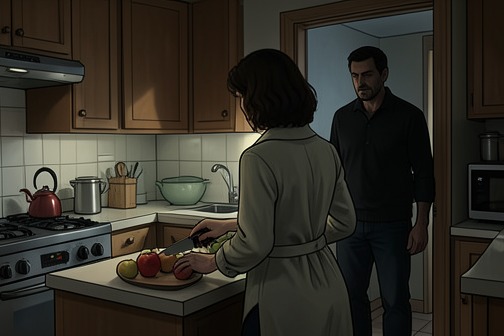
[Stella leaves her family to join Edgar in London](entity:event-recall-event-0f1f98f82a74) after [Peter Cleave](entity:character-recall-character-peter-cleave-800f090e5315) confronts her with the danger she has chosen not to see. His warning does not end the affair; instead, it precipitates her departure. In turning away from her family and toward Edgar, Stella converts a secret attachment into an irreversible act, while the costs of that choice begin to register almost as soon as she makes it.
## The Warning and Decision
Peter finds Stella in the kitchen after she has left the garden. She has brought her basket inside and is cutting cooking apples at the sink. Peter takes the coring knife from her and turns her to face him, insisting that she listen. He tells her that [Edgar Stark](entity:character-recall-character-edgar-stark-4c0e760bb2ef)’s wife, [Ruth Stark](entity:character-recall-character-ruth-stark-9160d92f6b38), was first his model, and that Edgar had built his art around her. When his idealization collapsed, Peter explains, Edgar developed morbid delusions about Ruth that escalated until he murdered and mutilated her, cutting off her head. Peter stresses that Edgar has shown neither insight into his actions nor genuine remorse.
Stella listens without looking at Peter, then rejects the warning as irrelevant. She says she does not know where Edgar is and has no reason to seek him out, and asks Peter to leave. He repeats that he came to warn her and urges her to take the warning seriously. After he goes, Stella runs upstairs and weeps. The tears release the anxiety of the preceding weeks, but their source is not only Peter’s account of Edgar’s violence: she also understands that Peter and the others know about her. If they know, she thinks, then her relationship with Edgar is finished. Her despair gives way to calculation. She tells herself that she can still go back to him; waiting would mean that, by the time she returned, he might be gone.
The phrase she repeats to herself—if she acted now—turns a possibility into a plan. [Max Raphael](entity:character-recall-character-max-raphael-4221b1f25955) is at [the hospital](entity:location-recall-location-the-hospital-6035d1cc8f6a), the house is otherwise empty, and [Charlie Raphael](entity:character-recall-character-charlie-raphael-eb26d3a0bf2d) is at school. Stella takes a drink and paces the drawing room, imagining that she will pack a suitcase, call a car, and leave for [Horsey Street](entity:location-recall-location-horsey-street-585673aea40b) without coming back. She calls the car. For a moment, thoughts of [Charlie](entity:character-recall-character-charlie-24c3a7bd9408) nearly stop her: she recognizes that her departure will affect him, but pushes the thought away and proceeds.
On the way to the station, Stella asks the driver to stop at the bank and withdraws the few hundred pounds in the joint account. At [Victoria Station](entity:location-recall-location-72262d538991), the crowd overwhelms her. She sits at the back of the cafeteria with coffee and a cigarette, terrified, then watches herself leave a coin by the saucer, gather her handbag and suitcase, and walk out as though she were an ordinary provincial visitor on a shopping trip. In the taxi to Horsey Street, detachment gives way to exhilaration. The decision is made, and the prospect of seeing Edgar again makes the remaining journey feel intolerably slow.
## Arrival at Horsey Street
At the top of Horsey Street, Stella stood with her suitcase as the cab pulled away. [Nick](entity:character-recall-character-nick-71bd8d1fa63d) was with Edgar in the warehouse loft. He told Stella they had not expected her; she replied that she had not known she would be coming and asked whether Edgar was there. Nick hammered on the door and called for Edgar to open it. When the lock finally turned from inside, Edgar appeared and stared at her. Stella picked up her suitcase and asked to come in. Edgar glanced at Nick, then asked whether she had come to stay. Stella said she was with him. His wary stillness broke into a broad grin: he flung an arm around her neck, and they lurched together into the loft, embracing in the middle of the floor. The journey’s anxious, deliberate steps ended in a reunion that made her abandonment of home feel, for the moment, like arrival.
Peter later acknowledged that he had anticipated Stella might do something like this, but had expected her to heed his warning. He had underestimated both her desperation and the extent to which Edgar had ensnared her. From this point, he no longer witnessed Stella’s life directly; he relied on her later, tentative and disjointed account of the days that followed. The shift in access matters: the escape is first narrated through the precise itinerary of her decision, then through a lover’s recollection and the family she has left behind.
Stella could reconstruct what her disappearance would mean at home. Max would return from the hospital and find her gone; Charlie would come back from school, and calls would follow as bewilderment became concern and then anxiety. She imagined Max resisting the truth at first, before realizing, as the hours passed, what she had done. Yet she had deliberately avoided thinking about Charlie while packing, ordering the car, and leaving without a note. She had tried to blur him into Max, making him part of the man she was abandoning, because facing his reaction threatened the happiness she had chosen to pursue. On waking after her departure, she pushed the thought away again. Her guilt remained, in her account, a shadow moving behind the brightness of her lover: present, but kept out of sight.
## The Departure’s Later Reckoning
The choice to leave Charlie Raphael behind acquires a terrible retrospective weight when, after the Raphaels have moved to Wales, Stella is with him at a pool on [Cledwyn Heath](entity:location-recall-location-cledwyn-heath-38dd215f45b6). During a severe dissociative episode, she watches him splash among the weeds while trying to catch something in the shallows. When he loses his balance and struggles in deeper water, she remains apart, smoking. The narrative renders her movements as rigid and separate: she turns her head away, brings the cigarette to her lips, and turns back as Charlie’s head and arm briefly break the surface. [Hugh Griffin](entity:character-recall-character-hugh-griffin-06aa4a793e83) comes over the hill, sees what is happening, and plunges into the water; Stella does not call out to him or move to help.
Hugh carries Charlie out and tries to revive him, but the boy dies. At first the adults treat Stella as being in shock. The response changes when Hugh insists that she had watched Charlie struggle without raising the alarm or attempting to save him. Whether a shout from the hill could have made a difference is later disputed because of the distance to the water; what horrifies the community is her apparent stillness. Sympathy turns to condemnation, and people call her unnatural, evil, inhuman, or mad. She is charged with manslaughter, remanded, and questioned repeatedly. Her experience is described as numb detachment: she watches herself endure the interviews as if from within a barricaded part of her mind and from a point outside her body.
This later catastrophe does not make the departure from home its cause. It does, however, throw the earlier decision’s evasion into sharper relief. When Stella left without a note, she had briefly considered what would happen to Charlie, then pushed the thought aside; later, at the pool, her inability to respond becomes a matter of life and death. The book links the two moments through the problem of attention: first she deliberately refuses to imagine her son’s distress, and later she appears unable to act as he is in danger. That connection complicates any simple account of her departure as a choice between domestic duty and romantic escape, without erasing the difference between a conscious decision and a dissociative state.
During a later meeting, Max Raphael tells Stella that the shock will wear off and that guilt will follow, devastating her so profoundly that she will need close watching for fear she may attempt suicide. He predicts that, with Peter Cleave’s help, she may eventually come to terms with what she has done, though she will remain terribly sad. Stella responds by throwing her lighter at him and trying to climb over the table to scratch his face. The warning that once drove her toward Edgar has become an unbearable forecast of the grief she cannot yet face. Her departure had left guilt shadowing the happiness she pursued; Charlie’s death makes that shadow impossible to keep at a distance.
## The Interview’s Clinical Aftermath
In the hospital meeting, Max begins speaking after a silence, just as Stella is about to ask him to end the interview. His forecast of overwhelming guilt and lifelong sadness turns the encounter from an attempt at communication into a pronouncement about her future. Stella responds by throwing her lighter and trying to climb across the table to scratch his face; staff rush in and take her away. The narrator closes the scene with an ironic judgment: Max is left to congratulate himself on his skill at the psychiatric interview. His certainty about the grief to come may be intended as care, but the encounter shows how clinical interpretation can become another form of control when Stella is not ready—or able—to answer it.
Event 4
Edgar Stark’s escape from the mental hospital
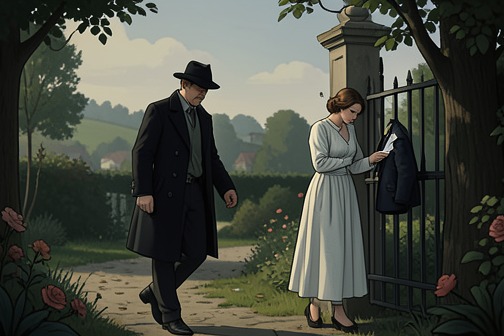
[Edgar Stark’s escape from the mental hospital](entity:event-recall-event-edgar-stark-s-escape-fr-d3b4ff4437ed) converted a system of supervised work and conditional freedom into the means of his disappearance. Wearing [Max Raphael](entity:character-recall-character-max-raphael-4221b1f25955)’s clothes, he slipped away from the estate and made his way toward [London](entity:location-recall-location-london-420923d4a60a); the delay in raising the alarm exposed how vulnerable [the hospital](entity:location-recall-location-the-hospital-6035d1cc8f6a)’s arrangements were and drew [Stella Raphael](entity:character-recall-character-stella-raphael-eef4e55d673c) into a fugitive life shaped by secrecy, fear, and romantic illusion.
## Background and Opportunity
By the summer of [1959](entity:time-recall-time-1959-43ffb2b0d1c1), Edgar had spent five years in the hospital after murdering his wife, [Ruth Stark](entity:character-recall-character-ruth-stark-9160d92f6b38), with a hammer. He had recovered his general sanity and took part in hospital activities, but he remained fixed in the belief that Ruth’s supposed infidelity had justified the killing. The evidence he offered for that belief was made up of ordinary details—a window opened as a motorbike passed, a crease in a pillow, or a stain on a skirt—given extravagant meanings. Because he showed no insight into the murder and continued to regard it as justified, [Peter Cleave](entity:character-recall-character-peter-cleave-800f090e5315) and the other doctors judged him unready for release.
Edgar nevertheless worked outside the wards as a parole patient. Each morning, supervised groups left through the Main Gate to maintain the estate grounds. Edgar was assigned to work in the garden of the deputy superintendent’s house, where Stella often encountered him while picking vegetables or flowers. The arrangement gave him access to the estate and brought him into daily contact with Stella, whose attraction to him grew despite her attempts to dismiss their conversations as harmless.
## The Escape
The hospital’s account of the escape was reconstructed afterward. After lunch, Edgar told [John Archer](entity:character-recall-character-john-archer-bb6f696f7d45) that he was wanted in the chaplain’s garden, then went off alone. He retrieved [Max’s clothes](entity:object-recall-object-max-109dc35e473d), which he had hidden in the woods at the end of the Raphaels’ garden, and wore them to disguise himself. He kept away from the road until he was clear of the estate; from there, he apparently travelled toward London by hitchhiking, bus, or train. The account could not establish which means of transport he used, but it placed the escape’s decisive steps in the woods and beyond the estate boundary.
The alarm came late. The interval between the discovery of Max’s missing clothes and the discovery that Edgar was absent was close to three hours. Max returned to the hospital, checked with staff in Block 3, went to his office, and then waited another half-hour before calling [Jack Straffen](entity:character-recall-character-jack-straffen-c535305f92b8). In the meantime, the work parties were due back, and John Archer had discovered that Edgar was missing. Peter Cleave was already with Jack when Max telephoned. The delay meant that the hospital lost valuable time in which an earlier search might have found Edgar, and the fact that the fugitive was wearing Max’s clothes made the episode personally humiliating for the deputy superintendent.
## Life on the Run
In London, Stella joined Edgar and [Nick](entity:character-recall-character-nick-71bd8d1fa63d) in a warehouse loft. The conditions were makeshift: there was one sink, often crowded with paintbrushes, one tap, and one lavatory. Stella took on the work of keeping the place clean, cooked simple meals on a two-ring stove, and made shopping lists for Nick, who shared expenses with her. At night, the three of them ate, drank, and talked, mostly about art. Stella described this period as one of rapid growth, believing that she was learning to think and feel as an artist and shedding her former identity as a wife and mother.
The danger of discovery fed rather than dispelled her idealization of their life together. She and Edgar could not go out in daylight for fear of recognition and arrest, a restriction that gave their existence what Stella regarded as the danger intrinsic to an artist’s life. Yet anxiety repeatedly broke through the imagined idyll: after four or five days, she sometimes woke to the enormity of what she had done and tried to push the thought away. She told herself they would soon be able to enter the world unnoticed, while the evidence of their isolation remained visible in the loft’s cramped routines and dependence on Nick.
Stella was also surprised to find that the fugitives received visitors. When someone knocked while they were eating sardines on toast, she rose in alarm; Edgar stayed at the table, and Nick calmly went to answer the door. The contrast between Stella’s expectation that fugitives must be cut off from everyone and the ordinary social life around Edgar and Nick unsettled her assumptions about the escape’s reality.
## Consequences and Significance
The escape became a public crisis when the press revived Edgar’s case. At his trial, two psychiatrists testified that he suffered from paranoid psychosis, and the court accepted the insanity defense. The renewed attention brought scrutiny to the hospital’s practice of allowing patients such as Edgar to leave the grounds daily to work. [Charlie](entity:character-recall-character-charlie-24c3a7bd9408) was kept in the garden while reporters questioned people on the estate; one reporter asked him what his father talked about at lunch, leaving the child confused and tearful. The escape thus breached more than the hospital’s perimeter: it carried the consequences of its security arrangements into the Raphael family’s home.
For Stella, the escape opened the route into the fugitive relationship she had recast as a melodrama of lovers defying the world for passion. Her first days in the loft brought both excitement and anxiety, while the restrictions and precarious domestic arrangements that accompanied Edgar’s freedom contradicted the ideal she tried to preserve. The disguise is the episode’s sharpest reversal: Max’s clothes, taken from the edge of the family garden, enabled Edgar to pass out of the institution and into the life Stella would mistake for liberation.
Event 5
Stella leaves home to join Edgar
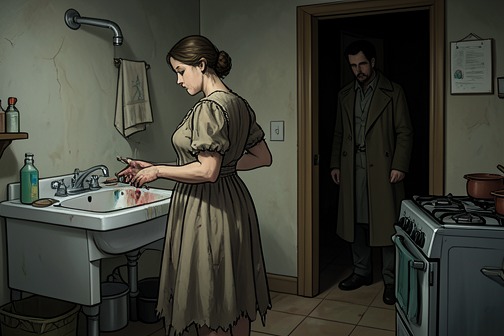
[Stella leaves home to join Edgar](entity:event-recall-event-stella-edgar-b0531f951f11) in the [Horsey Street warehouse loft](entity:location-recall-location-horsey-street-1c0ebdf2763f), exchanging family life for fugitive intimacy and an imagined artistic rebirth. The move gives her a sense of freedom and belonging, but its precariousness surfaces almost immediately: she tries to ignore the consequences, including her separation from [Charlie Raphael](entity:character-recall-character-charlie-raphael-eb26d3a0bf2d), until the police find her and [Max Raphael](entity:character-recall-character-max-raphael-4221b1f25955) comes to the station.
## Leaving for the loft
After four or five days with Edgar, Stella began waking to sudden anxiety about the scale of what she had done and the situation she had entered. These moments came early, while Edgar was still asleep. She tried to push them away rather than disturb what she experienced as an idyll, telling herself that the feeling would pass and that, eventually, they would move quietly and unnoticed into the world again. She could not bring herself to think much further ahead.
The loft’s primitive conditions made the change in her life tangible. There was one sink, one tap, and one lavatory, and the sink was often crowded with paintbrushes. Stella took up the work of keeping the place clean, cooked simple meals on a two-ring stove, and made shopping lists for [Nick](entity:character-recall-character-nick-71bd8d1fa63d), who shared expenses with her and Edgar. Domestic work remained part of her daily life, but its meaning had shifted: she no longer understood it as service to her husband and son, and she felt ashamed of the years when their domestic comfort had been her principal occupation.
## An artistic life under constraint
Stella’s days in the loft brought her closer to Edgar and Nick through ordinary routines as much as through art. At night, the three ate together, drank, and talked, most often about art. Stella deliberately absorbed Edgar’s tastes, ideas, and feelings, experiencing this as a way to shed an old, stale identity. She also began writing a little when no one was watching. Max and [the hospital](entity:location-recall-location-the-hospital-6035d1cc8f6a) seemed more distant with each passing day.
She later described this period as one of unusually rapid growth: she felt she was learning to think, feel, and see as an artist. Yet their supposed freedom depended on confinement. As fugitives, Stella and Edgar could not go out in daylight for fear of recognition and arrest. Rather than dispelling her excitement, that danger intensified it; she associated the restricted, illicit life with the existence of an artist. The contrast between her sense of awakening and the practical reality of hiding gives the episode its precarious charge.
## Anxiety beneath the idyll
Stella’s exhilaration did not erase her awareness of what she had left behind. In the quiet before Edgar woke, she confronted the enormity of her decision, then tried to set that knowledge aside and preserve the life she had chosen. Her effort to avoid thinking about Charlie Raphael failed, even as she attempted not to dwell on him. The refuge therefore offered no settled escape from family ties: the separation remained present in the very moments when Stella was trying to inhabit a new self.
## Police custody and Max’s arrival
The fugitive arrangement ended when Stella was taken into police custody. At the police station, the hours seemed unreal to her; she remembered a woman in uniform giving her tea. The police had established that she did not know where Edgar was, and they did not immediately question her. Their apparent view of her—as a victim seduced, manipulated, and abandoned by Edgar—shaped the gentle approach that Max also adopted when he arrived.
Stella tried to remain calm, but instead found herself clinging to Max. After days of feeling weak, alone, and desperate, she wanted to be cared for and accepted his touch even while it felt like a doctor’s or psychiatrist’s rather than a husband’s. At first she became passive, answering questions while others spoke quietly around her; she made no effort to understand or direct what was happening. Only later did Max’s role as husband displace the doctor’s, beginning what Stella experienced as a new nightmare. Her return to his care thus reversed the refuge she had sought with Edgar without resolving the conflict between dependence, escape, and the life she had left.
Event 6
Stella flees Edgar’s warehouse hideout
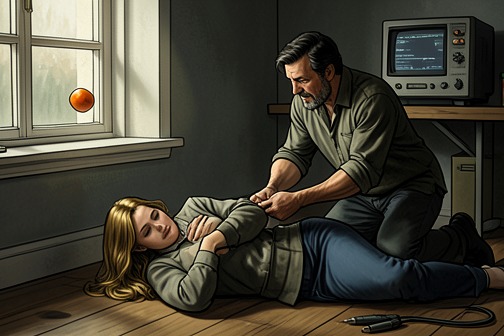
Stella’s escape from Edgar’s warehouse hideout begins when a familiar jealous accusation turns into a warning of a different order: she recognizes in his suspicion and behavior the madness connected to [Ruth Stark](entity:character-recall-character-ruth-stark-9160d92f6b38)’s murder. Once Edgar leaves, she slips out of the studio and finds [Nick](entity:character-recall-character-nick-71bd8d1fa63d), exchanging a room in which she fears what Edgar may do for the modest but immediate relief of safety, company, and a bath.
## The assault and its warning signs
Edgar’s accusation that Stella is having sex with Nick erupts into violence. She has just picked up an orange from the table when Edgar crosses the room, drags her to the floor, grips her wrists, and demands to know whether she thinks he is a fool. Stella does not answer; he slaps her harder than before, and she falls, turns over, and buries her face in her arms. The orange rolls toward the window. She is preoccupied with the possibility that he will tread on it because oranges are expensive, a mundane concern that coexists with the immediate danger.
She lies still, breathing into her arms, unable to hear what Edgar is doing or judge how much time has passed. Afraid that sitting up might enrage him further, she waits until a scraping sound draws her attention. Edgar stands with his back to her at the table. When Stella examines her face in her compact, one side is already changing color and pain pulses through it. The sound is Edgar sharpening a blade against a stone. The ordinary studio has become a place where she cannot tell what he intends, and her previous confidence that she knew him gives way to the recognition that she may have invented the safer man she thought she knew.
## The orange and the recognition of danger
Edgar cuts another slice from the orange and tentatively brings it to his lips, watching Stella in a way she cannot understand. His behavior recalls what [Peter Cleave](entity:character-recall-character-peter-cleave-800f090e5315) had told her about Edgar’s delusions concerning Ruth Stark: he had believed Ruth was poisoning his food. The possibility that Edgar now suspects Stella of poisoning him changes the meaning of the scene. She had found ways to explain away his violence and jealousy; this suspicion connects his present state to the delusions surrounding Ruth and to the murder she has been trying not to acknowledge.
Stella understands that she must get away, but does not dare leave the room while Edgar is still there. She fears that he will know what she is thinking and that discovery will make the danger immediate. Upstairs, she waits among the bedclothes, propped against the bricks and smoking, while the knowledge she has suppressed becomes unavoidable. She remains capable of pitying Edgar and understands his madness as disease, but that understanding does not make her safe. She fears he could do to her what he did to Ruth, and believes she must conceal her terror rather than let him perceive it.
## Leaving the studio
Edgar stays in the studio through the afternoon, working on Stella’s head. Peter Cleave suggests that the work may be an effort to see Stella clearly and master the madness in himself, but Stella does not know this; she waits for Edgar to go and makes her preparations mentally. Shortly after dark, he leaves without a word. She acts at once, packing her suitcase and dressing in less than ten minutes.
In a raincoat, head scarf, and sunglasses, Stella runs down the stairs and along the passage. She pauses to peer into the yard, which is empty, then walks quickly into the street. At the wall she checks once more that Edgar is not coming back. He is not. A cold wind comes off the river as she hurries away. The sequence is deliberate rather than impulsive: she has planned what to do, waits for the chance to leave unseen, and checks for Edgar before putting distance between herself and the studio.
## A temporary refuge with Nick
Half an hour later Stella enters a small pub near Waterloo. Its warm light, fire, carpet, gin and tonic, and cigarettes offer a brief appearance of safety, but she remains alert to the possibility that Edgar will find her. She sits with her bruised cheek turned toward the wall. After an hour, sadness overwhelms her; she tries to discipline herself in Max’s familiar manner and imagines the scene as a framed work titled Melancholy. She smiles, but tears continue to run down her face. When the man at the bar scrutinizes her, she leaves and tries to reach Nick for the third time.
The flat Nick takes her to is tiny, but better than the loft. He had returned to the loft, found it empty, and feared the worst; hearing Stella’s voice on the phone brings him enormous relief. He comes to the pub, shares a drink with her, and takes her back to the flat. Stella says that more than anything she wants a bath. In the hot water, she feels some of the unhappiness, squalor, anxiety, and guilt of the previous days lift. She examines her body but blocks out thoughts of Edgar. Her escape secures immediate shelter and a measure of physical and emotional relief; the events establish neither that the danger has ended nor that she has resolved what she knows about him.
Event 7
Edgar goes to Nick’s home to look for Stella
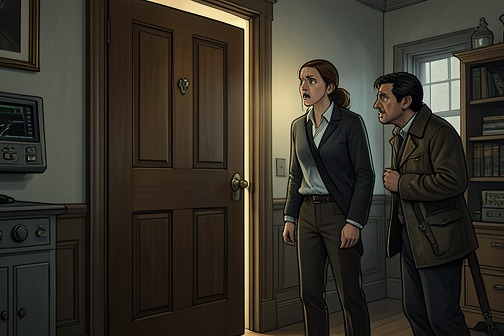
[Edgar goes to Nick’s home to look for Stella](entity:event-recall-event-edgar-nick-stella-73b908e9064a) is a tense encounter in which a locked door briefly separates Stella and [Nick](entity:character-recall-character-nick-71bd8d1fa63d) from the man pursuing her. The episode turns on uncertainty: Edgar has found their hiding place, but no one knows how he entered the building or whether he is still outside. When he finally leaves, Stella and Nick flee together, carrying the danger into another temporary refuge.
## Background and Approach
At dawn, Stella and Nick are awakened by the sound of someone turning the door handle. The front door is locked, and they never learn exactly how Edgar got into the building. Their inability to account for his presence gives the first moments their force: the barrier is real, but it does not make them feel secure. They sit up and stare at the door in horror.
Edgar calls for Nick to open it. His voice terrifies Stella, not least because it is still the strange, artificial accent she associates with the other version of him. Nick looks wildly at her and shakes his head. In the gloom, she can read the terror in his face. Edgar’s manner of address is almost companionable, but the reassurance that he will not hurt Nick does not dispel the threat; he is at the door looking for Stella, and the locked entrance has become the only boundary between them.
## The Doorway Standoff
When Edgar asks, “She’s in there, isn’t she?” Nick is paralyzed. Stella understands that even answering him would give Edgar an opening, so she silently signals Nick not to speak. She crosses the room, sits on the arm of his chair, covers his mouth with one hand, and grips his wrist with the other. Her response is physical and immediate: she tries to prevent a conversation that might expose them or draw Edgar further into the encounter.
Edgar calls again and thumps the door once, hard. Nick nearly jumps from the chair. Stella kisses him, and his hand creeps beneath her open dressing gown to touch her thigh. The moment is not simply a calculated distraction: Stella, too, becomes aroused by the situation as well as by Nick’s touch. But when his hand moves higher, she pushes it away. Her attempt to keep Nick silent has brought them into an intimacy that she does not allow to continue.
The silence outside leaves the danger unresolved. Stella listens at the door but hears nothing; Nick has slumped into the armchair and turned gray. She draws the curtain back only a fraction and sees Edgar emerge from somewhere along the side of the building. His walk now appears gangling and ill-coordinated. Stella says nothing to call him back, though the effort of letting him walk away costs her. She turns from the window to face Nick, who is slumped and shattered. Only then does she tell him that Edgar is gone.
## Flight and Temporary Shelter
Stella and Nick move out within the hour, slipping through a side door with one suitcase each while the street is nearly deserted. They pass two loud men in evening clothes looking for a cab. Stella has only her high heels and stumbles as she tries to keep up with Nick, who is still badly frightened. He takes her suitcase; she clings to his arm. Together they board a westbound bus, leaving [Southwark](entity:location-recall-location-southwark-1b8d7f8e417b) behind.
The bus carries them among sleepy passengers occupied with newspapers and their own ill humour. Stella and Nick draw little attention: she is a bruised woman in a raincoat, he a tall, shabby, nervous man. After several minutes they get off, and Nick says he knows where they are. He leads her through a side street to a run-down square of large Georgian houses surrounding brown grass, a single tree, and a fence. Their hotel occupies a house indistinguishable from its neighbours. A tired woman takes them up two flights of cheap carpeted stairs to a room overlooking a high brick wall topped with glass shards and an alley lined with dustbins, washing lines, and cats.
## Consequences and Significance
The flight removes Stella and Nick from the immediate confrontation, but it does not offer security. Stella later describes the two days with Nick as the grimmest yet. The account she retains is fragmentary, but pointed: he is unclean, messy when eating and drinking, considerate and devoted, and constantly watchful. His gaze feels hungry rather than tender, and Stella wonders whether he could rape her. The room’s sagging double bed and weak yellow overhead light make the surroundings, and the people in them, seem uglier to her; she spends hours lying there worrying about Edgar.
The encounter therefore leads not to a stable escape but to a new, compromised hiding place. Stella fears that Edgar is now too disturbed to avoid attracting attention and may do something stupid. At the same time, the hotel gives her reason to fear the man accompanying her. The locked door, the silent signals, the brief kiss, and the hurried departure mark a passage from immediate pursuit into an uneasy refuge, where danger has changed form rather than ended.
Event 8
Police find Stella at Horsey Street

[Police find Stella at Horsey Street](entity:event-recall-event-stella-horsey-street-c71b3f64ec81) at a turning point in her flight: she has stopped hiding from Edgar, but returning to the loft brings her into police hands instead. The encounter ends her immediate wandering and leads to a reunion with Max, though Stella is too depleted to take an active part in the questioning that follows.
## The Decision to Return
After another unhappy night, Stella leaves [Nick](entity:character-recall-character-nick-71bd8d1fa63d) and wanders the streets, indifferent to her open coat, the cigarette in her fingers, or whether anyone notices her. She feels insubstantial, like a ghost, but makes a decision: it suddenly seems absurd to be running and hiding from Edgar rather than from [the hospital](entity:location-recall-location-the-hospital-6035d1cc8f6a) authorities. In the rain, she takes a bus as far as Blackfriars and walks on to [Horsey Street](entity:location-recall-location-horsey-street-585673aea40b).
The return is not a confident approach. Boys stop their game to watch her turn into the alley, and their silent scrutiny does nothing to ease her dread. As she reaches the passage into the building, she falters more than once and thinks she cannot continue. The children follow her into the yard and remain there, still watching; their attention points to what she has not yet seen at the top of the stairs.
## Found at the Loft
The loft door is open, and men are inside. Stella starts back down, but one of them has already seen her. He catches up halfway down the stairs and recognizes her as Mrs. Raphael. She does not recognize him and has never seen him before. His call brings two more men to the stairs, and they share his surprise at finding her there.
They lead Stella back up to the loft. Edgar is not there, and the men do not appear to know where he has gone. Once they establish that Stella cannot tell them his whereabouts, they do not question her immediately at the loft. She later says she was grateful they did not handle her roughly; the narrator judges that surprise, rather than aggression, shaped their response to her unexpected appearance.
## At the Police Station
The next hours remain unreal in Stella’s memory. At a police station, a woman in uniform gives her a cup of tea. About an hour later, Max arrives. He and the police appear to adopt a gentle approach, treating Stella as a victim who has been seduced, manipulated, and abandoned by Edgar.
Stella tries to remain calm and cool, but she cannot sustain the effort. Before Max can speak, she is in his arms, clutching him tightly. She has been weak, alone, and desperate, and accepts the comfort of his touch without caring that it is the touch of a doctor and psychiatrist. For the moment, the need to be cared for outweighs the distinction between Max’s professional role and his place as her husband.
## Passivity and Aftermath
Stella’s embrace does not settle what the reunion means. Later, the doctor recedes and the husband advances, and the account marks the beginning of a new nightmare. In the meantime she goes limp, becoming passive and pliant like a child or a sick person. She answers questions while those around her frown and murmur to one another, but makes no effort to understand their discussion or participate in decisions about her.
The discovery therefore brings Stella out of hiding without restoring her agency. She has chosen to return to Horsey Street, yet the open loft, the police station, and Max’s arrival turn that choice into a sequence managed by others. Her immediate refuge is care itself: she wants to be looked after, even as the gentle reception gives way to a more painful reckoning with her husband.
Event 9
Max is dismissed by the hospital
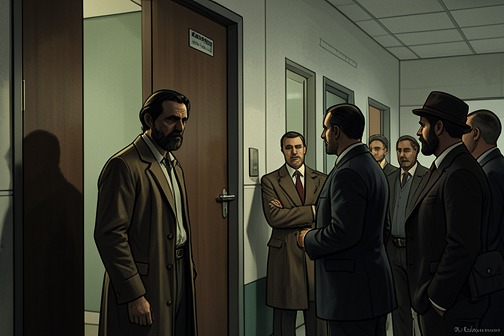
[Max is dismissed by the hospital](entity:event-recall-event-max-500c0ba23180) after [Stella Raphael](entity:character-recall-character-stella-raphael-eef4e55d673c) leaves with [Edgar Stark](entity:character-recall-character-edgar-stark-4c0e760bb2ef), turning a private catastrophe into an institutional scandal. [Jack Straffen](entity:character-recall-character-jack-straffen-c535305f92b8)’s decision removes Max from the deputy superintendent’s post because [the hospital](entity:location-recall-location-the-hospital-6035d1cc8f6a) regards his wife’s flight with an absconding patient as a liability to its mission.
## Background and the escape
[Max Raphael](entity:character-recall-character-max-raphael-4221b1f25955) had come to the hospital as deputy superintendent after impressing Jack Straffen in his interview. [Peter Cleave](entity:character-recall-character-peter-cleave-800f090e5315) had advised against appointing him, but Jack offered him the job, and the Raphaels arrived in the summer of [1959](entity:time-recall-time-1959-43ffb2b0d1c1), shortly after the Mental Health Act had passed. Max was a competent administrator, though Peter considered him reserved, melancholy, weak, and lacking in imagination.
The circumstances surrounding Edgar Stark’s escape made Max’s position especially exposed. Edgar had been held for five years because, despite otherwise recovering his sanity, he remained convinced that [Ruth Stark](entity:character-recall-character-ruth-stark-9160d92f6b38)’s supposed infidelity had justified her murder. Assigned to work in the Raphaels’ garden, he escaped wearing [Max’s clothes](entity:object-recall-object-max-109dc35e473d), which he had hidden in the woods at the end of the garden. The hospital’s reconstruction was that he slipped away from a work party and made his way to [London](entity:location-recall-location-london-420923d4a60a).
The alarm was not raised as soon as Edgar’s absence could have been discovered. Max spent nearly three hours trying to get to the bottom of what had happened before speaking to Jack; by then [John Archer](entity:character-recall-character-john-archer-bb6f696f7d45) had found that his patient was missing. When Max finally called, Peter was already with Jack, who knew of the escape. Max also had to disclose that Edgar was wearing his clothes, a fact the account presents as a source of humiliation and as part of the explanation for Max’s conduct that afternoon.
## The dismissal
In a conversation with Stella, Max told her that Jack had fired him. He described himself as finished and identified the reason the hospital considered him an embarrassment: his wife had run away with an absconding patient, making him a liability. Jack’s stated concern was institutional rather than simply personal; he believed that keeping Max on the staff would compromise the hospital’s mission.
The exchange gives the dismissal a stark domestic setting. Stella asked what Max would do, but he did not answer immediately; after his account of the firing, she turned to the practical matter of a ham. The shift from professional ruin to household routine sets the scale of the loss against the everyday life that continues around it, without suggesting that the dismissal has been resolved or accepted.
## Consequences and significance
The firing establishes that the consequences of Stella’s flight extend beyond her marriage: Max loses his position because the hospital treats the affair and the escape as a threat to its standing and work. Edgar’s use of Max’s clothes binds the escape directly to the deputy superintendent, while Stella’s departure makes that association public within the institution. The decision thus converts a chain of personal and security failures into a question of institutional credibility.
The episode also exposes the limits of Max’s authority within the hospital. Although he had been appointed to an administrative role, Jack determines whether he can remain on the staff. Max’s delayed report and the humiliating detail of the stolen clothes form the immediate backdrop, but the reason given for his dismissal is the liability created by Stella’s flight with Edgar. The event marks a decisive change in Max’s status: he is no longer the hospital’s deputy superintendent, but the man whose family crisis has become an institutional embarrassment.
Event 10
The Raphael family moves to Plas Mold
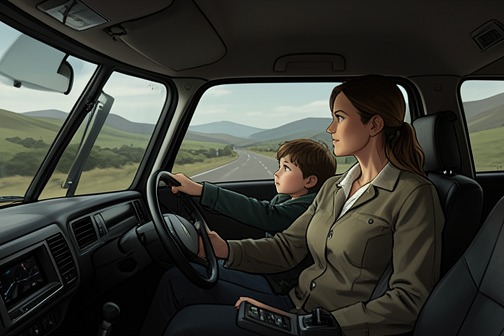
[The Raphael family moves to Plas Mold](entity:event-recall-event-raphael-plas-mold-7d50a3e6204b) after [Stella Raphael](entity:character-recall-character-stella-raphael-eef4e55d673c)’s affair with [Edgar Stark](entity:character-recall-character-edgar-stark-4c0e760bb2ef) has compromised the family’s life at [the hospital](entity:location-recall-location-the-hospital-6035d1cc8f6a) estate. The journey changes their address, not Stella’s allegiance: as [Max Raphael](entity:character-recall-character-max-raphael-4221b1f25955) drives north with Stella and their ten-year-old son, [Charlie](entity:character-recall-character-charlie-24c3a7bd9408), she mourns the possibility that Edgar will no longer know where to reach her. The move is both a forced family departure and a measure of how little distance can separate Stella from the love story she continues to imagine.
## Causes and the decision to leave
Stella and Max had come to the hospital estate in the summer of [1959](entity:time-recall-time-1959-43ffb2b0d1c1), when Max took up the deputy superintendent’s post. A forensic psychiatrist, he had applied while the family was living in [London](entity:location-recall-location-london-420923d4a60a); the superintendent, [Jack Straffen](entity:character-recall-character-jack-straffen-c535305f92b8), offered him the position despite [Peter Cleave](entity:character-recall-character-peter-cleave-800f090e5315)’s reservations. The move to [Plas Mold](entity:location-recall-location-plas-mold-24408ae88f90) comes after Stella’s actions have damaged Max’s standing. At his farewell, Jack offers him sherry and sympathy, while Cleave observes that Max had wanted Jack’s job and might have secured it if Stella had not so decisively undermined him. Colleagues have begun to question Max’s judgment because he married a woman capable of what Stella has done. Cleave nonetheless encourages them to keep an open mind, even as he agrees that Jack is right to let Max go from such a sensitive institution.
The family’s departure is imminent: Stella wanders through the empty rooms, recalling the summer, and understands that within a week they will be in Wales and she will never see this house again. Max has found a rental rather than a home of their own: one half of a large farmhouse, with the owner and his wife in the other. He describes a hillside setting overlooking a valley, without a real garden but with fields, woods, and a quarry nearby. Charlie listens closely, wanting to believe that the new place will be better.
## Departure and the journey north
It rains on the morning they leave. The removal men have already taken the furniture and packed possessions away in a huge black van, leaving labeled boxes and crates behind. Stella and Charlie watch the men drive off while Max locks up. The family drives to the Main Gate, hands in the keys, and leaves the estate for the last time.
The journey takes several hours. Charlie sits in front with Max, who is driving, and is more interested in the scenery than Stella is. She is glad they still have their comfortable car, but somewhere north of Birmingham her thoughts turn to Edgar: she worries that, when he comes looking for her, no one will know where she has gone or be able to direct him. Max watches her in the rearview mirror. Stella reads his attention as vigilance, waiting for a sign that she remains emotionally elsewhere and unrepentant; she cries, and her thoughts turn in anger toward Edgar for leaving her to make this journey without him.
Max turns his attention to Charlie, talking with him at length. When Stella begins listening again, she is less interested in their conversation than in the way Max is shaping the boy’s thoughts and drawing him beyond her influence. She wonders whether this is because Max considers her an unfit mother or because he wants to punish her, and suspects the latter. The journey thus carries a second separation: Stella fears losing Edgar’s trail while also sensing that her bond with Charlie is being altered in her absence.
## Arrival at Plas Mold
The family reaches the area after dark and spends the night in town, planning to meet the removal men at the farmhouse the next morning. When they arrive, the gate bears the name Plas Mold. The removal van is already in the yard, its tailboard down, with the men waiting nearby. In the wind and the smell of manure, Stella remains in the car while Max and Charlie greet a lean man in a tweed jacket, who produces the keys. They unlock the back door and go inside; a dog barks somewhere behind the house as the removal men begin unloading the boxes.
Max returns to invite Stella in, apparently confident she will like the place. She cannot decide whether the large gray house will shelter her. The arrival offers a practical beginning—keys, rooms, belongings being carried in—but does not resolve the question that has occupied her throughout the drive: whether Edgar can find her. The family has reached its new home; Stella’s attention remains fixed on the possibility of reunion.
## Significance of the move
The move relocates the family from the institution’s grounds to a rural household, but it does not restore their former domestic unity. The farmhouse is divided between the Raphaels and its owners, and the surroundings Max describes promise open country rather than a private garden. Stella’s uncertainty about whether the house will protect her gives the new address an unsettled meaning: it may offer shelter, yet it is also the place to which she fears Edgar cannot follow.
The journey brings the family’s conflicting attachments into the same confined space. Max drives and watches Stella; Charlie looks outward at the scenery; Stella looks inward toward the absent Edgar and watches Max influence their son. Their arrival therefore marks a physical break with the hospital estate without a corresponding emotional break from the summer’s events. The move changes where the Raphaels live, but Stella’s imagined connection to Edgar travels with her.
Event 11
Charlie’s drowning at the pool on Cledwyn Heath
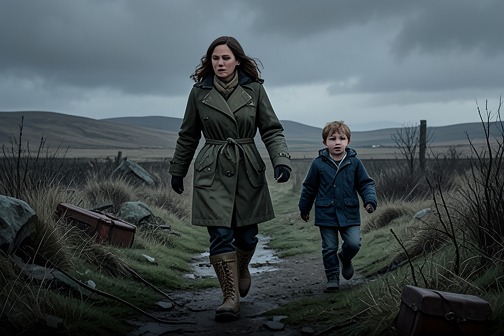
[Charlie’s drowning at the pool on Cledwyn Heath](entity:event-recall-event-charlie-cledwyn-heath-3bfb6e7a1c42) is the turning point at which [Stella Raphael](entity:character-recall-character-stella-raphael-eef4e55d673c)’s private psychological collapse becomes an irreversible public and legal crisis. As [Charlie](entity:character-recall-character-charlie-24c3a7bd9408) struggled in the water, Stella remained motionless, smoking; [Hugh Griffin](entity:character-recall-character-hugh-griffin-06aa4a793e83) reached him only after he had seen the scene from the hill. Charlie’s death, and the question of why his mother had not acted, transformed the family’s loss into an accusation against Stella.
## The outing and the approach to the pool
The day began with Stella already struggling. She had tramped through bleak, open country in Wellington boots, a belted raincoat and a scarf tied beneath her chin. Charlie walked ahead with his satchel bouncing against his back, repeatedly turning to check that she was keeping up. The contrast between his alert pleasure and her sense of encroaching blackness made the walk difficult for her before they reached the water. At the sight of the sea she was fighting an impulse to sink to the ground and not get up; [Max Raphael](entity:character-recall-character-max-raphael-4221b1f25955) tried to talk to her, but she felt beyond conversation.
At the picnic site, the adults gathered around Hugh Griffin, pouring tea from thermos flasks, while children formed noisy groups. A gust blew a map from the rocks. Stella moved away from the gathering, and Charlie came beside her, eating his sandwiches. When he asked whether she was hungry, she shook her head; when he asked if she wanted to see what lay beyond the hill, she agreed. They went out of sight of the others. Charlie descended the steep slope to a pool with weeds thick in its shallows, and Stella followed, then sat some distance back as rain began to fall.
## The drowning
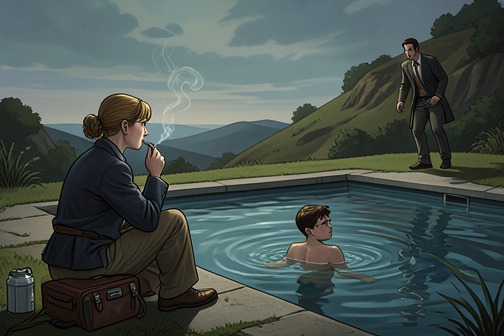
Charlie called out that he thought there were newts. Stella bent her head to her knees and covered her face as another wave of blackness swept through her. The ground seemed to move beneath her; when she looked up, the pool and Charlie appeared distant and indistinct, as though seen through a veil. She took out a cigarette and lit it, cupping her hand around the lighter. Charlie tried to catch something in the shallows. When he seized it, he lost his balance and fell into deeper water.
As Charlie struggled to get upright, flailing and shouting, Stella stood in the gusting rain. The account emphasizes the controlled repetition of her movements: she turned her head away, brought the cigarette to her lips, inhaled, and turned back. She dimly saw Charlie’s head break the surface and an arm claw at the air before both went under again. Rather than call for help or enter the water, she again turned aside to smoke. Her actions are presented not as a sudden attempt to intervene that failed, but as a series of separate, rigid gestures while the child remained in danger.
Hugh Griffin appeared at the brow of the hill behind her. Stella did not see him arrive or hear his shout. She became aware of him only as he ran past her through the rain and plunged into the pool, still calling out. He brought Charlie out in his arms and laid him on the ground, trying to revive him. The other adults came running over the hill. The children were taken back to the bus, the police were called, and Stella was largely overlooked amid the confusion. Someone gave her tea and put a rug around her shoulders, describing her as being in shock. After the bus left, police arrived; at the station Max collected her, and after more tea he drove her home, gave her a pill, and she went to bed.
## From shock to accusation
Stella slept through the following day. At the kitchen table, she and [Mair](entity:character-recall-character-mair-32de1a9f2963) sat in silence while the rain continued; Mair eventually called what had happened terrible. But sympathy for Stella did not last. In the days that followed, Hugh insisted that when he came over the hill, Charlie had been screaming in the water while Stella stood smoking and made no attempt to help. He also argued that an alarm from Stella might have saved the boy, although that claim was later disputed because of the distance from the hilltop to the pool.
The account distinguishes that disputed question of whether Charlie could have been saved from the community’s deeper horror at Stella’s stillness. Once people understood that she had not shouted or moved, they recast her as a mother who had watched her child drown without trying to rescue him. Their explanations narrowed to two possibilities: she was monstrous, or she was mad. The event thus produced not only grief but a public judgment about what a mother’s response ought to be, with Stella’s failure to conform to that expectation treated as evidence against her humanity.
## Police custody and the event’s aftermath
At the police station Stella was asked why she had not shouted when she saw Charlie in trouble, but she had no answer. The authorities moved toward charging her with manslaughter and remanded her. She was placed in a cell once more, questioned repeatedly, and moved from room to room without giving the answers people wanted. The narrative describes her as numb, empty and detached from the woman being questioned: she watched herself endure the days both from within a barricaded place in her psyche and, seemingly, from a point above and to one side of herself.
That description places the drowning at the junction of an observable act and an inward absence. Stella’s smoking and repeated turning away are concrete actions witnessed by Hugh; the black waves, distorted sight and later detachment convey the experience through which the scene is rendered from her perspective. The text does not settle the disputed claim that an earlier alarm would have saved Charlie, nor does it erase the fact that Stella did not act. Instead, the drowning leaves both realities exposed: Charlie is dead, and Stella’s inability to explain her conduct becomes part of the calamity. When [Peter Cleave](entity:character-recall-character-peter-cleave-800f090e5315) came to see her, she had not expected him, and his arrival prompted the first faint stirring of emotion she had felt in days.
Event 12
Stella is remanded and admitted to hospital after Charlie’s death
[Stella is remanded and admitted to hospital after Charlie’s death](entity:event-recall-event-stella-charlie-7f265bce4884) marks the conversion of a family tragedy into a criminal and psychiatric case. After [Charlie Raphael](entity:character-recall-character-charlie-raphael-eb26d3a0bf2d) drowns, witnesses interpret [Stella Raphael](entity:character-recall-character-stella-raphael-eef4e55d673c)’s failure to call for help as evidence of unnatural indifference; she is remanded on a manslaughter charge. [Peter Cleave](entity:character-recall-character-peter-cleave-800f090e5315) intervenes to bring her to [the hospital](entity:location-recall-location-the-hospital-6035d1cc8f6a) where she had once lived, offering treatment that she accepts. Her return is both a practical act of care and an exercise of institutional power: she enters in police custody, through the female wing rather than the Main Gate, and is immediately subject to the hospital’s routines and classifications.
## The drowning and the public accusation
During a family outing, Stella follows [Charlie](entity:character-recall-character-charlie-24c3a7bd9408) away from the picnic party to a pool below a hill. She sits some distance back while he explores the shallows. As a dissociative episode overtakes her, she experiences the landscape as distorted and distant. Charlie loses his balance and struggles in deeper water; she watches, repeatedly turning away to smoke. When [Hugh Griffin](entity:character-recall-character-hugh-griffin-06aa4a793e83) comes over the hill, Charlie is in the water and Stella has made no sound or moved to help him.
The account of what might have happened next is contested. Hugh insists that an alarm from Stella might have saved Charlie, but this claim is later disputed because of the distance between the hilltop and the water. The public response, however, turns less on that question than on her stillness. Once people understand that she watched her child drown without calling out, sympathy gives way to horror. She is recast as a mother who did nothing, and the available explanations narrow to monstrosity or madness. In the police station, when asked why she did not shout, she has no answer.
In the days that follow, Stella is repeatedly questioned and remains numb, empty, and detached from the woman being moved from room to room. The narration presents this detachment as an experience of separation from herself: she watches her ordeal from within a psychic refuge and, seemingly, from a point above and beside her body. The inability to give the explanation others demand is therefore not resolved by interrogation. It becomes part of the crisis that makes psychiatric treatment seem necessary to Cleave, even as the charge of manslaughter keeps the event within the law’s reach.
## From remand to treatment
Cleave tells Stella that she is going to a hospital because she has been ill and he wants to treat her. He asks whether she wants him to do so; she answers affirmatively and identifies the hospital he means. He then tells her that she will come there and that he will look after her. His decision is not presented as a neutral referral. He believes himself best qualified to treat her and acknowledges that bringing her back under these circumstances could seem unorthodox or dangerous, but he has the position to make it happen.
The decision also places the doctor and patient in a complicated relationship. Cleave warns Stella that [Max Raphael](entity:character-recall-character-max-raphael-4221b1f25955) will visit. She pleads not to be made to go through with the meeting, but Cleave insists, telling her to trust him and presenting the visit as being for Max as well as for her. His intervention is thus protective in intention but directive in practice: Stella agrees to treatment, yet does not control every condition of her return or the encounters that follow.
The day after their conversation, Stella is driven to the hospital in a police car. She passes her former home and enters not through the Main Gate but through the gate of the female wing. At the admissions room behind the front office, police hand her paperwork to Cleave. He conducts a brief formal interview, then accompanies her with Mary Flynn, a young female attendant, to the admissions ward. Stella brings three suitcases, saying that she needs only a few essentials; Cleave notices that she has packed most of her evening clothes, including [Stella’s black silk evening dress](entity:object-recall-object-stella-s-black-silk-ev-624ffd9573f3).
Admission makes the change in her status tangible. In a communal bathroom, Stella undresses, is bathed in a cubicle, and receives a thorough physical examination. She is given a cotton shift and escorted to a room with a barred window, a toilet, and a basin; the door has a barred grate. The sequence carries her from police custody into hospital confinement through a formal chain of handover, interview, examination, and placement. Her return to familiar grounds is not a homecoming: she crosses a different gate and is assigned a room whose fixtures make confinement visible.
## Clinical explanation and institutional life
Cleave frames the drowning through two clinical interpretations that he distinguishes in emphasis. He describes the circumstances of Charlie’s death as comparatively straightforward within the literature on maternal filicide, which he says often understands such acts as an extended suicide. In Stella’s case, he adds his own interpretation: hostility toward Charlie’s father was projected onto the child, a pattern he calls a [Medea complex](entity:state-recall-state-medea-complex-b001af9b2424). These are Cleave’s explanatory claims, not an account Stella herself can give at admission. He considers her relationship with [Edgar Stark](entity:character-recall-character-edgar-stark-4c0e760bb2ef) more clinically intriguing and believes that, at the moment of crisis, what she saw in the water was Edgar rather than Charlie or Max.
That interpretation helps explain why Cleave wants to treat her, but it also reveals the limits and authority of his perspective. He regards recovery as guidance through an intense period of suffering and guilt, followed by acceptance and integration of the trauma into memory and identity. He anticipates that Stella will resist him and relishes the prospect of removing her defenses. The patient’s silence and distress are therefore read through a psychiatrist’s framework, while the legal process has already assigned the event a different frame: a child is dead, and Stella is under remand for manslaughter.
The female wing is not merely a destination but a regulated environment with its own gradations of freedom. Its two blocks have enclosed yards with flower beds, lawns, and benches; patients with parole privileges may walk among the gardens and down the terrace steps, while an internal wall separates the women from the men. Stella initially enters the admissions ward, where the rules and restrictions are more immediate. Later, after she learns to sustain a composed manner, she is moved downstairs. From the patient’s perspective, the distinction rewards the appearance of accepting confinement without visible distress; in Cleave’s account, the self-control needed to do this is also a first step toward recovery. Downstairs brings greater privacy and freedom of movement, and patients may wear their own clothes. Stella’s transfer thus changes not only her surroundings but also the kind of conduct the institution recognizes as improvement.
## Consequences and delayed grief
The admission does not settle what Stella’s silence means. Cleave predicts that the shock will wear off and guilt will follow, potentially so intensely that she may attempt suicide. During a later hospital meeting, Max tells her that he expects her eventually to come to terms with what she has done, and she attacks him, throwing her lighter and trying to reach his face. The episode shows that placement in treatment does not immediately bring calm or reconciliation; the hospital contains conflict as well as care.
As her conduct becomes more controlled, Stella reports headaches after terrifying dreams. She wakes in panic with images that soon vanish, but a sound remains: screaming. She tries to dismiss the dreams and asks only for aspirin. Cleave interprets the screaming as the first return of guilt and specifically as the voice of a drowning child. He believes that she has begun to let go of Edgar and confront Charlie’s death. This is his clinical reading of a delayed and fragmentary experience, not an explanation Stella initially articulates herself.
The event consequently establishes a lasting tension between public judgment, legal responsibility, and psychiatric interpretation. The community’s account fixes on a mother’s apparent failure to act; the police remand her; Cleave treats her as ill and seeks to guide her through trauma. The hospital offers structured care while also imposing observation, confinement, and behavioral tests. Stella’s admission begins no simple passage from guilt to recovery: it places her inside a system that must interpret her silence, while the grief that cannot yet be spoken returns later in dreams and screams.
Event 13
Edgar is arrested in Chester
[Edgar Stark](entity:character-recall-character-edgar-stark-4c0e760bb2ef)’s arrest in [Chester](entity:location-recall-location-ae0bc1ab008e) turns a distant fear into a final barrier between him and [Stella Raphael](entity:character-recall-character-stella-raphael-eef4e55d673c). After a long silence about Edgar’s whereabouts, a reliable sighting near Euston Station suggests that he may be travelling north toward Stella and [Max Raphael](entity:character-recall-character-max-raphael-4221b1f25955)’s home in [Cledwyn](entity:location-recall-location-cledwyn-23276e6fadac). His arrest removes the imagined possibility of flight: for Stella, Edgar is no longer a fugitive she might join, but a man in custody only twelve miles away.
## Background and the Sighting
For a time, [Peter Cleave](entity:character-recall-character-peter-cleave-800f090e5315) has no news of Edgar and fears that he may be dead. The eventual sighting near Euston Station brings relief, but it also raises the possibility that Edgar has discovered where Stella and Max are living. The direction of travel matters: Euston suggests that he may be heading north, perhaps toward Cledwyn, though Peter and Max can only guess what he intends to do.
Peter calls Max with the news and tells him that the police are making security arrangements. Max is somewhat reassured, but remains worried. Peter does not conceal his own unease. The arrest follows this period of uncertainty, when Edgar’s whereabouts are unknown and the possibility of his approach has already made the family’s safety a concern. The account gives no details of the arrest itself; its significance emerges through the reports that reach Peter, Max, and Stella.
## Arrest and Delayed Disclosure
Max does not tell Stella immediately that Edgar has been arrested. The news has been kept from her throughout the day, and it comes out only after a domestic confrontation. Max and Stella stand glaring at one another on the stairs. [Charlie Raphael](entity:character-recall-character-charlie-raphael-eb26d3a0bf2d) appears on the landing, rubbing his eyes and frowning; Stella tries to deflect the moment by telling him that his father is pretending to be a fool. Max takes [Charlie](entity:character-recall-character-charlie-24c3a7bd9408) back upstairs, then returns to the kitchen and bluntly tells Stella what he has withheld: Edgar was picked up that morning in Chester and is being held there.
The arrest is therefore delivered not as a public report or a direct encounter with Edgar, but as news disclosed inside an already strained household. Max’s delay shapes Stella’s first response. Over the next days she buries her reaction to Edgar’s custody and redirects her feelings into anger at being displayed before [Brenda](entity:character-recall-character-brenda-e39cbd8c0058) as proof of her mental health, so that Brenda will resume giving Max money. The revelation enters a domestic life already marked by concealment, conflict, and pressure.
## Proximity and the End of Escape
The news that Edgar is in Chester gives the arrest a particular force: he is twelve miles away. Stella registers the distance alongside the fact that he is in police custody. He is close enough for his presence to feel immediate, yet custody makes escape with him impossible. The contrast extinguishes the fantasy she has been sustaining. What had been imagined as a possible flight collapses when the person at its centre is held by the police.
That collapse is not presented as relief. Stella’s hope of escape had formed an entire structure in her mind; the arrest brings it down at once. The news does not simply postpone a reunion or introduce a new obstacle. It closes off the future she had imagined with Edgar, leaving her without the fantasy that had helped her endure her circumstances. The narrative identifies this moment as the point at which her condition sinks into clinical depression proper.
## Consequences in the Household
In the days after the arrest, the family’s routines continue, but they do not restore intimacy. Stella and Max have been having such ferocious rows that Max apparently believes their marriage has no future. He abandons the detached psychiatric perspective he had tried to adopt and attempts to talk to her about separation; Stella refuses to listen and walks out of the room. His warning that the situation will not go away makes their rupture explicit, while the arrest has already removed the escape Stella had wanted.
The household’s strained quiet carries the consequences forward. Stella is holding on by her fingertips, with waves of despair arriving without warning. She pushes herself through making beds, doing laundry, and cooking dinner, not for the family but to preserve her own sanity. At evening meals, the family sits in silence; afterward Max and Charlie may walk if the weather is dry, while Stella clears the dishes, has another drink, and watches the light fade. She measures success by reaching the end of a day without going mad, not by any future she can desire. Edgar’s arrest is thus a decisive reversal: it ends the fantasy of escape and leaves Stella struggling to endure the ordinary days that follow.
Event 14
Edgar Stark murders Ruth Stark
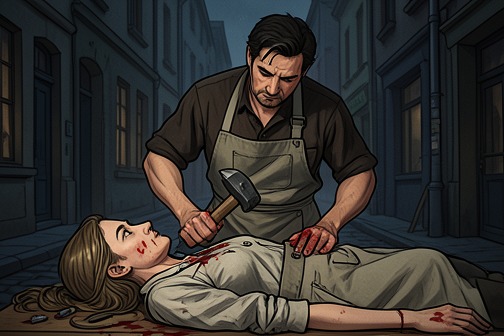
[Edgar Stark’s murder of Ruth Stark](entity:action-recall-action-edgar-stark-s-murder-o-0bf941e9ee2f) turns his delusions of infidelity into lethal violence and becomes the crime that shapes his confinement and the story’s later crises.
## Background and the killing
Edgar was a working sculptor; Ruth modeled for him and often supported him financially. About a year before the murder, he became convinced that she was having an affair. His accusations were wild and violent, and the marriage deteriorated until Ruth threatened to leave. One night, after the couple had been drinking, a terrible quarrel ended with Edgar killing her with a hammer. Her screams were heard along the street, but no one came to help. The violence after her death further indicated the severity of his disturbance.
## Clinical and legal aftermath
Edgar arrived at [the hospital](entity:location-recall-location-the-hospital-6035d1cc8f6a) in profound shock. His doctor expected grief and guilt to emerge as he recovered, but neither appeared: after a few weeks he regained his equilibrium and took part in hospital activities. His outward recovery did not resolve the central concern. Although highly intelligent, he showed no insight into why he had killed Ruth, and remained convinced that the murder had been justified.
The evidence Edgar offered for Ruth’s supposed infidelity consisted of ordinary domestic details: a flushing toilet, a stain on the floor, and a box of washing powder on a windowsill. He gave these occurrences extravagant meanings, yet would not relinquish his conclusion. He regretted drinking so much and acknowledged that the killing should not have happened, but blamed Ruth’s alleged taunts and insults. Because this belief remained fixed despite his otherwise apparent recovery, the hospital staff considered him unfit for release; after five years in the hospital, his doctor expected him to remain for years longer.
At Edgar’s trial, two psychiatrists testified that he suffered from paranoid psychosis, and the court accepted the insanity defense. His doctor admitted him to the hospital the following day. The legal finding and the clinical decision addressed different questions: the court accepted that illness bore on his criminal responsibility, while the hospital still had to judge whether his continuing delusion made release unsafe. Once Edgar’s case returned to public attention, the press questioned why a man who had killed his wife was allowed to work in the hospital gardens on a daily basis.
## The murder’s later echo
Years later, the murder remained more than the origin of Edgar’s confinement: it offered a brutal measure of the danger surrounding Stella. When [Peter Cleave](entity:character-recall-character-peter-cleave-800f090e5315) confronted Edgar, he recalled that Edgar had placed Ruth’s severed head on his sculpture stand and worked it with his tools as if it were clay. The disfigurement destroyed the likeness, leaving the teeth and clumps of hair as signs of what the object had been. Cleave’s thought that it could have been Stella, and nearly was, connects the earlier crime to the violence implicit in Edgar’s later attachment to her.
Edgar’s response to Stella was not transparent even to the doctor who controlled his fate. He spoke of her with contempt, but Cleave considered it possible that Edgar still loved her, or wanted to replace Cleave’s image of her with one of his own. The murder thus shadows the later conflict without resolving what Edgar felt: the same man who had treated Ruth’s body as material for his work could make love and hatred difficult to distinguish. For Cleave, that unresolved mixture turned the crime into an ongoing clinical and personal warning, not a closed episode.
## Obsession and projection
The murder also acquires a disturbing echo in Peter Cleave’s later account of Stella’s grief after [Charlie’s drowning](entity:event-recall-event-a4f8ffb80dc6). Cleave distinguishes the immediate clinical explanation of her failure to save her son from her fixation on Edgar: in the water, he argues, she saw Edgar, not [Charlie](entity:character-recall-character-charlie-24c3a7bd9408) or Max. Set beside Edgar’s conviction that ordinary household details proved Ruth’s infidelity, this interpretation links the two crises through distorted perception without making them equivalent. The murder establishes the lethal consequences of Edgar’s delusion; its later shadow falls over Stella’s story as Cleave tries to understand how her attachment to Edgar came to overtake what was before her.
Event 15
Stella and Edgar begin their extramarital affair

[Stella and Edgar begin their extramarital affair](entity:event-recall-event-a38ebd0eb8e1) in the summer of [1959](entity:time-recall-time-1959-43ffb2b0d1c1), when a patient assigned to work in her garden becomes the focus of Stella’s attraction and then her lover. The relationship begins within the ordered grounds of [the hospital](entity:location-recall-location-the-hospital-6035d1cc8f6a), but soon extends beyond them; in Stella’s later account, its urgency overwhelms ordinary caution, and its emotional force resists the moral judgments that might have made it easier to understand.
## Setting and Circumstances
Stella is living with her husband, Max, and their ten-year-old son, [Charlie](entity:character-recall-character-charlie-24c3a7bd9408), in the deputy superintendent’s house. Max, a forensic psychiatrist, has recently taken the deputy superintendent’s post. Edgar, a former working sculptor who has been at the hospital for five years, is still considered unsafe to release: he continues to insist that the murder of his wife, Ruth, was justified by her supposed infidelity. His remaining delusion makes the ordinary work assignment in Stella’s garden carry a serious institutional risk.
That summer, groups of parole patients leave the hospital grounds each morning under attendants’ supervision to maintain the estate. Edgar is assigned to the Raphaels’ garden, where he works on restoring the conservatory. Stella sees him when she goes out to pick vegetables or flowers. If the attendant, [John Archer](entity:character-recall-character-john-archer-bb6f696f7d45), is not there, she sits and talks with him. She later acknowledges that she was attracted to Edgar almost from the beginning; although she tries to dismiss the feeling, his regular presence gives her pretexts to seek his company.
## From Acquaintance to Affair
In a later conversation with Peter, Stella is asked when the relationship first became sexual. She identifies the [Vegetable garden](entity:location-recall-location-df536f516cc7). Recalling the scene, she describes the decision not as a calculated risk but as something that seemed impossible to avoid or postpone. The memory returns gradually in the conversation, as if the experience is acquiring shape again; her account presents the encounter as an overwhelming necessity rather than a choice she can readily explain.
Stella also rejects Peter’s suggestion that Edgar may have been using her because he had already planned to abscond. Her answer makes clear that she did not understand their connection as an escape strategy on his part. The affair develops amid the daily routines of the estate, where her visits to the garden and his assigned work bring them repeatedly into contact, even as the possibility of discovery hangs over that contact.
## The Affair Beyond the Hospital Grounds
Looking back, Stella tells Peter that she had desired Edgar with a physical and emotional intensity unlike anything she had experienced before. She recalls the affair both on the hospital estate and during the weeks she was in [London](entity:location-recall-location-london-420923d4a60a) with him. Her account makes the relationship more than a clandestine attachment confined to the garden: it becomes a shared life carried beyond the institution and into the city.
Stella offers no moral condemnation of Edgar when she recounts that he absconded without telling her or that he hit her. When Peter asks why she does not criticize him, she cannot give a reason; the idea of making her love conditional on his conduct simply does not arise for her. This refusal to judge him illuminates the imbalance between the relationship’s intensity for Stella and the harm and instability that accompany it.
## Consequences and Retrospective Meaning
The affair unfolds alongside Edgar’s escape from the hospital. He leaves wearing [Max’s clothes](entity:object-recall-object-max-109dc35e473d), which he has hidden in the woods at the end of the Raphaels’ garden, and makes his way to London. The escape exposes the consequences of the hospital’s lax supervision of outside work parties, while Max’s delay in establishing Edgar’s whereabouts gives the fugitive additional time. The affair is therefore bound to the breach between Stella’s domestic life and Edgar’s life beyond institutional control, though Stella does not recall it as a scheme Edgar devised to facilitate his escape.
Later, after Charlie’s death, Stella tells Peter that the affair is finished. That statement supplies her own decisive endpoint, but it does not turn the relationship into a simple moral lesson: she continues to speak of its intensity without condemning Edgar. In the larger account of her life, the affair is both an escape from the frustrations of her marriage and the beginning of a destructive sequence whose consequences reach far beyond the garden where she remembers it starting.
Event 16
Charlie’s drowning
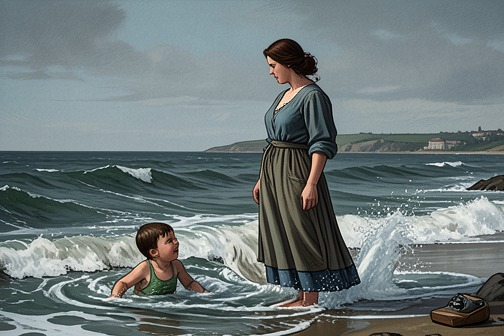
[Charlie Raphael’s drowning](entity:action-recall-action-charlie-raphael-s-drow-4f794b69f36d) is the defining loss in [Stella Raphael](entity:character-recall-character-stella-raphael-eef4e55d673c)’s life and the event around which her later guilt takes shape. She stood by and watched her ten-year-old son drown; the novel does not reconstruct the mechanics of the drowning, but returns to it through Stella’s memories, dreams, and the clinical interpretations made by [Peter Cleave](entity:character-recall-character-peter-cleave-800f090e5315).
## Background and Event
[Charlie](entity:character-recall-character-charlie-24c3a7bd9408) was the ten-year-old son of Stella and [Max Raphael](entity:character-recall-character-max-raphael-4221b1f25955). After his death, Stella was admitted to the psychiatric hospital. Peter later described her as having stood by while her child drowned, making the absence of rescue—not simply the loss itself—the central fact that she had to live with.
Peter regarded the pathology surrounding Charlie’s death as comparatively straightforward. He understood it as an extended suicide: in his account, Stella had wanted to remove the child from a situation she found intolerable, while also projecting onto Charlie the intense hostility she felt toward his father. He called this a classic [Medea complex](entity:state-recall-state-medea-complex-b001af9b2424). These are Peter’s clinical explanations of Stella’s actions, not a scene-by-scene account of what happened at the water.
## The Drowning’s Return in Memory
Charlie’s death returns in a recurring dream that Stella eventually describes to Peter. She tries to defend herself from the memory, but Charlie comes through those defenses. In the dream, he looks back at her with the serious expression and little frown she remembers, and says, “Mummy, can’t you see I’m drowning?” The question makes the past recur as an accusation: Charlie is dead, yet in Stella’s dream he is still calling for the help she did not give.
The dream’s distress extends into the ordinary morning routine of the ward. Stella tells Peter that its first hours are hardest, when she must wash, dress, and walk to the dining room with the other women while maintaining an outward poise. The child’s voice remains with her even as she tries to resume the day. She dreads sleep as a descent toward horror, and the dream’s aftereffect lengthens into the morning.
Stella’s account also has a rhythm of concealment. Peter sees her only after lunch, by which time the voice has faded and she is more composed; she then plays down the distress, while allowing him to recognize that she is doing so. The timing matters: her calmer presentation does not mean the dream has stopped or that its pain has passed. It means that by the time she speaks with him, its most acute hold has eased.
## Clinical Meaning and Aftermath
For Peter, helping Stella recover from Charlie’s death would require guiding her through intense guilt, acceptance of the trauma, and its eventual integration into memory and identity. He distinguishes this work from the more unusual clinical problem he sees in her fixation on [Edgar Stark](entity:character-recall-character-edgar-stark-4c0e760bb2ef). Yet the drowning is not contained by that clinical distinction: Peter interprets Stella’s vision of the child in the water as Edgar, not Charlie or Max, showing how her attachment to Edgar has become entangled with the trauma of her son’s death.
The dream gives the loss a recurring voice, but it offers no reversal: Charlie cannot be brought back, and Stella remains alone with the knowledge of what happened. Peter tells her he cannot restore her son but can try to relieve her suffering. Later, Stella dies by a fatal overdose in [the hospital](entity:location-recall-location-the-hospital-6035d1cc8f6a). The narrative places that death within the broader course of her suffering, without reducing it to a single consequence of [Charlie’s drowning](entity:event-recall-event-a4f8ffb80dc6).
Event 17
Edgar flees the Horsey Street studio and is arrested

[Edgar flees the Horsey Street studio and is arrested](entity:event-recall-event-acba89c7a6dc) is a turning point in [Edgar Stark](entity:character-recall-character-edgar-stark-4c0e760bb2ef)’s pursuit of [Stella Raphael](entity:character-recall-character-stella-raphael-eef4e55d673c): after she leaves the loft, he abandons the work he had made there, evades the police, and vanishes into a fugitive life before being caught on his way to her. The sequence ends not with a reunion but with his return to [the hospital](entity:location-recall-location-the-hospital-6035d1cc8f6a), where [Peter Cleave](entity:character-recall-character-peter-cleave-800f090e5315) still cannot determine whether Edgar meant to take Stella away or kill her.
## Background and Flight
After Stella left [Horsey Street](entity:location-recall-location-horsey-street-585673aea40b), Edgar remained in the loft for three days, working without rest on the head he was making. On the fourth day, an unidentified visitor apparently warned him that the police were coming. Edgar fled with a few clothes and books stuffed into a duffel bag. His departure was timed with bitter irony: the police arrived only a few minutes after he had gone, and Stella appeared at the studio only after they were there.
The studio’s contents were impounded. Among the work left behind were drawings made while Stella was with him and the head itself, objects that drew Peter’s particular interest because they might illuminate Edgar’s state of mind and whereabouts. The artistic work thus remained as a material trace of the relationship even as its maker disappeared.
## Disappearance and Pursuit
After leaving the studio, Edgar disappeared. Peter believed that an underground network of artists and criminals sheltered and fed him in the following weeks. Reports suggested that he moved repeatedly between studios and flats. One report placed him in a remote cottage near the sea in Cornwall; Peter’s own hunch was that Edgar stayed in [London](entity:location-recall-location-london-420923d4a60a), where he knew his way around. These possibilities remain conjectural in Peter’s account rather than a settled itinerary.
Edgar eventually went north to look for Stella. Peter later learned that he had been picked up in [Chester](entity:location-recall-location-ae0bc1ab008e) while on his way to her. The account leaves the purpose of that journey unresolved: Peter had not been able to establish whether Edgar intended to carry Stella off or murder her. His arrest therefore stops the physical pursuit without resolving the danger Peter associates with it.
## Arrest and Return to the Hospital
Edgar was readmitted to the hospital in April. Peter kept him alone in a room on the top ward of the Refractory Block, a placement Peter says was not intended as punishment. He wanted a thorough psychiatric evaluation and a treatment plan before handing Edgar over to a new doctor, but Edgar consistently refused to speak to him.
That silence left Peter with an urgent practical problem and an unresolved personal one. He needed to assess Edgar before his own departure, but he also wanted to know what Edgar now felt toward Stella and why he had tracked her to Chester. In an attempt to provoke a response, Peter eventually told Edgar that he was engaged to Stella, bluntly and without delicacy. Edgar’s flight had ended in custody, but his intentions—and the meaning of his pursuit—remained unsettled.
## Significance
The escape reverses the apparent ending of Stella’s time with Edgar. Her departure from the loft does not end his attachment; instead, it sends him into hiding and then north after her. The near-miss at the studio, where police and Stella arrive only minutes after he has fled, sharpens the separation between them while making his pursuit feel immediate.
The episode also leaves the reader with the limits of Peter’s knowledge. He can describe Edgar’s movements only in fragments, distinguishing reports from his own hunches, and cannot say whether Edgar sought reunion or violence. The later arrest and readmission contain the flight, but do not provide the certainty Peter wants about the man he has treated for years.
Event 18
Peter proposes to Stella
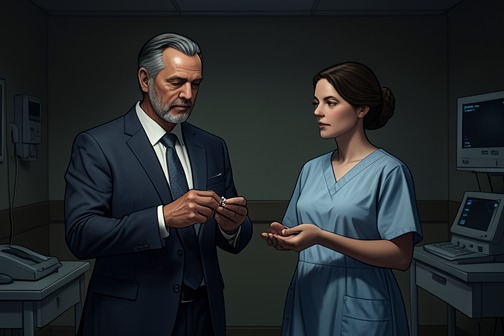
Peter’s proposal to Stella turns the promise of release from hospital into an imagined future of marriage, shared conversation, and domestic safety. What appears to be a hopeful commitment is later recast by Peter himself as part of Stella’s concealment: he comes to believe that she accepted him while remaining passionately attached to [Edgar Stark](entity:character-recall-character-edgar-stark-4c0e760bb2ef).
## Circumstances of the Proposal
By the time Peter considers proposing, Stella is a patient in [the hospital](entity:location-recall-location-the-hospital-6035d1cc8f6a) following the collapse of her family life. She had married [Max Raphael](entity:character-recall-character-max-raphael-4221b1f25955) while still very young, and the marriage had become a strained domestic arrangement; after [Charlie](entity:character-recall-character-charlie-24c3a7bd9408)’s death, she was returned to the institution. Her life outside it had been held together partly by the routines of a household she no longer experienced as a loving family. Inside the hospital, she learned to sustain a composed manner and was transferred from the admissions ward to a less restrictive ward, where patients had greater privacy and freedom of movement.
Stella was approaching discharge. In late May, Peter told her that he expected her to leave in July, and she followed a careful routine while waiting: dressing, visiting the hospital library, and reading in the dayroom. Other patients and staff treated her as someone between patient and free woman. She told them she planned to live in [London](entity:location-recall-location-london-420923d4a60a) with her sister’s family, although Peter notes that none of that family had visited her. Against this provisional future, he privately imagined asking her to live with him after she left the hospital.
Peter’s wish was personal as well as professional. Past sixty and expecting to retire soon, he imagined that Stella would bring light and grace to his quiet house. He thought they shared interests in art, travel, gardening, and books, and pictured a life in which they could talk and he could come to understand her affair with Edgar. He also imagined that she might find comfort and safety with him. His proposal therefore joined care with desire: he wanted to offer her refuge, but also hoped that their closeness might deepen into affection.
## The Proposal and Acceptance
Peter tells Stella that he knows she does not love him, but believes she needs him at that moment; he says he is willing to hope that her affection for him might deepen. Stella responds by describing herself as an injured bird, and Peter answers that he is good with injured birds. When she begins, “If I married you—”, he perceives tenderness in her face and is moved by it. She lays her hand on his and asks when they would marry.
The exchange gives Peter what sounds like a definite answer, but the moment is not uncomplicated. He senses pity in Stella’s earlier silence and suspects that she is not taking his declaration entirely seriously. Her gesture and question nevertheless allow him to believe that she is willing to share the future he has proposed. After calling him “Dear Peter,” she says she would like to return to the ward. The scene thus moves quickly from the intimacy of the proposal back into hospital routine; her acceptance does not dissolve the distance between them or establish what she feels.
Stella’s response also leaves the terms of the proposed marriage open. Peter has spoken of safety and of the possibility that her feelings might change, while she has not declared that she loves him. Her question about timing turns the proposal into a practical plan, but her return to the ward closes the conversation without resolving the emotional uncertainty that accompanies it.
## Plans for a Shared Life
In the weeks that follow, Peter and Stella discuss their future in his office each afternoon. Their plans grow more definite: they envisage a quiet wedding, followed by a honeymoon in Italy. Peter intends to show Stella Florence, which he knows well, and Venice, which he knows less well. They choose late September, when the weather should be mild and the tourists gone, and anticipate settling into a life of civilized companionship.
Peter gives their imagined marriage a particular emphasis. He reflects that marriage is commonly treated as an answer to sexual problems, but suggests that their version of it might instead answer the problem of conversation. The remark captures the future he wants: not a continuation of Stella’s consuming affair with Edgar, but a measured partnership grounded in shared interests and talk. He thinks the prospect may make her happy, while recognizing that she sits apart from his confidence, composed and melancholy, making calculations of her own.
The plans develop alongside Stella’s public account of what will happen after discharge. She tells people at the hospital that she will live in London with her sister’s family, while she and Peter privately discuss marriage and travel. Peter notices the discrepancy but does not say that he has told the [Home Office](entity:organization-recall-organization-home-office-3de7115d68d1) about their impending marriage. The proposed future therefore exists both as a plan between them and as something Stella does not disclose to the people around her.
## Reinterpretation and Significance
Peter later revisits the proposal after recognizing that he may have misunderstood Stella’s composure. He recalls having suggested that Edgar might be at the hospital, then retracting the suggestion as hypothetical. In retrospect, he thinks that the possibility had given Stella hope which she kept alive even after he denied it. He comes to read her apparent indifference to Edgar, her request for work in the laundry, her solitary periods, and even her dreams of a screaming child as performances designed to prevent him from discovering the truth.
That retrospective interpretation changes the meaning of the engagement. Peter concludes that Stella’s suffering was not, as he had supposed, chiefly remorse over Charlie’s death; she remained obsessed with Edgar, almost to the exclusion of everything else. He consequently sees her acceptance of his proposal as a masquerade by a woman still passionately in love with another man and desperate to hide it. This is Peter’s later judgment, not a truth Stella explains to him during the proposal itself. The discrepancy between his hopeful reading of her tenderness and his eventual suspicion of deliberate concealment makes the scene a hinge in his understanding of her: marriage had seemed to offer a shared future, but it had not displaced the attachment on which that future depended for its meaning.
Event 19
Stella at the psychiatric hospital ball

[Stella at the psychiatric hospital ball](entity:event-recall-event-b1599f53f68b) turns an evening of music and dancing into a test of appearance, loyalty, and clinical judgment. [Stella Raphael](entity:character-recall-character-stella-raphael-eef4e55d673c) attends after weeks of maintaining the carefully controlled image expected of a patient, and wears the black silk dress she wore the previous year, when [Edgar Stark](entity:character-recall-character-edgar-stark-4c0e760bb2ef) first embraced her. [Peter Cleave](entity:character-recall-character-peter-cleave-800f090e5315) initially reads the dress as a sign of dignity and defiance. Only afterward does he recognize its more intimate meaning: it is connected to her union with Edgar, and her attachment to him is not dead. The scene’s final unease comes from the distance between Stella’s poised public performance and the danger Peter suspects he has failed to see.
## Background and Stakes
The ball takes place after Stella has been returned to [the hospital](entity:location-recall-location-the-hospital-6035d1cc8f6a) following [Charlie Raphael’s drowning](entity:action-recall-action-charlie-raphael-s-drow-4f794b69f36d). At the pool, in a dissociative and emotionally numb state, she watched [Charlie](entity:character-recall-character-charlie-24c3a7bd9408) struggle in the water without calling for help. The people who had initially sympathized with her recoiled when they heard [Hugh Griffin](entity:character-recall-character-hugh-griffin-06aa4a793e83)’s account of her stillness; she was remanded and charged with manslaughter. The shock and public judgment of that episode form the immediate history behind her appearance at the dance, although the ball itself is not a hearing or a moment of public reconciliation. It is a hospital occasion in which her status as a patient is visible to the people who once knew her as a doctor’s wife.
By the time the dance is announced, Stella has been moved from the admissions ward to a downstairs ward. That transfer brings greater privacy and freedom of movement, but it also depends on staff seeing her as controlled and improved. Stella understands that ward life rewards an appearance of calm: an outburst could undo weeks of self-control, and she cannot know how long the performance must continue before it is judged sufficient. She is acutely aware of the humiliation of her changed status and of veiled contempt from patients and staff, particularly because she appears to receive special consideration from Peter, the superintendent and her psychiatrist.
The invitation therefore carries more weight for her than a simple chance to dance. At first she recoils from attending. She does not want to be displayed as a fallen woman, or to have the fracture between her former life and her present one exposed in the Central Hall. Yet she also wonders whether staying away would be taken as an act of nonconformity by Peter. She decides to attend, regarding the evening as a final challenge in her short career as a patient and resolving to give one last performance as the woman of sorrows. She has also begun to look forward to it, and Peter believes she has decided to let what happens there determine her fate.
## Preparing for the Dance
The ward grows increasingly feverish as the hour approaches. Women search for hairpins, perfume, underwear, and makeup; a dispute over a cheap brooch nearly becomes a fight before an attendant intervenes. The corridors fill with screams, tears, and chatter about love affairs. Stella stays in her room and dresses carefully rather than joining the commotion. The smart clothes she brought from Wales no longer fit properly, and she chooses an outfit that, in her own calculation, risks suggesting sin rather than sorrow.
Before leaving her room, Stella counts her pills again. She is calm and believes she has enough. The detail gives the preparations a darker undertow, but does not, by itself, establish exactly what she intends or when she might act. Her measured dressing and her composure are visible; the private significance of the counted medication is not yet understood by those around her.
When Stella joins the other women, her appearance immediately changes the mood of the group. They recognize her as the loveliest among them and take pride in the reflected distinction she brings to their entrance. With a loose black shawl over her bare arms and shoulders, she moves calmly among them as they cross the courtyard and follow the terrace toward the hall. The scene makes her beauty a public fact and a kind of social resource: for the evening, the women collectively present her as their flower of beauty, while the figure of the sorrowful woman becomes a role she can inhabit.
## The Ball and Its Performance
The Central Hall looks as Stella remembers it: chairs around the walls, open bay windows, and a band tuning on the stage. Peter enters with the chaplain and acknowledges Stella with a bow. When he sees what she is wearing, he is astonished. Beneath the shawl is the same low-cut black evening dress of coarse ribbed silk she wore a year earlier, at the dance where Edgar took her in his arms. Peter reads the choice as a spirit unbroken by shame, a deliberate gesture of pride in the face of the hospital community. He feels proud of her.
That interpretation is sincere but incomplete. Peter watches Stella openly and believes his affectionate attention reassures her that she is behaving exactly as he wishes. His presence also helps preserve the event’s orderly surface: patients and staff defer to his quiet authority, while covert glances reveal how closely Stella’s presence is being watched. The contrast between the formal occasion and its concealed scrutiny makes her composure part of the spectacle. Her former colleagues and current caregivers see the doctor’s wife who has become a patient; Stella, in turn, manages the impression she makes on them.
As the men’s wards enter, Stella’s attention sharpens and the atmosphere grows charged. Edgar is not among the men. Peter notes that he is in no condition to attend, while Stella has to continue the evening without the person who gives the dress its private meaning. She dances several times, and though the hall’s eyes are on her, her mask does not slip. She does not dance with Peter, who dances with no one. Each time she catches his eye, he understands her demure, inscrutable smile as reassurance directed toward him, almost as if she were dancing with him in spirit. The chaplain alone among the senior staff asks her to dance; he leads well and allows her to move with ease and grace.
Peter speaks from the stage toward the end of the evening, offering the benign words and jokes customary for the occasion. Stella watches rather than listens, absorbed by his presence and by the warmth and ease he conveys. Peter believes she genuinely hates the prospect of causing him pain. This private belief adds another layer to his misreading: he treats her attention to him as evidence of an emotional bond capable of displacing Edgar, while the dress itself carries the competing history of the night she first became bound to Edgar.
## Recognition and Aftermath
Stella sits out the last dance and returns with the other women along the terrace in the moonlight. Their evening seems to end successfully: they are tired, satisfied, and ready to say good night on the ward. Stella prepares for bed. Later, she gets up quietly, runs cold water into the basin, and reaches into her cupboard. The narrative does not immediately disclose what she is doing.
Peter, writing in his office, cannot stop thinking about the dress. At first he dismisses the thought that Stella might still love Edgar. Then the meaning of the garment becomes clear to him: he recalls that it was the dress she wore on the night Edgar took her in his arms, and recognizes it as her wedding dress in the private sense of the union she experienced with Edgar. What he had praised as defiance directed at the hospital was, he realizes, meant for Edgar. Her performance at the ball has not signalled that the affair is emotionally over; his reading of her has been clouded by his own private concerns, a failure he identifies as countertransference.
Alarmed, Peter telephones the downstairs ward. The attendant checks Stella’s room and reports that she is in bed, asleep and breathing deeply. This check provides no confirmation that she has taken the pills, and it does not resolve what her counting them meant. Peter nevertheless remains profoundly uneasy and does not return to his writing. The ball thus closes not with a public breakdown, but with a belated correction in the psychiatrist’s understanding: Stella has carried out her performance without visibly losing control, while the symbol he mistook for recovery has revealed the persistence of her attachment to Edgar and the limits of his clinical confidence.
Event 20
Stella dies by suicide by overdose
[Stella Raphael](entity:character-recall-character-stella-raphael-eef4e55d673c)’s suicide by sedative overdose is the final reversal in [the hospital](entity:location-recall-location-the-hospital-6035d1cc8f6a) narrative: what [Peter Cleave](entity:character-recall-character-peter-cleave-800f090e5315) had interpreted as recovery, grief, and a new future with him proves to have concealed Stella’s continuing devotion to [Edgar Stark](entity:character-recall-character-edgar-stark-4c0e760bb2ef). The black silk dress she wears to the hospital ball becomes the clue that exposes Peter’s misreading, but recognition comes only after she has taken a fatal dose.
## Immediate Setting and Warning
The event follows the hospital ball, where Stella sits out the final dance and returns with the other women to the female wing. After the lights are turned out and the ward falls quiet, she gets out of bed, runs cold water into the basin, and reaches into her cupboard. The narration initially withholds what she is doing. At the same time, Peter is in his office, still unsettled by seeing her at the dance in the black silk evening dress she wore on the night Edgar took her in his arms.
That dress links the ball to the beginning of Stella and Edgar’s sexual relationship. Peter had taken her appearance for a gesture of pride or defiance directed at the hospital community. Looking again, he understands it as a private act of address to Edgar: in his interpretation, it was the dress she had worn on the night she became wedded to him. Its significance is not simply that Stella remembers the affair. It overturns the reassuring meaning Peter had assigned to her recent conduct.
## Recognition and Misjudgment
Peter’s realization gathers several earlier signs into a different pattern. Stella’s engagement to him, which he had treated as a real prospect for her future, was instead a masquerade concealing her passionate attachment to Edgar. He also revises his interpretation of her troubled sleep. He had believed that the indistinct screaming in her dreams was the voice of [Charlie](entity:character-recall-character-charlie-24c3a7bd9408), and that it marked the beginning of her facing her guilt over her son’s drowning. Now he suspects that the dreams and their screaming concern Edgar instead. What had looked to Peter like the painful but promising return of feeling may have been bound up with her continuing hope of being reunited with her lover.
That hope had, Peter thinks, been stirred when he raised the possibility that Edgar might be at the hospital, then said the possibility was hypothetical. He imagines that the first suggestion had been enough to keep hope alive, even after he withdrew it. Seeing the black dress, he fears that Stella had worn it for Edgar and that his failure to appear might make life intolerable to her. These are Peter’s conclusions, not an account of Stella explaining her decision. The scene makes the limit of his certainty part of the event: he understands the signs only after she has acted, and his own feelings have already clouded his judgment.
## The Overdose and Death
Alarmed, Peter caps his pen, telephones the female wing, and asks the attendant on duty to check Stella’s room. The attendant finds her in bed, apparently asleep and breathing deeply. The brief reassurance does not settle Peter’s unease. He reviews the preceding weeks and recognizes how his personal hopes may have shaped his view of Stella’s recovery and of her engagement to him. He then hurries across the terrace towards the female wing.
The staff spend the long hours of the night trying to save Stella, but she has taken a fatal dose of sedatives. Her familiarity with psychiatrists, Peter observes, has enabled her to judge the dose with precision. She does not regain consciousness and dies shortly before dawn. The account gives no final explanation from Stella herself; instead, it sets the measured preparation in her room against the urgency of the rescue and the belatedness of Peter’s recognition.
After her death, Peter describes her face as changing as she relaxes, her beauty becoming more remarkable and recalling her earlier appearance. He connects that change to the end of her efforts at deception and repression. The image is both intimate and troubling: even at the moment of death, the narrative presents Stella through Peter’s gaze, the same gaze whose interpretations had mistaken performance for recovery.
## Burial and Consequences
Stella is buried three days later in the hospital cemetery, outside [the Wall](entity:expression-recall-expression-the-wall-fadb411b2e02) behind the female wing. The service, conducted by the chaplain, draws few mourners beyond the staff. [Max Raphael](entity:character-recall-character-max-raphael-4221b1f25955) attends, thin and stooped, supported by his mother, [Brenda](entity:character-recall-character-brenda-e39cbd8c0058). Peter receives them in his office afterward. Brenda expresses hope that Stella is at peace; Max gives no sign of recognizing the poignancy of being there, and he has not told his mother of Peter and Stella’s marriage plans.
The death does not resolve the story of Edgar. Peter has not told him that Stella is dead, because he wants first to hear Edgar’s side of events. Edgar remains in the Refractory Block, hostile and uncooperative. Max also continues to suspect that Stella knowingly helped Edgar escape by giving him [Max’s clothes](entity:object-recall-object-max-109dc35e473d), rather than being deceived or acting on impulse. The unresolved suspicion leaves Stella’s actions open to dispute even after her death.
The suicide therefore closes Stella’s personal trajectory without supplying a single, authoritative account of her motives. It also exposes the danger in Peter’s confidence that he could read her recovery: her controlled appearance in the downstairs ward and her engagement seemed to promise a life beyond the hospital, while the dress, the hope attached to Edgar, and the overdose reveal how much remained unseen. Peter’s late recognition is not a cure or a rescue. It is the final consequence of having mistaken the story Stella presented for the whole of her experience.