Congruence Stick
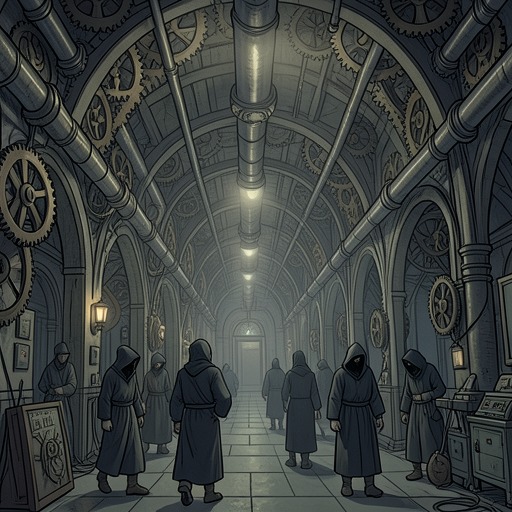
BabelResonance rods are the central mechanisms of Babel’s distributed silver-working system: tall, engraved silver structures that sustain linked bars throughout England from hidden centres of power. They are introduced as technical equipment, but their decisive significance emerges when Robin Swift and Victoire Desgraves remove only two dozen rods and Oxford’s infrastructure begins to fail. The rods therefore connect language, material technology, institutional monopoly, colonial power, and organized resistance.## Structure and Operation Robin Swift first encounters the rods in the sealed southern wing of Babel’s eighth floor, an area protected by three sets of locks and separate from the familiar workshop. The room resembles a giant piano or a fun-house exhibit. Silver rods of different lengths and heights stand across the floor, some waist-high and others reaching almost to the ceiling, with narrow spaces between them. Although each appears to vibrate at tremendous speed, the room remains silent. Their hidden activity gives physical form to the otherwise invisible network of meaning that sustains silver-working across the country.
Professor Chakravarti explains that resonance is primarily an economy of materials. High-carat silver must be reserved for bars requiring endurance, including those used by the British Navy to protect merchant ships. Bars operating on English land can contain a greater proportion of alloys because resonance continually fuels them from a central source. The arrangement turns Babel into the centre and the working bars of England into its periphery: distant devices draw power from Oxford rather than carrying the full burden of independent activation.
The rods are engraved with commonly used match-pairs and with further letters and symbols that outsiders cannot decipher. Their connections are forged through shared material and specialized etymological work. An Ashmolean bar, for example, has to be smelted from the same material as the corresponding rod, while matching etchings are adjusted on both objects. Babel also uses an invented alphabet based on a seventeenth-century manuscript discovered by an alchemist from Prague. This artificial script cannot manifest meaning, but it can deepen the bond between linked bars and prevent anyone outside Babel from reproducing the process.## The National Network The main resonance centre lies in Oxford because the Translation Institute cannot maintain many large centres without trained translators. Smaller centres exist in Edinburgh and Cambridge, but the effect weakens with distance, leaving Oxford with the largest share of the national system. Professor Chakravarti and Professor Lovell are responsible for maintaining the rods, and Robin Swift’s graduation is expected to make only three people capable of performing that work. The apparent technical arrangement is therefore also a labour arrangement: an enormous infrastructure depends on an extremely small and controlled body of linguistic specialists.
The rods extend Babel’s authority far beyond its tower. Professor Chakravarti accepts Robin Swift’s comparison between the network and British outposts in the colonies, which call upon the imperial centre for soldiers and supplies. The metaphor reveals that resonance is not merely a neutral engineering convenience. Like an imperial system, it concentrates power at the centre, distributes benefits outward on dependent terms, and makes the periphery vulnerable when the centre withdraws support. London’s metallic modernity, with its silver-powered machines, clocks, transport, and industrial works, is thus tied to the same centralizing logic.
The network also embodies Babel’s command over knowledge. The rods cannot simply be repaired by anyone who possesses silver; their maintenance requires trained translators, proprietary symbols, shared materials, and access to technical records. Even regional silver-working centres in London, Liverpool, Edinburgh, and Birmingham cannot fully compensate when Babel’s operation is interrupted because they lack the same maintenance ledgers. The rods make dependence practical, while secrecy makes that dependence difficult to overcome.## Removal and Cascade Failure During the strike, Robin Swift identifies the resonance system as a possible pressure point. When Victoire Desgraves asks what resonance is, he takes her to the eighth floor and explains that the rods maintain distant bars that are not designed for endurance. If the centre is removed, he reasons, the periphery should begin to fail. The act crosses the boundary between withholding services and deliberate sabotage, but Robin Swift and Victoire Desgraves proceed. Robin Swift pulls the nearest rod from its fixture, expecting resistance, noise, or some dramatic sign of rupture; instead, it slides out with surprising ease. Victoire Desgraves removes a second rod and then a third, and the pair ultimately take two dozen.
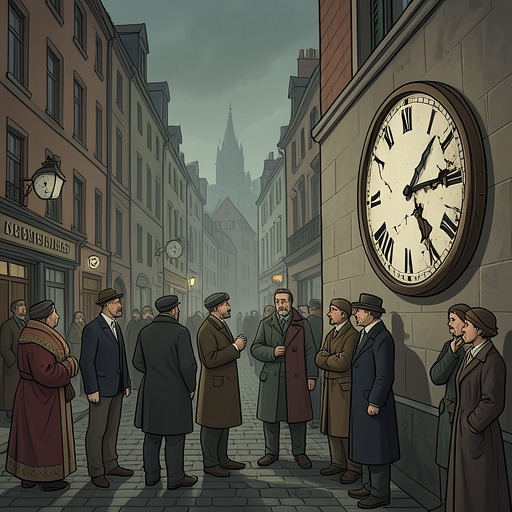
The result is not symbolic but immediate and material. Oxford begins to crumble with the rapidity of a house of cards. The next day every bell-tower clock stops at precisely 6:37 in the morning. Later, sewage, whose flow had been facilitated by silver, becomes an unmoving mass of sludge and sends a great stink across the city. That evening the street lighting fails one lamp-post at a time until High Street is completely dark, the first such darkness since gas lamps were installed two decades earlier.
Transportation breaks down on the third day. Carriages have depended on speed-based match-pairs, often drawing on Latin and sometimes Old Slavic, to travel quickly without dangerous accidents. Drivers, accustomed to letting the bars compensate during difficult turns, fail to adjust when the system collapses. Oxford’s roads fill with overturned wagons and cabs. In the Cotswolds, a family of eight falls into a ravine after a driver relies on the vanished assistance during a tricky turn.
The postal network suffers its own failure. Royal Mail carriages have used the French-English match-pair parcelle-parcel to make parcels seem a fraction of their true weight. Once the bar stops functioning, horses must pull loads three times heavier than expected, and postal carriages collapse on their routes. The rods thus reveal how ordinary convenience has concealed an extensive chain of linguistic and material dependencies. What appears to be human efficiency is often the effect of a hidden bar, and what appears to be a simple object is sustained by an institutional centre most users never see.## Institutional Design and Political Meaning Professor Chakravarti explains that Babel intentionally made Oxford and other cities as dependent on the Institute as possible. Bars were designed to last weeks rather than months because maintenance appointments generated income. The short life of the bars was therefore not an unavoidable technical limitation; it was a commercial decision that inflated prices and manufactured demand. The resonance rods sit at the centre of this arrangement, converting technical knowledge into recurring revenue and institutional leverage.
Their removal exposes a risk created by Babel itself. A system built around central power, restricted expertise, proprietary notation, and deliberately limited durability has little redundancy when its centre is cut away. The failure of clocks, sewage, lamps, roads, postal routes, and transportation demonstrates a cascade rather than an isolated malfunction. The rods make the material world appear stable only while the political and economic conditions supporting them remain intact.
The same logic reaches London and the wider British economy. Silver powers the ice-making machines of wealthy kitchens, brewery engines, flour mills, locomotives, textile machinery, plough-frames, seed drills, threshing machines, and drainage pipes. Without it, railways stop expanding, water becomes foul, air thickens with grime, and Britain’s textile industry may collapse, creating the prospect of national starvation. Regional centres can delay the consequences, but they cannot replace Babel’s full capacity, especially without its ledgers. The resonance system therefore transforms a local strike into a threat to urban life, commerce, industry, and imperial power.
The rods’ final force lies in the contradiction they materialize. They are instruments of connection, allowing a bar in one place to draw on power generated elsewhere; yet that connection is structured as dependency. They make distance manageable while concentrating authority, make modern life convenient while making it fragile, and turn language into an infrastructural resource controlled by a small institution. When Robin Swift and Victoire Desgraves pull the rods free, they do not merely damage machines. They expose the hidden architecture by which Babel has made the country’s apparent independence impossible.