Invisible Silver Strip
BabelThe invisible bar is a silver bar inscribed with the Chinese word wúxíng, translated as “Invisible,” whose power does more than hide its users from sight. It makes language physically operative: when Robin Swift speaks the word while touching the bar, visibility gives way to a condition in which bodies, objects, air, walls, and streets can no longer be cleanly distinguished. The device therefore becomes one of the book’s clearest demonstrations that translation is not merely the substitution of one word for another, but a hazardous passage between different conceptions of reality.
Discovery and First Use
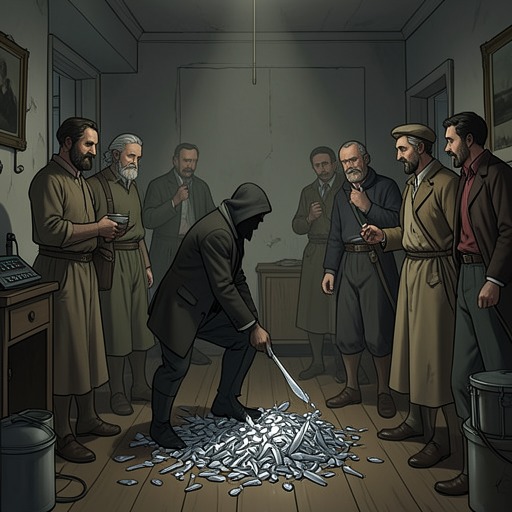
Robin Swift first encounters the invisible bar at night on Holywell Street, after entering the Bodleian Library to take Ramiz Rafi Mirza’s notebook. Three slim youths dressed entirely in black are struggling with a trunk whose broken bottom has spilled unmistakable silver bars across the cobblestones. One of the men repeatedly utters a Chinese word with increasing urgency, and Robin recognizes it as wúxíng before learning that it signifies something “formless, shapeless, incorporeal,” with “Invisible” as its closest English equivalent.
The scene is also an encounter with Robin’s double. The man holding the bar has Robin’s brown eyes, straight nose, chestnut hair, and even the same untidy fall of hair across his face. This physical resemblance makes the object’s appearance more than a chance discovery: the bar places Robin before an uncanny reflection of himself, while the stranger’s plea for help draws him into an action whose consequences he cannot understand. Robin takes the bar, repeats the word, and feels it vibrate as a breathy sound seems to come from nowhere. All four people disappear, but the narration immediately qualifies that description. They are not simply invisible bodies; they lose human form and become diffuse, mingled with silver, cobblestones, brick, air, and night. Robin can no longer tell where his body ends or where the bar begins, and the wonder of concealment turns into fear that he may not be able to return.
Limits and Operation
The invisible bar is not perfectly reliable. During the Holywell Street encounter, the three youths’ images flicker beneath the streetlamp; at moments they appear translucent, yet they remain decidedly visible. Its failure exposes the material vulnerability behind the apparent marvel. The bar is not an effortless cloak but a device whose success depends on the speaker, the word, the circumstances, and perhaps the relationship between language and the person attempting to use it.
The book presents the English translation as inadequate to the experience. “Invisible” names an effect that human observers can recognize, but wúxíng reaches toward a state beyond ordinary visibility. The users still exist, yet not in a human form; they drift and expand until they seem continuous with their surroundings. In this sense, the bar’s power is semantic as well as physical. The Chinese term does not simply label a pre-existing mechanism. Spoken by Robin while his hand rests on the silver, it activates a transformation that neither Chinese nor English fully contains.
Griffin Harley Lovell and the Bar’s Return
Griffin Harley Lovell later gives Robin the same invisible bar he used on the night they first met. Robin is worried about the university’s protective traps and about the unknown match-pairs being used by the translators, while Griffin dismisses the danger and tells him the bar will provide “a quick getaway” if matters go wrong. Griffin also warns that Robin may need to use it on his comrades, since carrying a chest of silver out of the city unseen would be difficult. The object thus shifts from mysterious contraband to practical equipment within the resistance’s dangerous work.
The gift also confirms a connection between Robin and Griffin that extends beyond their physical resemblance and shared knowledge of silver-working. When Griffin uses the word after Robin has been imprisoned, he explains that hearing Robin say it for the first time allowed him to understand the bar’s operation, as though he had been waiting his whole life for those words. Griffin uses wúxíng to break through the cell door’s obstruction and free Robin, turning the object into an instrument of rescue as well as concealment. The bar’s recurrence makes the earlier Holywell Street encounter retrospectively legible: what first appeared to be an impossible double was part of Griffin’s hidden history, and Robin’s voice was essential to Griffin’s awakening to the device’s power.
Escape and Narrative Significance
The invisible bar becomes decisive again when Robin and Victoire Desgraves are threatened by constables. Robin searches through the satchel until his fingers find the silver’s cold burn, whispers wúxíng, and says “Invisible.” He and Victoire flicker and vanish just as three constables run into the square and identify the fallen figure as Sterling Jones. The bar therefore interrupts an immediate chain of pursuit and turns concealment into survival, but its use also leaves the surrounding violence unresolved: the constables still arrive, Sterling’s fate remains the urgent question, and invisibility changes who can be seen without erasing the consequences of what has happened.
Across these appearances, the invisible bar connects several oppositions: visible and hidden, human and shapeless, object and body, Chinese and English, recognition and misrecognition. Its silver is tangible enough to burn cold against Robin’s hand, vibrate, spill from a broken trunk, and be passed from Griffin to Robin; its effect dissolves precisely those boundaries that make tangible objects and individual bodies intelligible. The device consequently embodies the book’s larger concern with translation as transformation. A word that seems to promise simple absence from sight instead opens onto a dangerous realm in which the user becomes inseparable from the world, and in which the most powerful form of concealment may also threaten the stability of the self.