Opium Crisis
BabelThe Opium Crisis is the escalating confrontation between Qing authorities and British merchants in Canton over the opium trade, foreign access, and the confiscation and destruction of more than twenty thousand chests of opium. In the novel, it is not a narrow commercial dispute but the decisive pressure point at which private profit, diplomatic coercion, imperial strategy, and Babel’s translation expertise converge. The crisis reveals how demands presented as free trade can become a program of informal empire, backed by war plans and the prospect of controlling China’s immense reserves of silver.
Causes and Imperial Background
The immediate conflict grows from incompatible political and commercial aims. British merchants, represented above all by Jardine, Matheson & Company, want open ports, wider market access, freedom to trade beyond the restricted foreign enclave, and the removal of limits on imports such as opium. The Qing government, wary of foreign influence, seeks to contain British and other foreign traders at Canton and Macau. Professor Lovell explains that earlier British attempts to secure broader rights had failed: the Macartney embassy in 1793 and the Amherst embassy in 1816 both broke down over the refusal of their leaders to kowtow, while the 1834 Napier affair ended in cannon fire and Lord William Napier’s death from fever in Macau. The delegation involving Professor Lovell, Robin Swift, and their companions is therefore presented as a fourth attempt, supposedly strengthened by Babel translators who might prevent another failure of cultural communication.
Behind the language of negotiation, however, lies an organized campaign for commercial advantage. Mr Baylis describes the opium bond as a mechanism that would make foreign ships assume responsibility before Chinese law for opium smuggled into China, while also complaining that the previous informal arrangement had allowed ships to anchor at places such as Lintin and Camsingmoon and distribute their cargo through local partners. Under Imperial Commissioner Lin Zexu, that arrangement is no longer tolerated. Lin’s arrival brings house searches, the disruption of distribution networks, the suspension of trade, and confinement of foreign merchants within the Factories until they comply with Qing demands.
The British position is sharpened by the scale of the seizure. Mr Baylis says that Captain Elliot allowed Chinese authorities to confiscate more than twenty thousand chests of opium, worth nearly two and a half million pounds. He calls the seizure unjust British property and treats it as grounds for war, even though Elliot believes that surrendering the drug prevented starvation and violence. The opposing interpretations establish the crisis’s central moral reversal: an illegal and destructive trade is recast by its beneficiaries as an attack on national honour and property.
Escalation in Canton
When Robin Swift reaches Canton, the city is already under intense pressure. Mr Baylis reports that Chinese authorities have broken up distribution rings and bombed a fast crab in the harbour, while searches and the mere mention of opium have spread fear through the city. He blames Lin Zexu, who demanded the immediate surrender of all opium and suspended trade when the foreigners refused. The foreign merchants are effectively placed under siege inside the Factories, transforming a commercial dispute into a confrontation between local enforcement and foreign collective resistance.
The next morning Robin accompanies Mr Baylis to meet Lin Zexu at a government office. Baylis portrays Lin as exceptionally difficult but also acknowledges his reputation as Lin Qingtian, a commissioner so incorruptible that bribes cannot move him. In person, Lin is not the monstrous figure suggested by Baylis’s racist descriptions but a mild, average-sized man whose unusually bright and perceptive eyes distinguish him. His own interpreter, William Botelho, has studied English in the United States, introducing another layer of linguistic and political complexity into the meeting.
The British demands are delivered less as a conversation than as a lecture. Robin translates Baylis’s requests that opium be legally sold along the coast, that the treatment of foreign agents receive an official apology, and that the twenty thousand confiscated chests be returned or compensated at market value. Baylis then argues that the Qing Emperor should abandon exclusive trade policies, insists that Chinese people themselves would prefer free association with foreigners, and invokes Adam Smith as though economic theory could settle the question of Chinese sovereignty. Robin attempts to render the demands in a flat, emotionless manner, embarrassed by their patronizing tone and by the absence of genuine dialogue.
The crisis reaches its most visually direct turn when Letitia Price sees a huge fire across the river. The flames are controlled, concentrated on chests loaded onto deep-bellied boats in the shallows, and the wind carries the sickly sweet smell of their contents to the English Factory. The cargo is opium, and Lin Zexu is burning it. The destruction converts a dispute over possession into an irreversible political fact: the drug will not be returned, and the British commercial claim has been answered by the Qing government’s public assertion of its right to enforce prohibition.
From Commercial Dispute to War Planning
The opium-burning becomes the justification British merchants need to demand military intervention. Lin issues a proclamation banning English trade from Canton entirely, while Jardine, Matheson & Company presents the prohibition as an insult to Britain that must be answered in order to preserve national honour. The House of Lords begins debating a military expedition, although Parliament remains hesitant about committing resources to a distant and unprecedented war. The stakes are not merely diplomatic. The proposed defeat of China would give the British Empire access to what the novel describes as the world’s greatest reserve of silver, enabling faster warships, more accurate and longer-ranged guns, and broader imperial projects in Africa, Asia, and South America.
The hidden documents that Robin Swift discovers make the transformation from trade dispute to planned invasion unmistakable. A letter from Reverend Gützlaff contains a detailed sketch of Canton’s main docks, alongside a list of Chinese naval vessels. Other correspondence records the number and placement of junks, forts on surrounding islands, and troops stationed at coastal positions. These papers are not speculative policy discussions but war plans. Their precision shows that military preparation and commercial agitation are operating together rather than sequentially.
Professor Lovell’s role gives the discovery its personal and ideological force. Robin had hoped that his father might merely have been a scholar swept along by the hostility between merchants and the Qing government. Instead, Lovell appears among the most hawkish voices, describing the benefits of war, including access to linguistic resources, and expressing contempt for Chinese military capacity. An unsent letter to Lord Palmerston claims that the Chinese fleet consists of outdated junks, identifies the Cambridge as their only ship capable of serious combat, and declares that British forces will make short work of it with the Nemesis. Lovell has therefore helped design the conflict whose diplomatic consequences he was ostensibly sent to manage.
Silver-Working, Infrastructure, and Dependency
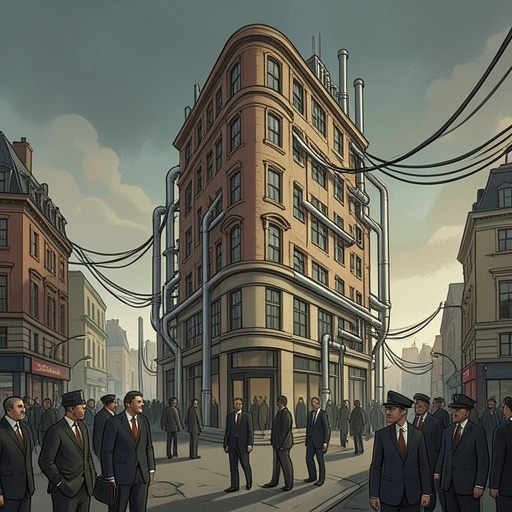
The Opium Crisis is inseparable from the novel’s material system of silver-working. London is described as a city with a mechanical heartbeat, where silver hums through cabs, carriages, buildings, streets, clock towers, and shopfronts. Its metallic sound contrasts with the bamboo-supported infrastructure of Canton, while its abundance makes the capital larger, heavier, faster, and brighter than nature would permit. London’s wealth is also presented as predatory: it has accumulated much of the world’s silver ore and many of its languages, grown rich on its spoils, and remained desperately poor beneath its silver-gilded surface.
Babel’s own technology mirrors the political structure of empire. Professor Chakravarti explains that Babel is the centre and resonance-dependent bars throughout England are the periphery, drawing power from the centre. Robin compares this arrangement to British outposts in the colonies calling upon the home country for soldiers and supplies, and the comparison is accepted as convenient. The metaphor makes the crisis’s larger logic visible: linguistic power is centralized, exported, and used to sustain a network whose peripheral institutions depend on the imperial centre.
The telegraph briefly appears to offer a different technological future. After Samuel Morse demonstrates a device that transmits messages through electrical impulses, Babel scholars bring him to Oxford, where the silver-working department is astonished that the system needs no match-pairs and operates on pure electricity. By July 1839, Babel has connected the first working telegraph line in England to the British Foreign Office in London. Professors De Vreese and Playfair develop an alphanumeric code beyond Morse’s original numeral-only system, allowing commercial and personal messages as well as restricted signals. Yet this apparent liberation from match-pairs also strengthens the institutional and imperial network by making instantaneous communication between Babel and London profitable and politically useful.
The dependence created by silver-working becomes clearer when the system fails. Transportation in England relies on speed-based match-pairs whose historical meanings permit carriages to travel faster without accidents. Once the bars stop working, drivers who have grown accustomed to their assistance cannot compensate: overturned wagons and cabs block Oxford’s roads, and a family of eight falls into a ravine in the Cotswolds when a driver relies on horses to manage a dangerous turn. The postal system collapses as well, because French-English match-pairs make heavy parcels seem lighter; when the bars fail, postal carriages strain under loads three times their apparent weight and collapse mid-route.
The consequences extend throughout Britain. Silver powers ice-making machines, brewery engines, flour mills, locomotives, rail construction, water systems, air-cleansing processes, and the machinery of the textile industry. It is also embedded in plough-frames, seed drills, threshing machines, and drainage pipes, so a prolonged interruption threatens not only urban convenience but agricultural production and national food supply. Regional silver-working centres in London, Liverpool, Edinburgh, and Birmingham can provide a temporary substitute, but they lack Babel’s maintenance ledgers and cannot replace the central institution indefinitely. The technological infrastructure thus reproduces the same imperial dependency dramatized by the opium negotiations: a system that appears universal is controlled through concentrated knowledge and access.
Historical and Narrative Significance
The Opium Crisis functions as the novel’s clearest demonstration that translation is political action. Babel translators are summoned to prevent cultural misunderstanding, yet Robin’s work initially serves to make an unequal set of demands sound orderly and negotiable. The crisis exposes the limits of linguistic mediation when the parties do not merely misunderstand one another but pursue incompatible claims to law, trade, territory, and authority.
Its structure also moves from public rhetoric toward concealed intention. The first demands concern legality, apology, compensation, and free trade; the opium-burning supplies the emotional spectacle of outrage; the discovery of the war plans reveals that the confrontation has been prepared as an imperial opportunity. What appears to be a reaction to Qing enforcement is shown to be part of a wider design in which merchants, Parliament, military planners, and linguistic institutions can align around access to silver and expanded colonial power.
The crisis therefore links Canton and London without making them equivalent. Both cities are contradictory mouths to the world, but London’s industrial abundance rests on a larger system of extraction and dependence. The conflict in Canton threatens to become the mechanism by which London acquires still more resources, while the later failures of silver-working reveal the fragility concealed by modern convenience. The Opium Crisis is consequently both a historical confrontation and a test of the novel’s central premise: when language and technology are organized around imperial appetite, communication does not prevent violence; it can prepare, justify, and accelerate it.