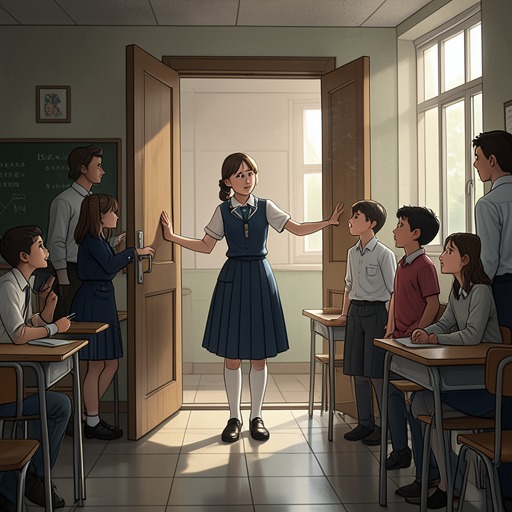
Ava and Nola's Therapeutic Relationship
BeautifulThe therapeutic relationship between Ava Spirini and Nola is a steady, non-prescriptive support through which Ava can examine bereavement without being told to get over it. Nola offers practical ways into difficult subjects, explains that grief has no standard timetable, and helps Ava consider how her identity and choices have changed since Kelly Waititi’s death. The work does not remove Ava’s grief; it gives her room to speak, make sense of it, and keep living alongside it.
Access and a Choice-Led Beginning
Nola works at TAPs, where students may see her if they choose. Minda recommends that Ava make an appointment, and Nola begins by defining the terms of their relationship: Ava does not have to say or do anything she does not want to, and she may decide how much to share. Nola describes her purpose as helping Ava find strategies for feelings she is struggling with. The emphasis is on collaboration and choice, not on forcing disclosure or treating Ava as a problem to be corrected.
When Nola asks Ava to talk about herself, Ava hesitates over what that means. Nola does not insist on a verbal answer. Instead, she offers drawing, with music playing, so that they can have something to discuss besides Ava herself. This change of activity gives the session a less direct route into personal material: Ava can first respond to a page, rather than having to begin with an account of her life.
Ava draws a sequence of squares, puts a heart in the smallest one, and fills it in. As a song plays, she writes down a lyric with one pronoun changed, then repeats the altered line in increasingly large lettering until it covers the page. When Nola looks at the drawing, Ava feels self-conscious and says she does not know what it is. Nola attends to its details, including the small element hidden beneath the other lines. Ava says that the heart is covered over. Talking about the image gradually becomes a way of talking about herself and what has happened. The drawing is not presented as a diagnosis; it gives Ava and Nola a shared object through which difficult material can be approached at a manageable distance.
Making Room for Grief
Nola introduces grief by drawing a simple graph: one line represents time, another the experience of grief, and an X marks the death. She fills the space with irregular, haphazard lines rather than a smooth progression. Her explanation rejects the idea of a typical route or schedule. Grief can remain painful, ease by degrees, and do so at an unknowable time; Ava is not asked to measure herself against someone else’s recovery.
That explanation matters against the scale of Ava’s distress. Six months after Kelly Waititi’s death, Ava feels as though time has slowed and fears that she will feel this way for the rest of her life. The graph does not promise a date when she will be well. Instead, its uneven lines make room for the fact that the experience cannot be predicted in advance. Ava feels relief at being given no false timetable and thanks Nola for saying plainly that grief may continue to hurt.
Nola also draws on her own bereavement, explaining that her father died four years earlier and that she still misses him every day. She describes the ordinary impulse to reach for her phone to call him before remembering that she cannot. Ava recognizes the familiar shape of that absence: she most wants to tell Kelly about everyday things, including a song they shared or something Kelly would have found funny. Nola does not claim that their losses are identical. Her disclosure makes space for Ava’s particular memories and shows how grief can remain present in routine moments as well as in explicit recollection.
Identity, Change, and Ava’s Choices
Nola challenges the idea that Ava should return to the person she was before Kelly died. People change continually, she explains, and Ava is grieving not only Kelly but also parts of her former self. The point is not that Ava must welcome this change or quickly know what comes next. Nola distinguishes the fact of change from the possibility of continuing: Ava is still alive, and the work can begin with understanding what this changed version of herself wants. She suggests taking that process a week at a time, leaving future changes for the future unless Ava already knows there is something she wants to address.
Ava uses that invitation to raise Gideon and the uncertainty in their relationship. She tells Nola about their friendship, their kisses, and a conflict in which each fears hurting the other: Ava has resisted Gideon acting as her boyfriend, while Gideon has accused her of leading him on. Nola brings the discussion back to Ava’s own wishes, asking whether she knows what she wants rather than letting fear of hurting Gideon stand in for an answer. Ava can say that she does not want to hurt him, but the question of what she wants remains difficult. The conversation makes her ambivalence available for examination without Nola choosing for her or declaring the relationship’s outcome.
Continuing Work and Its Limits
Ava continues seeing Nola every fortnight. Nola returns to the box analogy and to the principle that there is no right or wrong way to feel; it is the choices made in response to feelings that can lead to trouble. Ava later uses this distinction to look back on emotionally complicated decisions. She judges sleeping with Lincoln as a poor choice, while recognizing that breaking up with Gideon was the right choice even though it hurt intensely. Her account does not turn either judgment into a simple measure of whether she has recovered. It shows her beginning to separate the presence of grief from the decisions she makes while grieving.
The relationship’s significance lies in this combination of permission and practical reflection. Nola does not claim to know Ava’s experience in advance, prescribe a single path through bereavement, or promise to make the pain disappear. She listens, offers a drawing or a graph when direct conversation is difficult, shares a limited personal experience, and helps Ava return to questions of identity and agency. Ava’s grief remains part of her life; therapy gives her a way to acknowledge it without treating pain as proof that she is failing or that forward movement is impossible.