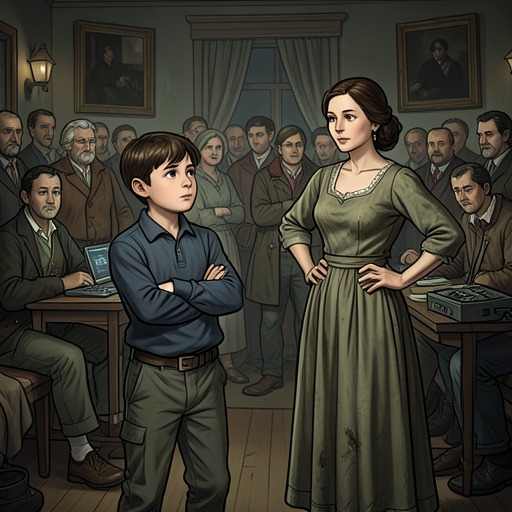
Gideon and Annie
BeautifulGideon and Annie’s relationship gives Gideon a source of affection, perspective, and encouragement beyond his immediate daily life. Annie is his older sister, two years ahead of him, and often in London or travelling in Europe; distance does not make her remote. In their calls and letters, she is playful and forthright, while Gideon openly admires her and misses her every day. Their closeness is shown less through grand declarations than through small acts of attention: a recommendation about which poem to perform, a reminder to be brave, and the confidence to tell her what is changing in his life.
Annie and the Family They Share
Annie is described as the smartest person Gideon knows. She was dux of her school and won scholarships to several universities, but politely declined them to work in a pub and travel around Europe. Her choices suggest independence rather than lack of ability: she is fiercely opinionated and political, loves mathematics, and paints large murals with pastels. Gideon also remembers her as entrepreneurial from childhood. At eight, she ran a tuckshop business, buying lollies with her pocket money and reselling them for a profit until a parent discovered the scheme and the school shut it down. At fifteen, she joined a friend’s father’s pyramid scheme to fund a trip to Europe. The recollections combine admiration with sibling humor, presenting Annie as capable, unconventional, and difficult to reduce to a single role.
Their affection belongs to a family Gideon sees as unusually close. He says the family genuinely likes one another, and points to his parents’ enduring love as part of that atmosphere. For their twenty-fifth anniversary, Annie and Gideon organized a surprise party in the backyard; their parents became drunk and went skinny-dipping in the pool, which Gideon considers a success. The anecdote places the siblings together as collaborators and frames their ease with one another within a household where affection is openly expressed rather than merely assumed.
A Long-Distance Presence
Annie’s life in London gives the relationship a recurring distance, but the narrative makes that distance tangible through ordinary communication. During a video call, she shows Gideon and their mother the rainy view from her window. The call lasts only a few more minutes, yet Gideon’s description of Annie ranges well beyond the screen: he recalls her ambitions, her schemes, her interests, and the fact that he misses her every day. Her presence is therefore both immediate and remembered—pixelated on a device, but firmly established in his account of home and family.
Letters and calls let them exchange encouragement without requiring Annie to be physically present. Annie sends a postcard bearing a photograph of the Queen, and Gideon remembers it when he thinks about how she would stand up for him if he ever needed her to fight on his behalf. In a letter, she tells him that he would love London as much as she loves him, and urges him to be brave. Her affection is direct; her support does not depend on being beside him. The recurring references to London, the postcard, and the video call give their bond concrete forms of contact across the distance.
Advice, Teasing, and Trust
Annie’s encouragement is practical as well as affectionate. When Gideon is anxious about an upcoming poetry competition, she appears on an iPad screen and tells him to perform her favourite poem. He worries that it is too intense for the occasion, but Annie dismisses the hesitation and urges him to commit to it. Her confidence helps him move from indecision to agreement. She does not make the choice for him; she gives him a clear preference and a push, then asks whether he will do it.
Their manner with each other is teasing and familiar. Annie calls him her little brother, pulls faces, and responds to his jokes without ceremony. When Gideon asks about one practical matter, she says she will sort out the other arrangements by lunchtime and fax him because faxing is the only way to contact him. The detail links her affectionate informality to the restrictions shaping his life: even an ordinary piece of sibling help requires adapting to his lack of usual electronic contact. Susan calls from the hallway to ask whether Annie is still online, and Annie tells Gideon she loves him before the call ends. Their warmth is not presented as solemn; it is woven into interruptions, jokes, and everyday logistics.
What They Give Each Other
Gideon’s letters show that Annie’s confidence in him matters, even when he answers her encouragement with comic self-assessment. After she tells him to be brave, he reports several developments: he has begun writing to a girl and considers her a friend, he has had an awkward sexual experience, and he has learned that his therapist Robbie is leaving without having a mental breakdown. He presents these as evidence that he has been brave. The letter turns Annie’s advice into a way for Gideon to take stock of change and report it to someone whose opinion he values.
The sibling bond also appears in what Gideon believes Annie would do for him. He imagines that she would get into fights on his behalf, while also admitting he has never been in a fight himself. This is not an account of an actual confrontation; it is Gideon’s measure of her loyalty, grounded in his confidence that she would protect him. Across the calls, postcard, and letters, Annie offers affection without treating Gideon as helpless, and Gideon responds with both admiration and candor. Their relationship gives the novel a steady line of family connection: even when Annie is away, her encouragement helps him recognize his own tentative acts of courage.