the lowest yet
BelovedIn Toni Morrison's Beloved, the expression "the lowest yet" is Ella's fiercely private name for the two men—a father and his son—who held her captive and sexually abused her for more than a year during her girlhood. The phrase never appears as a public epithet; it is the currency of Ella's inner life, the measure against which she weighs every subsequent evil. It condenses an entire history of violation into three words, and it becomes the fixed point around which her entire moral universe rotates.
Origin and Meaning
The phrase is introduced through Sethe's speculation about Beloved's past. When Beloved cannot explain where she got her dress and shoes, or who imprisoned her, Sethe tells Denver that she believes Beloved was "locked up by some whiteman for his own purposes, and never let out the door," and that she must have escaped to a bridge or someplace and "rinsed the rest out of her mind." Sethe then recalls that "something like that had happened to Ella except it was two men---a father and son---and Ella remembered every bit of it. For more than a year, they kept her locked in a room for themselves." Ella's own testimony is stark and unadorned: "You couldn't think up," she had said, "what them two done to me." The phrase "the lowest yet" is Ella's shorthand for this experience—the absolute floor of human depravity, below which she believes nothing can sink.
Ella's Moral Standard
Ella's entire character is built on this foundation. The narrative explains that her puberty was spent in a house where she was shared by father and son, "whom she called 'the lowest yet.'" It was this experience that "gave her a disgust for sex and against whom she measured all atrocities." The text is explicit: "A killing, a kidnap, a rape--whatever, she listened and nodded. Nothing compared to 'the lowest yet.'" This is not mere bitterness; it is a fully formed ethical system. Because nothing can surpass the horror she endured, she is able to absorb the worst news of the world without shock, and she is equally able to dismiss lesser evils as beneath her notice. Her judgment of Sethe's infanticide is filtered through this lens: "She understood Sethe's rage in the shed twenty years ago, but not her reaction to it, which Ella thought was prideful, misdirected, and Sethe herself too complicated." The phrase thus functions as both a scar and a shield—a wound that has hardened into an unassailable standard of judgment.
The Phrase in Action: The Exorcism
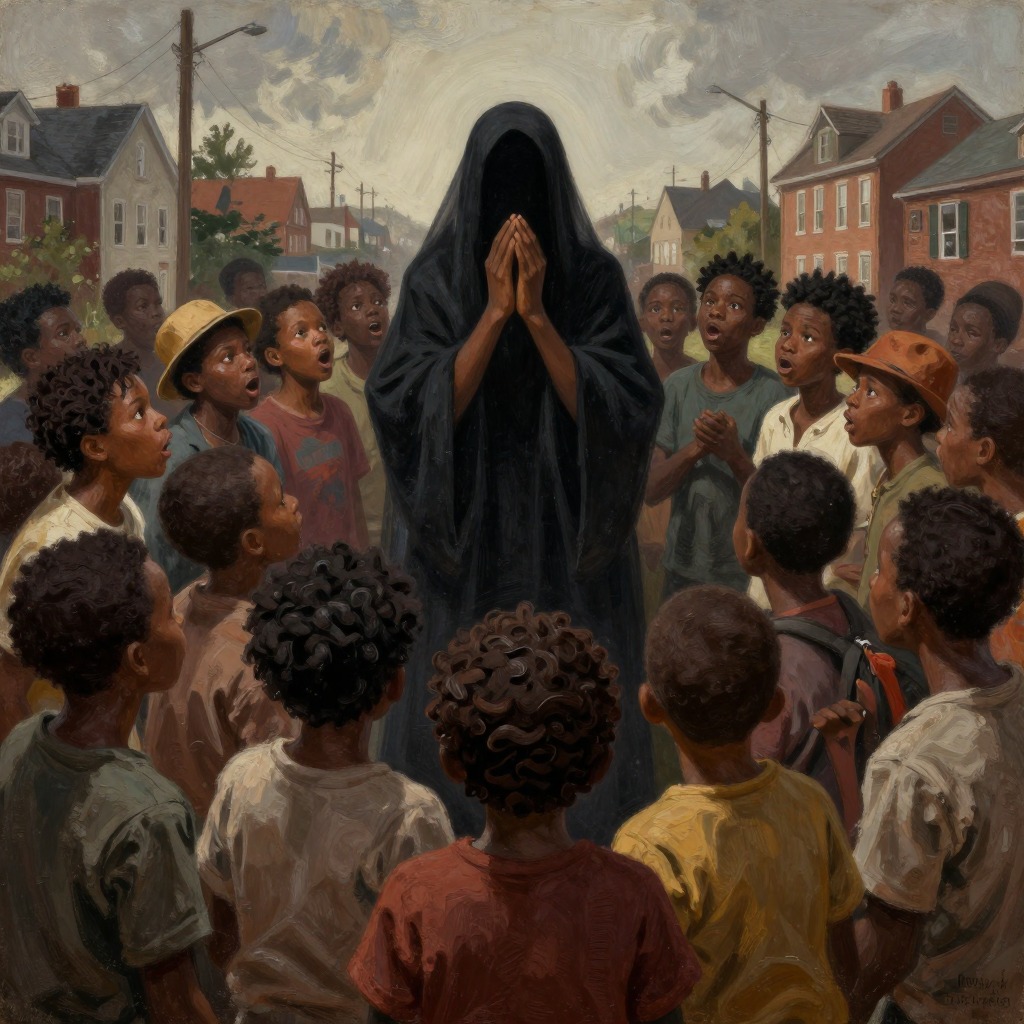
Ella's standard directly motivates the novel's climactic community action. When rumors reach her that Sethe's dead daughter has returned in the flesh and is "whipping Sethe every day," Ella is initially skeptical but becomes furious at the idea of "past errors taking possession of the present." Her reasoning is rooted in her own history: "She didn't like the idea of sin moving on in the house, unleashed and sassy." The narrative draws the connection explicitly: "There was also something very personal in her fury." When the women debate whether to intervene, Ella's voice is decisive. She rejects the notion that Sethe deserves her punishment—"Guess she had it coming" is met with her flat "Nobody got that coming"—and she articulates the principle that "What's fair ain't necessarily right." Most tellingly, when she hears that 124 is occupied by something beating Sethe, "it infuriated her and gave her another opportunity to measure what could very well be the devil himself against 'the lowest yet.'" The phrase is her yardstick even for the supernatural. And when the women gather outside 124, it is Ella who stands apart from the kneelers, "trying to see through the walls, behind the door, to what was really in there," and it is Ella who hollers, initiating the wordless sound that breaks the back of words and drives Beloved away. Her personal history, compressed into that single phrase, is what arms her to confront the ghost.
Significance
The phrase "the lowest yet" is a testament to the way trauma can be transformed into a kind of moral authority. Ella's abuse does not break her; it forges her into a woman who cannot be shocked, who refuses to sentimentalize love (she "considered love a serious disability"), and who is willing to act when others hesitate. It also marks her as a counterpoint to Sethe: where Sethe's response to violation was to claim her children as her "best thing" and to kill rather than let them be dirtied, Ella's response was to build a wall of pragmatism and to measure all evil against her own. The phrase is never spoken aloud in the narrative—it exists only in the narrator's account of Ella's thoughts—yet it is the hidden engine of the novel's resolution, the private standard that propels the public act of rescue. In the end, "the lowest yet" is not just a label for two monstrous men; it is the name of the abyss that Ella stared into and survived, and the measure of everything she refuses to let happen again.