Distress-Signal Response Obligation
BlackwaterThe Distress-Signal Response Obligation is the rule requiring a vessel to respond after opening a distress signal. Its immediate force is plain: when Roland and Novac identify an ice hauler in engine trouble, their proximity and the fact that they have opened the call leave them obligated to act. The same response later becomes the basis for transferring the pilot to Henri Marcell’s ship, linking rescue duty to the demands of wartime staffing.
Recognition and obligation
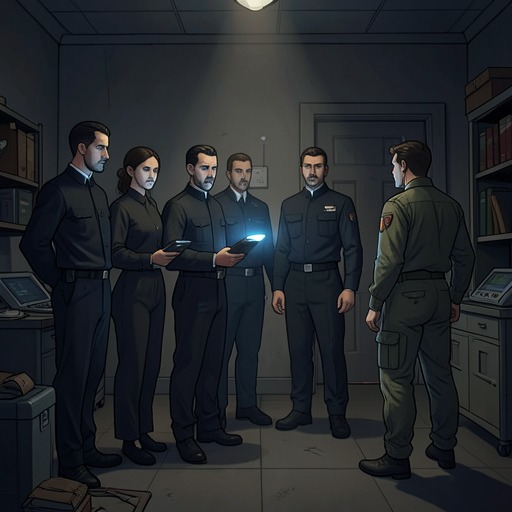
While Roland and Novac are still beyond Vulcan range, an alert appears in the upper-right corner of Roland’s monitor, a part of the display nicknamed the Uh Oh Corner. Roland points out the distress signal. Novac opens it and identifies the vessel as an ice hauler suffering engine trouble. They are closer than any OP Cutters, and, as Novac explains, law and regulation require them to respond because they have opened the signal. The rule is thus triggered not merely by awareness of a ship in danger, but by the act of receiving and opening its call.
The obligation interrupts Roland’s expectations of service. He had imagined fighting Union Martians, not confronting pirates looking for a drink, though he recognizes the practical value of supplying essentials such as fuel and water. His hesitation about the distress signal sits beside that earlier reluctance: rescue and logistical work are not the combat role he most wants, but the duty is not presented as optional once the call has been opened.
A rescue that changes the roster
The responding pilot’s status carries forward into Henri Marcell’s effort to assemble a crew. On the day pilots are scheduled to arrive, Marcell learns that most are on leave and that the one exception is out responding to an SOS. The personnel officer says Marcell must either wait for the leave to end or cancel the individual leave forms. In other words, the response is recognized as a real duty even amid the administrative disorder that has left Marcell without a prepared roster.
Marcell asks for every pilot’s personnel file and complete qualifications, deciding to construct the roster himself. He specifically orders that the pilot responding to the SOS be transferred to his ship as soon as the pilot’s duty day is finished. The rescue obligation therefore has a second consequence: the pilot’s response delays immediate reassignment, but also identifies the pilot Marcell wants for his new command.
Duty amid institutional friction
The episode contrasts a clear operational rule with the poor coordination surrounding Marcell’s arrival. He is frustrated that orders bearing an admiral’s signature have not produced a ready roster. Gunnery Sergeant Hoffmann describes the local officers as comfortable and out of the spotlight, in a position between Deimos and the outer limits of the Mars Sphere; Marcell, for his part, expects even noncombat specialists to enable the ship’s work. Against that institutional slack, the distress response is a concrete obligation already being carried out beyond the ship.
The rule belongs to a wider wartime environment in which cooperation depends on both formal structures and improvised action. Marcell’s ship is assembled from pilots with different assignments, while its purpose is to attack the Union in ways the enemy does not expect. The distress call does not itself explain that strategy, but the pilot’s response becomes part of the crew’s formation: a rescue duty intersects with a force being built for unconventional operations.
Meaning and limits
The obligation gives a distress signal practical authority. Opening it commits the nearby responders, and the call’s consequences persist after the immediate emergency as the responding pilot’s duty day and subsequent transfer are arranged. The evidence establishes the requirement and its effect on Roland’s patrol and Marcell’s staffing, but does not specify the eventual outcome for the ice hauler or set out the rule’s full legal wording.
Its significance lies in that passage from signal to responsibility. In a setting where combat assignments, personnel administration, and supply needs compete for attention, a call for help imposes a definite course of action. The rule binds the response before anyone can know what tactical advantage or inconvenience it may bring, and turns an initially unwanted interruption into part of the machinery of the war.