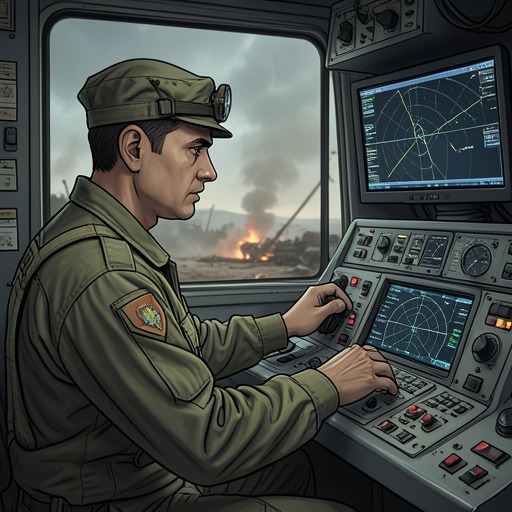
Pilot's code of honor
BlackwaterThe Pilot's code of honor is a remembered standard of conduct between pilots, defined by restraint toward a helpless opponent and assistance to a damaged one. Roland describes it as a tradition in which pilots avoided shooting someone who had parachuted from their aircraft and guided crippled enemy craft toward home. Its significance in the story lies in the contrast it offers to combat's immediate demands: even amid suspicion and danger, Roland frames the encounter as a moment in which courtesy and professional restraint remain imaginable.
The remembered standard
Roland explains the code to Charlotte after she observes that his behavior had been almost polite. He says that pilots once followed a code of honor, giving two concrete examples: they did not shoot at a parachuting pilot, and they helped a crippled enemy craft follow a course home. The standard is therefore not an abstract appeal to virtue; it concerns specific decisions made when an opponent is vulnerable or no longer able to fight effectively.
Roland places the tradition in the twentieth and early twenty-first centuries, saying that pilot conduct had been more normal then. The recollection presents the code as an older professional ideal rather than a rule shown to govern every present-day engagement. It supplies a point of comparison for the present without establishing that the custom has formally disappeared.
The encounter with Charlotte
The code enters the conversation after Roland and Charlotte leave the colony and move above it. Seeing no hostile sensors active, Roland allows himself to relax. Charlotte calls his conduct almost polite, and he answers by reaching for a historical explanation: pilots had once recognized obligations that extended beyond defeating an enemy.
The scene's contrast is significant. The immediate setting remains one of military danger, but the exchange turns from the possibility of hostile action to a remembered ethic of restraint. Roland does not claim that the code resolves the danger or dictates every decision; his examples instead make clear what humane conduct could look like when one pilot has been disabled or forced to abandon an aircraft.
Professional culture and wartime adaptation
The code also sits alongside a broader tension between established military expectations and the improvised methods the crew must use. Commander Anna describes the ship's purpose as striking the Union in a way its forces do not expect and says that a mismatched crew naturally follows from that mission. Gunnery Sergeant Hoffman likewise presents adaptability as a defining strength of the corps. Against that emphasis on unconventional action, Roland's recollection preserves an older limit on how pilots should treat one another.
The surrounding story repeatedly shows how practical demands shape military conduct: a maintenance chief warns that Rocco's machine's knee joints have exceeded standard tolerances, Roland is ordered to test a Panzerter III's guns and thrusters, and Captain Marcell must contend with delayed personnel and missing Panzerters. Those details do not define the code itself, but they place it in a world where survival depends on maintenance, readiness, and rapid adaptation. The remembered ethic adds a professional and moral dimension to that world, making assistance to an enemy pilot part of the same culture of skilled conduct that sustains a fighting force.