The Glazer family’s rule against wives working outside the home
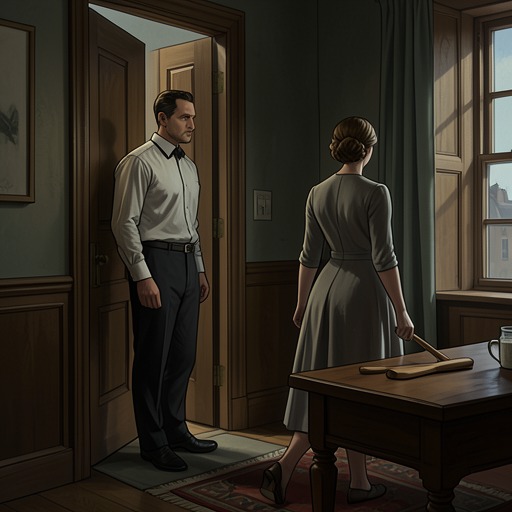
BlondeThe Glazer family’s rule against wives working outside the home made domestic labor a measure of proper womanhood and masculine authority. Its force appears not only in the expectation that Norma Jeane Baker(Marilyn Monroe) keep house, but in the conviction that paid work belonged to men even when the family had endured poverty. For Norma Jeane, housework became a sacred duty and a privilege; for the family, the division of labor was a source of pride. Her tentative question about whether the war might alter that arrangement met with silence.
Identity and Scope
Among the Glazers, a persistent Christian fervor accompanied the shared belief that women, especially married women, should not work outside the home. The rule was presented as a family norm, not as an arrangement made necessary only by a particular household’s circumstances. Its importance lay in defining who was expected to earn and who was expected to maintain the home: men’s labor could be public and remunerated, while a wife’s work was to remain domestic.
The boundary was firm even in the family’s memory of the Great Depression. Some Glazers had been forced to live in a mobile home in the San Fernando Valley, and Bucky Glazer had been embarrassed and ashamed of the experience. He did not give Norma Jeane the details, and she did not press him. But the family’s account of that period still made work a male prerogative, extending even to boys under ten, including Bucky. Economic hardship had not, in the family’s telling, dissolved the gender division; it had drawn male children into the working group while leaving women’s work at home as the expected arrangement.
The Rule in the Household
Norma Jeane’s daily life gave the principle a concrete form. Each morning she cleaned the couple’s ground-floor apartment at Verdugo Gardens from top to bottom. The home consisted of three modest, cramped rooms and a bathroom just large enough for the tub, sink, and toilet. The scale of the apartment made her work an intimate, repetitive task: she was responsible for the limited space in which the couple lived, and she approached that responsibility with the devotion and fervor of a missionary.
That devotion was not simply reluctant compliance. Norma Jeane wanted to be perfect for Bucky and regarded the home entrusted to her as a privilege as well as a duty. She did not register the irony in the idea that no wife could ever succeed with Bucky; instead, she treated the work of caring for the household and the man who had entrusted it to her as something almost sacred. The rule could therefore operate without appearing to her as an external prohibition. Its domestic ideal had become part of the way she understood her own obligations as a wife.
Pride, Silence, and the War
The Glazer prohibition was tied explicitly to virile pride. The family’s opposition to wives working outside the home was described as a matter of male honor, so the arrangement did more than assign tasks: it affirmed the status of men as workers and positioned women’s employment as a challenge to that status. The family’s remembered Depression-era hardship sharpens the contradiction. Men and even young boys had worked, but that history did not prompt the family to reconsider whether women might also earn wages.
Norma Jeane’s question about whether the rule still applied now that the country was at war briefly tested the boundary against changing circumstances. The question hung unanswered. That silence is the clearest indication in the episode that the norm was not being treated as an open household negotiation. The war, which might have offered a reason to revise a settled division of labor, elicited no stated exception from Bucky. He instead made clear that he would never accept a wife who worked outside the home. The exchange leaves Norma Jeane’s appeal suspended, while the husband’s position remains absolute.
Gendered Labor and the Wider Story
The rule’s immediate effect is visible in the apartment, where Norma Jeane’s effort is concentrated in cleaning and maintaining a home. Its wider significance emerges in contrast with the later circulation of her image. At the photo shoot with Otto öse, the camera’s gaze becomes a powerful, sensual mirror for her; the photograph also renders her body vulnerable to the photographer’s control. Later, a reporter identifies the anonymous model in the Miss Sogni d’Oro calendar as the rising Marilyn Monroe, and the image becomes a public scandal under studio rules that prohibited contracted actresses from posing nude. The negative and image rights had already been sold for fifty dollars when Norma Jeane urgently needed money, and the photograph was later republished without her authorization.
These episodes do not establish that the Glazer household rule directly caused the later exploitation of Norma Jeane’s image. They do, however, place domestic and commercial expectations of women in revealing contrast. In the marriage, her value is associated with service to the home and to her husband; in the publicity scandal, her body becomes an image circulated and judged by others. In both settings, male authority shapes the terms on which female labor or appearance is accepted. The household rule is therefore more than a private preference: it shows how a gender hierarchy can be experienced as devotion by the woman performing the work, defended as pride by the men who benefit from the division, and left intact even when the surrounding circumstances appear to invite change.