Graffiti on the gallery window
BloodhoundsThe graffiti on the Walsingham Gallery window is both an apparent accusation and a manufactured clue. Shirley-Ann Miller reports seeing the words “She did for Sid” sprayed on the glass during a gallery party. Barnaby Shaw wipes them away instead of calling the police, and the message seems to implicate a woman in Sid Towers’s death. Later, traces of spray paint on Rupert Darby’s beret connect him to the incident. The final account reverses that apparent evidence: the graffiti was staged, and its wording was a false lead within a plan involving Sid’s murder and the framing of Rupert.
Appearance and discovery
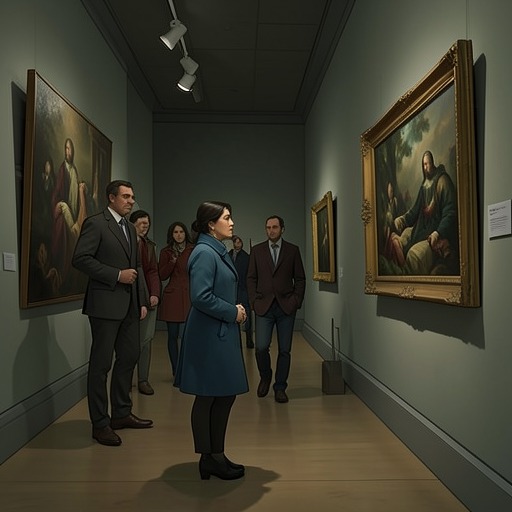
The writing appears on a window of the Walsingham Gallery on the evening of a party. It is not immediately conspicuous: the gallery lights make the glass easier to look through than to examine, and guests are occupied with the event and the picture sales. Barnaby later tells Peter Diamond that no one remarked on the writing until he and Jessica noticed it. The setting helps explain how something displayed in public could nevertheless escape attention.
Jessica is upset when she sees the graffiti and wants to call the police. She brings Shirley-Ann out of the party to look at it, making Shirley-Ann a direct witness rather than someone repeating a rumour. Shirley-Ann later stresses that she saw the words herself. Prompted by Julie Hargreaves to speak up, she resists treating her knowledge as mere intuition and insists that what she reports is factual. The message therefore enters the investigation through a specific chain of observation: Jessica sees it, calls Shirley-Ann to the window, and Shirley-Ann later tells Diamond what was written.
The words make the graffiti more than an act of damage. “She did for Sid” assigns responsibility for Sid’s death to an unnamed woman, turning a brief line on glass into a compact accusation. Its uncertainty is useful to whoever wrote it: it suggests a culprit without identifying one, inviting suspicion to settle on someone else.
Removal and suppressed evidence
Barnaby decides to wipe the writing away. His explanation is that it was better to ignore the incident than to treat it as serious; he says Jessica would have called the police if left to herself. His account also identifies the people involved in the decision: A.J. and Shirley-Ann joined him in persuading Jessica not to report it. Shirley-Ann recalls that she agreed a police call would ruin the party. The choice to clean the window is thus not presented as Barnaby acting entirely alone, even though he takes the leading role in removing the words.
That decision has a practical consequence for the investigation: the original writing is gone by the time Diamond asks about it. He must reconstruct the incident through witnesses and through traces connected to the spray paint. Barnaby’s act may appear protective of the party rather than incriminating, but it also prevents the message from being preserved and formally reported. The difference between Jessica’s impulse to call the police and the group’s decision to erase the writing becomes important once the graffiti is understood as part of a larger deception.
Barnaby and A.J. had been together during the evening, looking after picture sales. Shirley-Ann observes that they did not behave like rivals and seemed to get on well. That detail complicates any simple reading of Barnaby’s decision as an isolated response: the people discouraging a report were connected to one another, while the visible act of removing the evidence left the party free to continue.
Paint, Rupert’s beret, and the investigation
When Diamond later raises the graffiti with Barnaby, Barnaby is startled and asks who told him. He explains that most guests had not seen the writing and that the gallery’s lights made it easy to look through the windows without looking at them. He also names the Bloodhounds members who were present: Milo Motion and Rupert, whom he describes as the man with the beret. The beret, initially a detail of identification, acquires evidentiary weight when Diamond says that it has traces of sprayed paint.
Diamond tells Shirley-Ann that Rupert was at the party with paint on his beret and offers to show her the recovered item. The paint links Rupert to the graffiti incident, but the implication is not proof that he wrote the message. Instead, Diamond treats it as a possible motive for silencing him: Rupert could have exposed the person or people responsible. In this way, the graffiti and the beret form a misleading pair of clues. The window supplies a public accusation; the paint supplies a physical trace that appears to place Rupert within the event.
The distinction between the writing and the residue matters. Shirley-Ann can establish what she saw, while the beret gives the police a material object to examine. Neither fact, taken alone, settles who created the graffiti. The investigation’s later explanation depends on recognizing that a clue can be genuine as an object yet deceptive in the story it seems to tell.
Staging and narrative function
The final reconstruction identifies the graffiti incident as staged. Rupert was deliberately left with spray paint on his beret, making the physical trace appear to connect him to the message. The line “She did for Sid” was also false: the person it seemed to accuse had not killed Sid. The explanation is that the message was written by the conspirators themselves, who expected that a self-authored accusation would not direct suspicion back to them. The apparent confession or denunciation was therefore a calculated piece of misdirection.
The incident belongs to a wider effort to conceal A.J.’s responsibility for Sid’s death and to frame Rupert. Jessica had worked out that A.J. was responsible and covered for him; by the time the plan shifted toward Rupert, she was involved. The staged graffiti helped prepare that later framing by associating Rupert with sprayed paint, while another fabricated riddle was presented as if Rupert had written it and predicted his own suicide. The window message was not an isolated prank but one stage in a sequence designed to make invented evidence look like a trail of discovery.
Its significance lies in the gap between what the words appear to reveal and what their manufacture conceals. The accusation seems to offer a quick answer to Sid’s death, and the paint on Rupert’s beret seems to corroborate a connection. Yet both impressions were engineered. The graffiti’s passage from public message to erased trace, then to investigative clue and finally to exposed fabrication, makes it a small but pivotal instrument of the novel’s larger contest between apparent evidence and actual responsibility.