The paper bag with the list of rhyming words
BloodhoundsThe paper bag with the list of rhyming words is a small object with an outsized role in Peter Diamond’s investigation: it first appears to connect Sid Towers to the Penny Black riddles, then becomes evidence that Jessica Shaw may have written the lists herself. Its significance depends less on what the words say than on who handled the bag, where it came from, and what the investigators can actually establish. The object exposes the danger of treating an evocative clue as a complete account of its own history.
The Lists and Their Apparent Meaning
The bag bears lists of rhyming words rather than finished lines of verse. Peter Diamond identifies three groups associated with the words black, motion, and room. One group includes Jack, flak, knack, and mac; the other two rhyme with motion and room. These associations invite a direct connection to the case: Penny Black, Milo Motion, and the locked-room problem surrounding the murder aboard the boat. The lists look like preparatory notes for riddles, but resemblance is not proof of authorship or purpose.
That distinction had initially been lost. Julie Hargreaves regarded the writing as strong evidence that Sid had composed the earlier riddles, while acknowledging that the bag contained only a list of rhyming words, not verses. The connection seemed persuasive because the lists appeared to echo the case’s central terms. Once the possibility that the bag had been planted or passed between people entered the investigation, however, the same suggestive words could no longer securely identify their writer. The bag’s contents remain concrete; their interpretation changes.
Origin and Chain of Possession
Diamond applies the principle of continuity of evidence to the bag. For a prosecution, he explains, investigators must establish where an item originated and what happened to it after it left a person’s possession. Here neither end of that chain is secure at first. A secondhand bookshop is proposed as the source, but Diamond cautions that this is by no means certain. The bag contained a book, and the book belonged to Sid, yet that does not prove that Sid acquired the bag from a shop. It might have come from another collector, perhaps someone else in the Bloodhounds, and might have reached Sid either accidentally or deliberately.
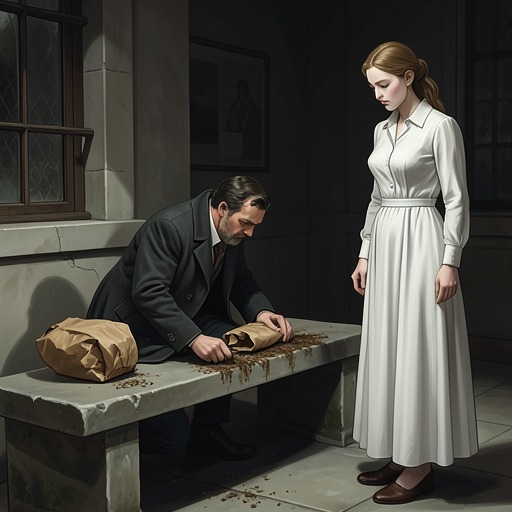
The later passage of the bag is more specific. Diamond says it was Sid’s and that Sid handed it to Jessica. During the gathering, Jessica used the bag to help Miss Chilmark when she was hyperventilating, pressing it against her face. It then ended up in Jessica’s handbag, from which Jessica handed it to Diamond. Jessica acknowledges the chain of possession as Diamond sets it out. That admission establishes her handling of the object, but it does not by itself establish that she wrote the lists. The distinction between possession and authorship is precisely what the investigation has to preserve.
From Clue to Suspect
The bag’s arrival in Jessica’s handbag changes the direction of the inquiry. Julie sees the implication: Jessica could have written the lists. But Julie also identifies an apparent objection. If Jessica had used the bag for her own notes, why would she hand it to the police rather than destroy it? Diamond offers a competing possibility: she may have wanted the investigators to see the lists and conclude that Sid wrote them. In that reading, the bag’s usefulness as evidence would itself be part of its design. At this point, however, the suggestion is a hypothesis, not a proven account of Jessica’s intention.
When Diamond questions Jessica, he presents the lists more concretely: the rhymes, he says, correspond to Penny Black, Milo Motion, and the locked room. He asks whether they are working notes, then challenges her with the conclusion that she wrote them and Sid had nothing to do with them. Jessica’s response is limited to a slight movement of her padded shoulders. Asked whether she wrote the other riddles, she answers no. The scene therefore separates two propositions that had previously been run together: the bag’s lists may be Jessica’s, while the evidence presented here does not establish that she composed the other riddles.
Diamond describes his own reversal to Jessica. Until the previous afternoon, he had assumed the lists were Sid’s and treated them as working notes for a riddle he had not completed before his death. That interpretation made Sid appear to be the poet behind the riddles, the thief of the Penny Black, and the person who had entered a locked boat. Diamond now admits that this reading was a mistake. His alternative is that Jessica wrote the lists, and the bag’s transfer from Sid to Jessica to the police supplies the chain on which he bases the accusation. He calls her his prime suspect, while also making clear that the exchange is not a formal interview and that he is giving her an opportunity to explain.
Evidentiary and Narrative Significance
The bag functions both as physical evidence and as a trap for premature certainty. Its rhymes point toward prominent elements of the case, but they do not tell investigators who wrote them, when they were written, or why the bag reached Sid. Its route can be partly reconstructed, yet even a strong chain of handling cannot fill every gap in origin or intention. Diamond’s method is to examine both ends of that chain rather than letting the apparent match between words and events settle the matter.
The object also records the investigation’s changing account of Sid. Initially, the lists reinforce the belief that he authored the riddles; later, their uncertain provenance loosens that connection and brings Jessica under suspicion. The bag does not resolve the case in the evidence presented here, and Jessica’s handling of it is not equivalent to a confession that she wrote the lists. Instead, it makes the detectives confront the difference between an item that appears to explain the crime and an item whose history has been adequately established. That difference turns an ordinary paper bag into a measure of the investigation’s evidentiary discipline.