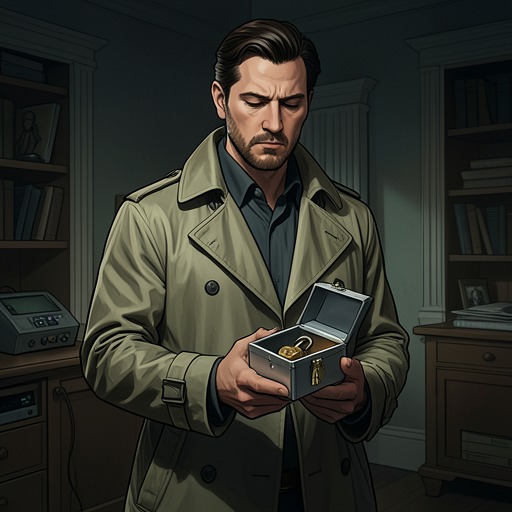
Milo Motion's copy of The Hollow Man
BloodhoundsMilo Motion's copy of The Hollow Man is a first British edition of John Dickson Carr's locked-room mystery and the book Milo brought to a Bloodhounds meeting to read from chapter seventeen. Its importance lies in the way a familiar reading object becomes entangled with the investigation: the chapter was announced in advance, the meeting's members knew which book Milo would bring, and a stamp could potentially have been placed between its pages. The book also prompts an essential distinction between Milo's copy and Sid Towers's separate copy of the same work, which was known in America as The Three Coffins.
Identity and Edition
The book Milo identifies as The Hollow Man is the British title of Carr's novel. When Peter Diamond asks about the title of Sid's book, Milo first names The Three Coffins, then explains that this was the title used in America. The work is therefore associated with two titles, not two different stories: Milo's copy bears the British title, while Sid's copy is discussed under the American one. Milo corrects Diamond's assumption that the title is English, clarifying that he means British, and notes that publishers sometimes give books different titles for the American market.
Milo describes his volume as the first English edition, published by Hamish Hamilton in 1935. It has no wrapper, a loss that matters to him as a collector: he says that with one, the copy might be worth a few pounds. That detail gives the volume a value beyond its immediate use as a text. It is a particular edition whose condition affects its collectability, even as the investigation makes the book's contents and whereabouts more pressing than its market price.
The Book at the Bloodhounds Meeting
Milo had told the Bloodhounds at their previous meeting that he would bring The Hollow Man to their next gathering and read the locked-room chapter. At the Monday meeting, he brought the book and opened it at chapter seventeen. His stated plan explains why the volume was expected there; it also means its presence was not, by itself, suspicious. The announcement had made the choice of book and chapter common knowledge among those who attended the earlier meeting.
Sid brought a copy too. Milo supposes that Sid wanted to follow the text, and describes him as quiet but knowledgeable about Carr. Sid's volume was called The Three Coffins, and Milo says he had understood Sid to admire Carr's work. The two men thus arrived with separate copies of the same novel: Milo's British edition for the reading, and Sid's differently titled copy for following along. Keeping the copies distinct matters to Diamond's inquiry; the shared story and the two titles could otherwise make references to the books seem to describe a single volume.
Connection to the Stamp
Diamond recognizes that Milo's announced reading gave the other Bloodhounds advance knowledge of the book's position and intended opening. Since the chapter was to be chapter seventeen, an attendee from the previous meeting could have known where the book would be opened. Diamond reasons that any of them might have placed the stamp between the pages, provided they were clever enough to find a way. The book consequently becomes a possible hiding place within a circle of people who knew Milo's plan; the announcement supplies opportunity, not proof of who used it.
That possibility turns the locked-room chapter into more than a selection for a club reading. A fictional puzzle about confinement is attached to a real investigation in which access, timing, and the placement of an object must be considered. The text does not establish in these passages exactly who put the stamp in the book or how it was done. What it does establish is why Milo's copy was relevant: its expected arrival and opening had been disclosed beforehand, so the book's use at the meeting could have been anticipated.
Evidence and Distinct Copies
Later, Julie Hargreaves handles a bulky package identified as the book someone had with him at the Bloodhounds meeting. She names it The Three Coffins. This reference reinforces the need to distinguish the books by their titles and owners: Milo has already identified his own first British edition as The Hollow Man, while Sid's copy is discussed as The Three Coffins. The package passage does not, on its own, make those two physical volumes identical. Its value to the article is as a reminder that the investigation deals with books sharing one text but belonging to different people.
The novel therefore occupies two roles in the episode. As a collectible edition, Milo's copy has a specific publication history and a missing wrapper; as a planned reading text, it is predictable enough for other club members to know when and where it would be opened. Its literary subject supplies the locked-room motif, while its material pages offer a possible location for the stamp. The tension between those roles makes the volume an object of evidence: not merely a book being discussed, but a book whose title, ownership, planned use, and pages all matter to Diamond's reconstruction.