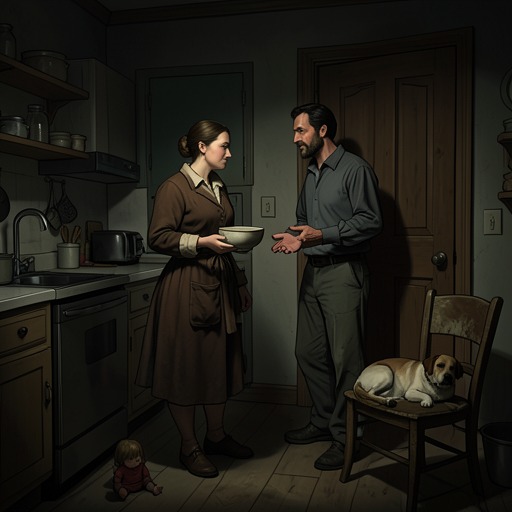
Shirley-Ann Miller—Bert
BloodhoundsShirley-Ann Miller and Bert’s relationship is presented through ordinary domestic routines and frank conversation rather than a formal account of their history. Its defining pattern is mutual familiarity with an imbalance of energy: Shirley-Ann tells Bert everything and presses him to think with her, while his strenuous days often leave him ready to sleep. Their exchanges place practical hopes and private speculation side by side, making their intimacy visible in what they share and in how differently they respond.
Shared Life and Economic Hopes
Bert urges Shirley-Ann to seek full-time work, but she answers that she is waiting for him to open the private health club he is forever promising to establish in Bath. She imagines herself as its receptionist in a white suit, a concrete role within his plan rather than an abstract show of support. Bert’s ambition is specific: he hopes to partner with a leading hotel and provide the latest gym facilities, a swimming pool, steam rooms, saunas, and sunbeds. The obstacle is finance; the bank has so far refused to provide a loan.
That exchange gives their hopes a practical tension. Shirley-Ann’s response makes room for Bert’s dream in the way she imagines her own future, but the venture remains dependent on money he has not secured. Her own employment is precarious: she hands leaflets to tourists in front of the Abbey, and rainy weather can cancel the work without pay because she is paid by the hour. When the season ends, she expects to return to stacking shelves at Salisbury’s, if vacancies remain. The contrast does not establish that Bert’s plan will succeed or that Shirley-Ann has abandoned other work; it shows the uncertain circumstances in which their shared future is discussed.
A Habit of Confidence
Shirley-Ann’s openness is stated as a settled feature of their relationship. Sitting in bed with a mug of cocoa, she tells Bert about the writing on the Walsingham Gallery window. She sees no reason to keep the incident from him: no one had instructed her to remain silent, and withholding it would make her feel furtive. She always tells him everything. That habit makes Bert a recipient of her account of the Bloodhounds and the surrounding events, even though he has not met Jessica and is not himself part of the investigation.
Their private conversation is therefore also a channel through which Shirley-Ann tests her thoughts. Bert asks who wrote on the gallery window, but she admits that she does not know. She notes that Milo was at the party and so was Rupert, while cautioning that their presence proves nothing; whoever wrote the words might not have attended at all. The exchange shows her sharing uncertainty as readily as conclusions. Her trust in Bert does not mean that she has evidence to offer on every question, but it gives her a place to voice possibilities without pretending they are established facts.
Different Rhythms of Attention
Bert’s participation is shaped by fatigue. He has spent much of the day doing sport, and weekend football refereeing also leaves him tired. When Shirley-Ann asks whether there is anything in the possibility that Jessica killed Sid, he responds wearily and says he is tired. Shirley-Ann recognizes the unfairness of asking him to judge someone he has never met. Yet Bert says that he has heard enough from her about the group to form an opinion and considers Jessica capable of murder. His view is second-hand, grounded in the stories Shirley-Ann has told rather than personal acquaintance.
The scene does not turn that exchange into a sustained investigation carried out jointly. Bert is already horizontal and close to sleep; Shirley-Ann remains awake, sitting up and taking sips from her cocoa. After he nearly dozes off, she continues thinking aloud. Her Snow White mug, the bedside table, and the clock showing that it is past midnight locate the discussion within the small, familiar space of their bedtime routine. The details also register its cost: she knows she needs sleep in case she is offered another chance to work as a tour guide in the morning, but Bert’s brief opinion has set her mind racing.
Speculation and the Limits of Agreement
Shirley-Ann begins by considering whether Jessica might have discovered Sid entering Milo’s boat and become angry on realizing that he was the stamp thief. She rejects that explanation as insufficient, reasoning that Jessica is too intelligent to act in so direct a way. She then forms a more elaborate hypothesis: Jessica and Sid may have planned the Penny Black theft together, using Sid’s security expertise and Jessica’s intelligence to defeat the Postal Museum’s cameras and locks, gain access to Milo’s narrowboat, and place the stamp in his copy of The Hollow Man for discovery at a meeting. In this account, the theft and the riddles were intended to astonish the Bloodhounds, and the stamp was returned; the plan went wrong when Sid went back to the boat and Jessica followed him.
These claims remain Shirley-Ann’s conjecture, not facts established by the conversation. She imagines Jessica striking Sid, locking him in, and leaving, then concludes that Jessica did for him. Bert has drifted into a shallow sleep and has heard none of the theory; when she shakes his shoulder, he answers apathetically. His response does not confirm her reconstruction. The scene instead distinguishes the closeness that allows Shirley-Ann to tell him everything from agreement or sustained attention: she brings him into her thinking, but reaches the conclusion largely alone.
Their relationship thus serves as both a domestic refuge and a sounding board with limits. The health-club plan shows them imagining a practical future together, while the midnight exchange reveals Shirley-Ann’s need to work through a dangerous possibility aloud and Bert’s exhaustion at the edge of the conversation. Their intimacy is conveyed not by a resolution between them but by the routine of disclosure itself: even when he is nearly asleep, he is the person to whom she turns.