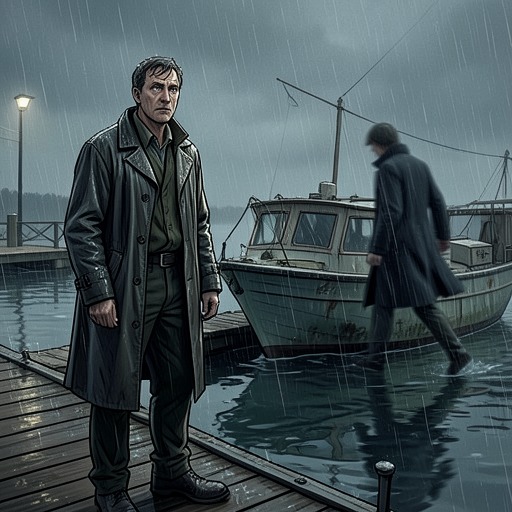
Gilbert Jones—Rupert Darby
BloodhoundsGilbert Jones—Rupert Darby is a relation created by accusation and murder rather than by any prior acquaintance or personal dispute. Jones chose a stranger as a disposable suspect, marked him out through the staged gallery graffiti, and killed him so that his death could be mistaken for suicide. The scheme turned Rupert into a false answer to the questions surrounding Jones’s crimes: a man made to appear guilty, then made unable to contradict the story told about him.
The Stranger Chosen as a Suspect
Jones acknowledged that Rupert had never crossed his path before he selected him. That absence of connection was precisely the attraction: Rupert was not someone whose history with Jones might lead investigators toward the real motive. Jones first considered Jessica Shaw, whom he regarded as clever enough to have written the riddles and whose art-gallery party offered an opportunity to attract notice. The message on the gallery window could create a distraction, but Jones also needed someone else to bear responsibility for writing it. He settled on Rupert instead.
The choice was chillingly practical. Jones reasoned that a stranger could be used without an existing relationship to complicate the frame. The gallery message would draw attention toward a conspicuous suspect, while the supposed suicide would appear to close the inquiry. Rupert’s lack of connection to Jones did not protect him; Jones treated that very lack as a useful concealment. The relationship between them was thus not a feud but a trap built around one-sided knowledge: Jones knew why he had selected Rupert, while Rupert had no prior encounter with him.
Constructing the Frame
The graffiti incident joined Rupert to a crime he had not committed. Jones marked him with spray paint, making him recognizable by his beret, and arranged matters so that suspicion would fall on him as the person responsible for the writing. The staging depended on visible signs that could be read as evidence against Rupert, even though Jones had engineered their significance. A message about Sid Towers further encouraged a misleading interpretation of who had caused Sid’s death; the accusation did not identify the real killer.
The frame was not simply an attempt to make Rupert look suspicious in isolation. It connected the gallery-window incident to the riddles and the earlier killing, offering investigators a ready-made account in which Rupert appeared to be the author and the deaths appeared to fit that account. Jones later described the plan as a means of buying time while suspicion was closing in on him. The deception converted public clues into a false narrative: the more attention the graffiti attracted, the more it could direct attention away from Jones.
Murder and the Staged Suicide
Jones’s scheme escalated from framing Rupert for the graffiti to killing him. The account of the plan describes Rupert being surprised as he came out of his local, after being marked with paint, and later getting him drunk before hanging him. A further riddle, supposedly written by Rupert, predicted his suicide. Together, the planted message and the staged death were intended to make the conclusion seem settled: Rupert had written the graffiti and then killed himself.
The appearance of suicide was essential to the false relationship Jones imposed on Rupert. It made the victim seem to have authored both the accusation and his own ending, concealing the fact that Jones had chosen him as a target. Jones did not treat the killing as an unforeseen consequence of the frame. In the final explanation, the death is explicitly distinguished from Sid Towers’s killing: Rupert’s murder was planned, and stringing him from a bridge was no accident. The staged ending was designed to make an intentional murder look like the final act of Rupert’s supposed guilt.
Motive and Significance
Jones explained that he feared Peter Diamond would eventually reach him and that he needed a dramatic distraction. He initially thought of implicating Jessica Shaw, then chose Rupert as the more useful alternative. The evidence therefore presents the connection as instrumental from Jones’s side: Rupert was selected not for something he had done to Jones, but because Jones believed he could be made to carry suspicion. No prior insult, rivalry, or personal history is offered as the reason for the choice.
The contrast between Jones’s elaborate intellectual ambition and Rupert’s vulnerability defines the relation’s significance. Jones regarded the locked-room crime as proof of his brilliance before the Bloodhounds, the police, his workmates, and everyone he believed had slighted him. In that design, the deaths of two men became secondary to the success of the puzzle. Rupert’s murder exposes the human cost of treating a crime as an intellectual performance: the apparent solution was built by assigning guilt to a stranger and then killing him to make the assignment look true. Jones’s plan ultimately failed, but it had already transformed Rupert’s anonymity into the instrument of his destruction.