Turner's watercolor of Bath Abbey
BloodhoundsTurner's watercolor of Bath Abbey matters less as a stolen artwork than as the conspicuous object used to divert attention from a different target. Kept in the Victoria Gallery and valued at more than a million, it prompts an urgent security review after a cryptic message appears to threaten it. Peter Diamond eventually recognizes the painting’s role in the misdirection: the riddle’s Victoria is not the gallery but the Queen Victoria depicted on the Penny Black.
Identity and Significance
The painting is identified by the assistant chief constable as a watercolor of Bath Abbey by J. M. W. Turner. It is described as one of Turner’s earliest works, completed before he was twenty-one, and the assistant chief constable presents Turner as possibly the greatest painter Britain has produced. The painting’s artistic distinction is paired with a striking monetary figure: it is said to be worth over a million. Its value makes the threatened theft credible enough to command police attention, even among officers whose knowledge of fine art is limited.
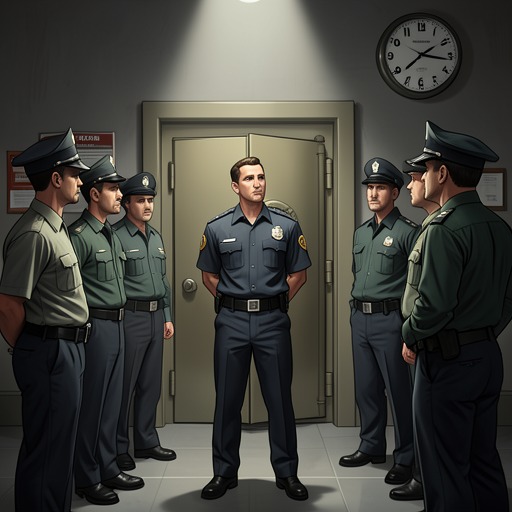
The scene establishes that gap through the officers’ responses. John Wigfull asks whether the work is housed in the Pump Room, and the assistant chief constable supplies the correct location, the Victoria Gallery. After that explanation, the room falls silent when he asks whether anyone has seen the painting. Tom Ray reacts to the price by questioning whether a single picture can be worth so much. Their uncertainty contrasts with the authority of the assistant chief constable’s account, while also showing how the painting’s institutional importance must be explained before the officers can respond to it as a security concern.
The Security Review
The assistant chief constable treats the apparent threat as an opportunity to prevent a major theft and assigns the Bumblebee team responsibility for reviewing the gallery’s security. Wigfull is to liaise with Impregnable, the security company. The instructions are practical and comprehensive: inspect the windows, roof, and every point of access; confirm that the alarms work; and ensure that the guards know of the threat. The painting is kept upstairs in the permanent collection, a detail that makes the building’s physical vulnerabilities central to the review.
Wigfull asks whether the objective is to frighten the thieves off. The assistant chief constable hesitates before describing the operation as crime prevention. That exchange gives the review a double edge: it is a genuine precaution, but its usefulness depends on a threat whose author and meaning remain unknown. The police are mobilized around a specific, valuable object and a plausible set of access points, although the later interpretation of the message changes what that activity signifies. The painting’s security becomes the visible business of the investigation while another object remains concealed by the riddle.
The Riddle and Its Reinterpretation
The threat reaches the police through BBC Radio Bristol. The broadcast presents a four-line message beginning with the initials J.M.W.T. and the phrase about being surrounded by security, then invokes Victoria and promises that the speaker will shortly come to her. The station says that it received the message early that morning, that its meaning and sender are unknown, and that the same message went to the local press. Its appeal to listeners turns the puzzle into a public challenge as well as a police problem.
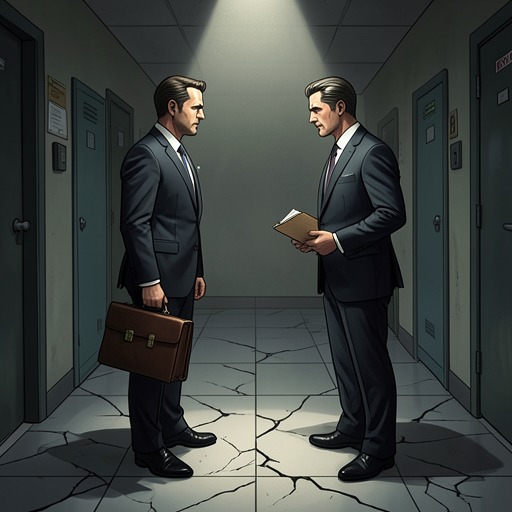
When Peter Diamond later repeats the message to John Wigfull, Wigfull initially shows no sign of understanding it. Diamond explains that the officers have been set up: the Turner was a distraction, and Victoria did not mean the name of the gallery. It meant the Penny Black, the stamp bearing Queen Victoria’s head. The initials and the security language had encouraged the police to connect the riddle to Turner and the painting; the word Victoria then appeared to confirm the gallery reading. Diamond’s solution separates those clues from the interpretation that first made them seem to fit.
The Painting as a Decoy
The painting’s importance in the episode comes from the way its real attributes support a false lead. Turner’s initials, the Victoria Gallery, the work’s high value, and the warning about security combine into an apparently coherent threat. None of those details needs to be fabricated for the diversion to work: the painting is genuinely famous, genuinely valuable, and genuinely kept in a gallery whose security the police can inspect. What misleads the officers is the assumption that the riddle’s references all point to the artwork and its location.
Diamond’s explanation reverses that assumption. The painting remains the subject of a real security review, but it is no longer the intended target indicated by the message. The change is also a shift in what the word Victoria can mean: first a gallery name in the police inquiry, then the monarch represented on the stamp. By making a celebrated painting the plausible center of attention, the riddle directs investigation away from the Penny Black. The watercolor thus functions as both a valuable artwork and an instrument of misdirection, its public prominence helping the actual clue remain overlooked.