Longboat Bay
BluebackLongboat Bay is the coastal home that shapes Abel Jackson’s identity and the setting where his family’s history of living from the sea turns, eventually, toward protecting it. Its orchard, shoreline, surrounding forest, and underwater reefs sustain daily work and intimate memory; the exposed remains of the family’s whaling past make that history visible, while the sanctuary established there offers a different inheritance for the future.
Setting and Inherited Life
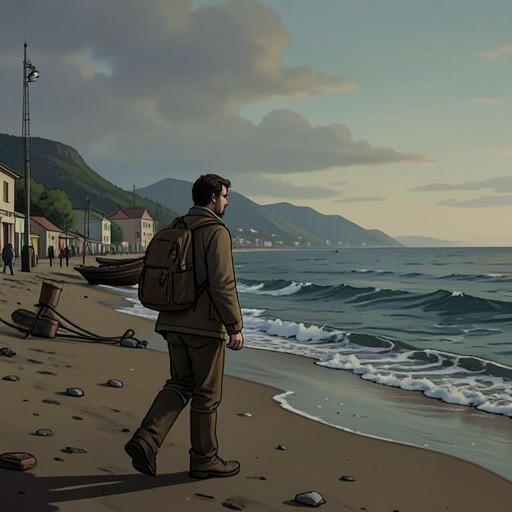
The Jackson family had lived at Longboat Bay for more than a hundred years, and its land had belonged to them since whaling times. National park surrounded the family’s property. Behind the orchard, a small cemetery held the white crosses and headstones of Jacksons who had lived and died there. Abel’s father had a cross, but no body lay beneath it. The family’s presence thus joined a particular patch of land to a history of both belonging and loss.
The household depended on the bay and the land rather than on town infrastructure. Abel and his mother fished and grew fruit and vegetables, kept ducks and chickens for meat and eggs, and raised goats for milk. There was no mains electricity and no water supply apart from rainwater. The work was demanding, but it was the only way of life Abel had known. He swam every day and roamed the forest of the national park; the bay was not simply a view from home but part of the practical world that fed and formed him.
The orchard linked land-based work to the rhythms of the coast. Abel carried washed kelp uphill to the fruit trees, while fish they caught were used as fertiliser. Rows of fig, apricot, orange, lemon, olive, and mulberry trees stood among bells hung to keep birds away. From there he could look out over Longboat Bay, with thoughts of the sea and Blueback drawing him back toward the water. The family’s livelihood crossed the boundary between shore and sea at every turn.
The Bay as Home and Memory
Abel learned the sea by diving with his mother, who taught him everything he knew on land and underwater. Their work gathering abalone depended on breath, repeated descents, and close attention to the reef: they took a few from each clump and left the others to breed and grow. As they worked, reef fish picked through the stirred sediment. The underwater world was both a source of food and a living community around them.
It was in these waters that Abel first encountered the large groper he named Blueback. The day became a dividing line in his sense of the place: the sea and bush had always been his life, but after meeting the fish they felt more precious. Even while helping his mother prepare abalone for freezing, Abel was planning to return to Robbers Head to see Blueback. Longboat Bay held the daily work of home, but its waters also opened onto encounters that Abel could not command or fully understand.
That attachment became clearest when Abel had to leave for school in a town far inland. The flat wheat country, cleared of trees, felt constricting beside the varied, living landscape of home. He was surrounded by other students and the noise of the hostel, and Longboat Bay remained present in his mind as a persistent ache. In a dream, Blueback led him through a deep crevice past drowned sailors and other bodies to Abel’s father and Mad Macka. Abel saw his father as a young man who would always be thirty-two, but Blueback kept him from reaching the body and carried him back toward the surface. The dream gives the bay and its depths a role in Abel’s experience of family memory: they hold what he longs to recover, while marking what cannot be returned to him.
His mother’s attachment to Longboat Bay was equally strong. She told Abel that she hated being inland and that the place held her memories of his father. She missed Abel when he was away, but did not feel lonely in the same way; the bay itself was a kind of friend. Abel, for his part, told her that he loved the house, land, water, fishing, and growing things, and never wanted to leave. The two shared a bond to the place, though Abel’s later travels would test whether belonging required remaining there permanently.
A Coast Marked by Use and Change
The bay carries the history of the Jacksons’ changing relationship with the sea. Abel’s mother explained that the family had come as whalers: lookouts watched for passing pods from the ridge, and crews rowed out in longboats to harpoon them. Watching Right whales from a boat, she admitted feeling bad about a hunt that had taken place before her time. She also reflected that the sea had taken its share of the family. Abel thought of the crosses behind the orchard as a whale passed, feeding by straining water through its baleen. The scene places the living animals alongside the human history of taking them and the family’s accumulated losses.
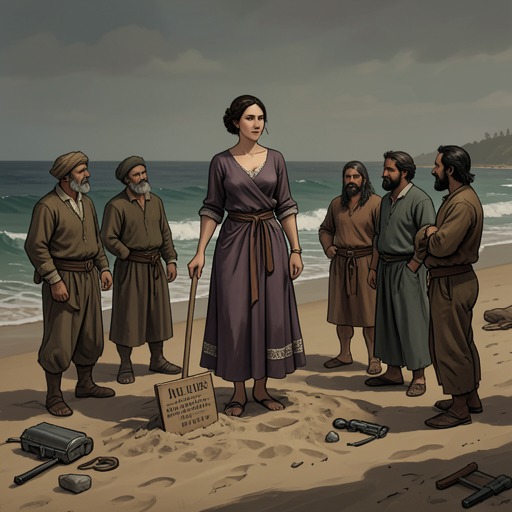
That history rose physically to the surface after a violent storm. The storm damaged fences and the freezer shed, battered the shore, and exposed thousands of whale bones along the bay. For Dora Jackson, stepping among them was like walking through a graveyard. The bones had lain beneath the sand for a century or more, hidden under ground she had crossed for forty years. Their sudden appearance made the earlier whaling era impossible to treat as a distant abstraction: the family’s prosperity and presence on the coast had been supported by the extraction of blubber oil, baleen, seal fur, and fish.
The bay also faced newer pressures. A month after an oil tanker broke apart off the coast, Abel watched the slick spread on television from far away, then saw the ship catch fire and the slick burn as bad weather dispersed it. No oil reached the shore, but the incident showed how close Longboat Bay had come to disaster. Elsewhere, Dora observed increasingly fierce and erratic weather, a year without salmon, a leopard seal far from its usual home, and five dead dolphins caught in the cliffs at Robbers Head. These events made the condition of the coast feel unstable even before the great storm revealed its buried past.
Protection and Return
After seeing the whale bones, Dora concluded that it was time to help the sea live and protect the bay permanently. From the wreckage of her house, she began writing letters and continued for months, sending hundreds to politicians, business leaders, and scientists. They ignored her at first. She persisted, and photographs of Blueback reached newspaper editors. Her campaign turned a family’s inherited claim to the coast toward the public protection of its waters.
The decision was confirmed while Abel and Stella were working far away. A message reached their expedition boat that Longboat Bay had been declared a sanctuary, with the marine life there protected by law. Abel read it before he had dried himself; Stella called in a helicopter, and he went below to pack. The declaration changed the bay’s status, but it also changed the direction of Abel’s life. He and Stella returned, and Abel chose to stay rather than continue travelling with the Foundation.
Dora came home to a freshly painted house, repaired sheds, and newly planted gardens. Although she was still recovering and needed help to walk, she stood with a frame when officials arrived to declare the bay a marine reserve. She recognized among them politicians who had once been businessmen seeking to build hotels there. With satisfaction, she watched the marker buoys being placed along the sanctuary’s boundary, which extended to Robbers Head. She hoped for other havens along the coast, but the protected bay itself was a hard-won beginning.
A Living Sanctuary
Abel, Stella, and Dora made a life together at Longboat Bay. As Dora recovered, the three mended nets, bottled fruit, smoked fish, and told stories while they worked. Abel and Stella supervised the bay, watched over summer visitors, and wrote papers on abalone breeding. They also guided divers to see Blueback feeding on crabs and swimming around his reef. Scientific observation and ordinary household work belonged to the same life, both grounded in continued attention to the place.
The sanctuary’s effects became visible in the abundance of the bay. Fish entered the protected waters, bred there, and helped swell stocks beyond the refuge. Seagrass, coral, and sponges thrived; abalone grew in the reef, while dolphins and sharks returned to the area. Sea lions came back to Robbers Head after being absent for a hundred years. Visitors could dive into a flourishing underwater world and see what the ocean might be like when left room to recover.
Dora died after one last swim in the bay, and Abel made a new cross for the cemetery behind the orchard. He did not regret staying. The life he had wanted as a boy became his everyday life, while the bay’s protection connected the family’s history to a future not defined solely by taking from the sea. Abel and Stella returned to scientific work, but neither they nor the visitors who came from around the world discovered all the sea’s secrets. Longboat Bay’s significance rests partly in that limit: it is a home people can know through work, memory, and observation, yet a living place whose depths remain beyond complete human knowledge.