Longboat Bay’s marine sanctuary status
BluebackLongboat Bay’s marine sanctuary status is the legal protection of the bay and the life within it, established after years of commercial pressure and Dora Jackson’s persistent advocacy. Its decisive significance is both ecological and familial: a place from which the Jacksons had long made their living becomes a refuge where marine life can recover, and where Abel Jackson and Stella continue to study and protect the sea.
Definition and Boundaries
The sanctuary is described as a marine park in which everything that grows and swims in Longboat Bay is protected by law. Its boundaries extend out to Robbers Head, marked by buoys set by officials when the bay is formally declared a marine reserve. The markers make the protection visible on the water, defining a safe area within a wider coast where fishing pressure remains a concern.
The declaration arrives in two linked stages. Abel and Stella first receive a fax while diving in a warm lagoon: the message says that Longboat Bay has been declared a sanctuary and marine park. They immediately set out for home. Later, Dora, standing with the aid of a walking frame, watches officials establish the reserve and place its boundary buoys. The legal announcement and the physical marking of the water turn years of campaigning into an enforceable change to the bay’s status.
A Coast Shaped by Use
The sanctuary changes the purpose assigned to a coast that had supported the Jackson family for generations. The family’s land at Longboat Bay dates to whaling times, and Dora recalls that the Jacksons came as whalers, watching for passing whales from a ridge before rowing out in longboats to harpoon them. When Right whales later appear beside Abel and Dora’s fishing boat, the sight prompts Dora to acknowledge the family’s whaling history and the losses the sea has also taken from them.
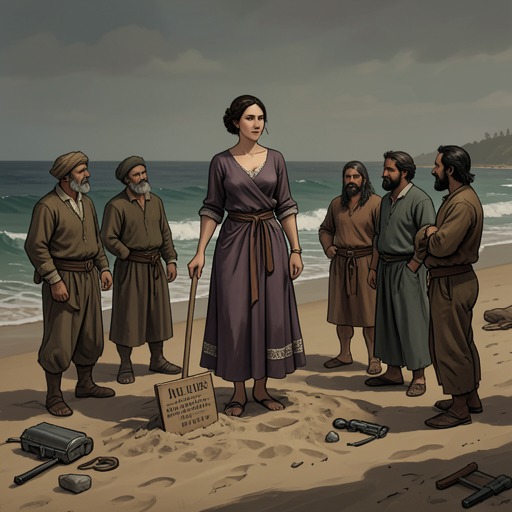
That history becomes tangible when a storm exposes thousands of whale bones buried beneath the sand. Dora recognizes them as remains left by the Jacksons’ whaling past and understands that the family’s inherited relationship with the sea must change. The generations before her had drawn their livelihood from the ocean; she decides that her own work must help the sea live. Sanctuary status therefore represents more than a new restriction: it reverses the direction of the family’s inherited use of the coast, from taking marine resources to protecting them.
The need for protection is not abstract. At Robbers Head, Costello’s boat carries large piles of fish, many undersized, alongside crates of live Abalone and an illegal box of crayfish. After Dora intervenes, Costello and his offsider resume stripping the reef; the Fisheries patrol eventually boards the boat, and it leaves under tow. Costello’s fines cost him his licence, but the reef remains exposed to renewed pressure. The episode shows why the sanctuary’s later legal status matters: one enforcement action against a commercial operator does not by itself secure the bay for the future.
Campaign and Establishment
Dora begins organizing for lasting protection after the storm uncovers the whale bones. From the wreckage of her house, she writes letters through the night and continues for months, sending hundreds to politicians, business leaders, and scientists. Many ignore her. She also sends photographs of Blueback to newspaper editors, using the fish’s recognizable image to draw attention to the bay. Her campaign is sustained through repetition and patience: she keeps writing until the people and offices she is addressing can no longer simply outlast her.
A further warning comes when an oil tanker breaks apart off the coast. Abel watches reports of the spreading slick from overseas, then sees the ship catch fire and the oil burn as foul weather disperses it. The slick never reaches shore, but Abel understands how close the coast has come to disaster. Dora calls the incident a warning. Alongside the pressure on the reef, the near-disaster underscores the vulnerability of the wider coast and the stakes of securing protection for Longboat Bay.
When the official declaration is made, Dora points out politicians who had previously been businessmen seeking to build hotels in the area. Her satisfaction at seeing the boundary buoys set reflects the distance between those earlier development plans and the protected reserve. She hopes there will be more havens along the coast, though for the moment she is content that Longboat Bay itself is safe.
Ecological Effects and Continuing Stewardship
After protection is established, the bay grows richer with life. Fish enter the sanctuary, breed there, and help swell stocks along the coast beyond it. Seagrass, coral, and sponges thrive; Abalone become abundant; Dolphins and sharks return, and sea lions come back to Robbers Head after an absence of a hundred years. The account links the protected refuge with recovery inside its boundaries and benefits beyond them, rather than treating the reserve as an isolated patch of healthy water.
The sanctuary also shapes how people encounter the bay. Divers visit from elsewhere to see its marine life, including Blueback, and Abel and Stella take visitors to watch the fish feed and move around its reef. They return to scientific work, write papers on Abalone breeding habits, and continue to observe and monitor the bay. Protection thus supports both a living marine refuge and sustained attention to the processes that maintain it.
Abel’s commitment is personal as well as scientific. He gives up his work with the Foundation, brings Dora home, and stays at Longboat Bay; he never regrets that choice. Dora recovers enough to walk with assistance and remains connected to the place she fought to protect. After her death, Abel and Stella continue to supervise the bay and care for its visitors. The sanctuary endures as a practical inheritance: not simply a legal designation, but a responsibility passed into the next generation, grounded in knowledge of the coast and the decision to let its marine life flourish.