Oceanic ecological disturbance and decline
BluebackOceanic ecological disturbance and decline is traced through the changing waters of Longboat Bay: from the rich reef Abel Jackson learns to harvest carefully, to unexplained fish deaths and accumulating signs of environmental instability, and finally to a protected bay where marine life flourishes again. The sequence offers no single explanation for the sea’s changes. Instead, it sets close observation and practical care against the limits of what people can know or control.
A living sea and a family history
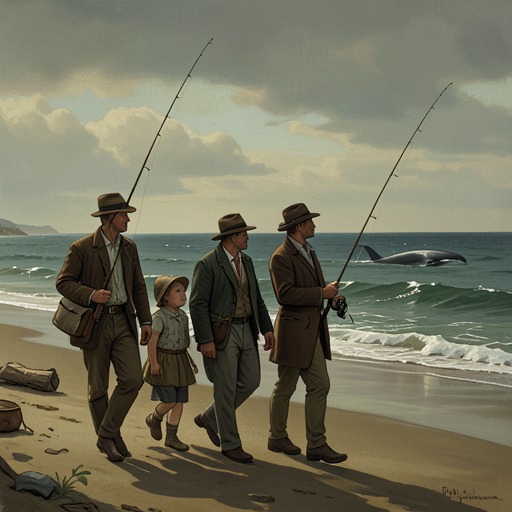
When Abel Jackson is ten, underwater life is abundant and familiar. He dives with Dora Jackson, who teaches him to take only a couple of abalone from each clump and leave the rest to breed and grow. As they work, reef fish gather around the stirred sediment and scraps of meat. The harvest is part of a life sustained by both sea and land, not an activity separate from the bay’s ecology. That dependence has a long history. The Jacksons have lived at Longboat Bay for more than a hundred years, and Abel’s father’s family came there as whalers. Dora tells Abel that the family once watched for Right whales from a ridge, then rowed out in longboats to hunt them. Her hope that the whales do not remember the hunt leaves the history unsettled: the same sea that fed generations also bears the consequences of their use. The family’s later subsistence fishing and selective gathering differ in scale and method from commercial extraction, but they do not make the family independent of environmental change.
Disturbance without an explanation
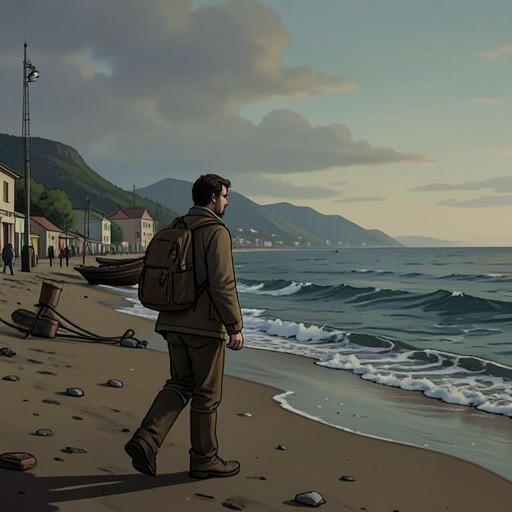
The first unmistakable local warning comes when Abel returns home from high school and finds the beach black with dead Pilchards. There has been no storm, warning, or oil spill to explain the die-off. Flies fill the air, gulls hover above the fish, and Abel and Dora load the soft remains into a truck to spread on the orchard and garden soil. The fish can still be put to use, but their sudden death changes the meaning of a familiar seasonal resource: what normally helps feed the land has arrived as an unexplained mass loss from the sea. A dive later that day offers no visible answer. Along the point and out at Robbers Head, the abalone have recovered from Costello’s fishing season; schools of fish appear healthy, while kelp and coral seem alive. Abel even plays with Blueback. The contrast between the beach and the underwater scene frustrates diagnosis: the bay looks ordinary beneath the surface, though the dead fish have made ordinary conditions impossible to trust. Later that month, tuna skippers report dead Pilchards floating along the coast as well. The event is no longer confined to the beach Abel knows, but nobody has an explanation for it.
Pressures and warning signs
The book distinguishes unexplained ecological disturbance from damage that can be linked to human activity. At Robbers Head, Abel sees Costello’s boat carrying great mounds of fish, many undersized, alongside crates of abalone and illegal crayfish. Costello and his offsider continue stripping the reef even after Abel and Dora intervene; Blueback keeps away, nursing a sore head. Costello’s fines later cost him his licence and put him out of business. After that fishing season, the abalone recover, showing a local improvement associated with the end of that pressure. The recovery does not, however, account for the unexplained Pilchard deaths. Other events widen the sense of vulnerability without establishing a single cause. A month after an oil tanker breaks in two off the coast, Abel watches images of the spreading slick from far away. Bad weather breaks it up, and no oil reaches shore, but the near miss makes clear how close Longboat Bay has come to a much larger disaster. Dora calls it a warning. In later years, the weather grows more fierce and erratic; a leopard seal arrives from Antarctica, salmon fail to appear one year, and Dora finds five dead dolphins caught in the cliffs at Robbers Head. These changes accumulate as troubling observations, not as a proven chain of cause and effect.
The limits of knowing
Abel responds to the Pilchard deaths by wanting to understand the sea. His question is not only what has happened, but what the water might feel like to the creatures living in it. He imagines that Blueback, old enough perhaps to have known Dora as a girl and Abel’s parents when they were young, could tell him what the sea knows. That imagined store of memory remains beyond human access. The fish’s presence links generations in Abel’s mind, but it does not turn the ocean into a readable record. The story also places this uncertainty beside Abel’s memory of the deep as a realm of lives and histories he cannot retrieve. In a dream, Blueback leads him through a crevice past drowned sailors and children to Abel’s father and Mad Macka. Blueback then draws Abel away from his father and back toward the surface. Later, on a plane home, Abel dreams that Dora sinks into the bay and Blueback follows her into darkness. These dreams are not evidence of ecological change; they give imaginative form to the sea’s depth, its losses, and the boundary between human desire and what cannot be brought back. In waking life, Abel and Stella travel to damaged and unfamiliar waters, including estuaries choked with pollutants, but the knowledge they gain does not yield a final secret of the sea.
Protection and renewal
Dora’s persistent campaigning helps turn concern for Longboat Bay into a formal safeguard. After years of writing to politicians, business leaders, and scientists, she learns that the bay has been declared a marine sanctuary, with its living things protected by law. When officials later mark the reserve’s boundaries with buoys, it extends to Robbers Head. The boundary gives practical force to a hope Dora has held for the bay, though she also wants other havens along the coast. The ending shows the ecological consequences within the story’s account of the sanctuary. Fish enter the protected bay, breed there, and contribute to stocks beyond it; seagrass, coral, and sponges thrive, and abalone grow plentifully. Dolphins and sharks return, as do sea lions at Robbers Head after a hundred years away. These changes do not solve the earlier mysteries or reveal everything the ocean contains. Abel and Stella continue their scientific work, watching, listening, and reading without discovering the sea’s secret. Their decision to leave the sea room to be itself is therefore not a claim of mastery, but a form of care shaped by uncertainty: protection can allow life to recover even when people cannot fully explain the waters they depend on.