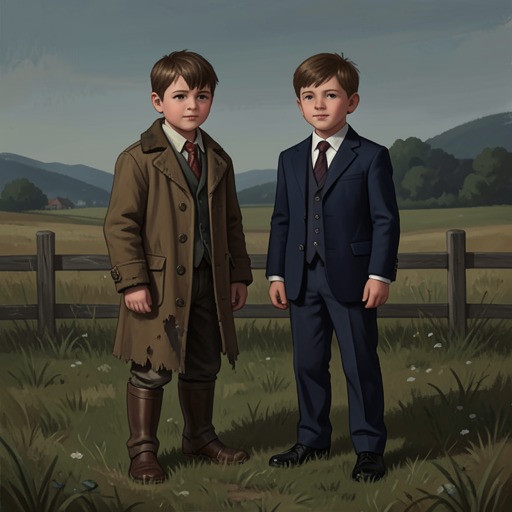
Chickens
BuddenbrooksChickens are a recurring part of the rural setting around Count Eberhard Mölln’s farm and of the imaginative world his son Kai shares with Hanno Buddenbrook. Their narrative significance lies in this double presence: they are among the animals Kai knows from daily life, and they become part of the force he imagines leading against a powerful magician to rescue Hanno.
Setting and Appearance
When Hanno and Ida Jungmann walk north beyond the Burg Gate, they glimpse a small, nearly worthless farmstead where chickens are among the first signs of life inside the gate. The property’s modest surroundings—also including a manure pile, a doghouse, and a poor cottage-like manor house—contrast with the imposing title Count Eberhard carries. The chickens belong to a household far removed from the Buddenbrooks’ ordered town life, and to the setting in which Kai has been raised.
The farm’s animals become familiar landmarks as Hanno encounters Kai there. Kai has grown up among chickens and dogs, and his childhood play includes frightening the chickens with somersaults while he roughhouses with puppies. The account places the birds within the everyday activity of the farm: they are not decorative emblems, but part of the living environment in which Kai’s untamed energy develops.
Encounter at the Farm
At Kai’s insistence, Hanno visits the estate to see newborn guinea pigs. The boys first inspect the vegetables and the animals, including chickens, dogs, and guinea pigs, before entering the house and finding Count Eberhard reading and eating. The visit brings Hanno close to the place he had previously seen only from outside; the chickens are part of the grounds that the boys explore before meeting Kai’s father.
The farm episode also establishes a contrast between the two boys’ surroundings. Kai brings Hanno into an isolated household with animals and practical outdoor work, while Kai’s later visits take him into the Buddenbrooks’ large home. The chickens help mark the difference without being assigned a meaning beyond the scene: they are a concrete element of Kai’s home and of the rural life from which their friendship reaches into Hanno’s domestic world.
From Farm Animals to Story
After Ida Jungmann has read familiar fairy tales to the boys, Kai begins making up stories of his own. Their tales draw partly on reality but transform it with a mysterious, heroic cast. In the story Hanno particularly enjoys, a boy chosen to become a fearless hero will lead an invincible army of dogs, chickens, and guinea pigs against an evil magician. The magician has imprisoned a handsome, clever prince named Josephus by changing him into a brightly coloured bird.
Kai’s chickens therefore pass from observed farm life into imaginative action. In the tale they are not merely scenery: they belong to the army that will confront the magician and help rescue the prince and Hanno. The story elevates animals Kai has grown up with into participants in a fantasy of protection and release, while keeping the adventure anchored in the familiar creatures of his farm.
Narrative Significance
The chickens’ recurring presence connects the description of Kai’s childhood, the boys’ visit to his father’s property, and Kai’s storytelling. The progression is small but precise: Hanno first encounters the birds as part of the farm’s surroundings; Kai’s play shows his familiarity with them; and, in his story, they become part of a powerful force acting for Hanno’s rescue. The narration thus moves from setting to shared imaginative life without suggesting that the real animals themselves possess the agency they receive in the tale.
This change of scale also characterizes Kai’s storytelling. His fantasy reworks the tangible company of his farm into a heroic cast, giving chickens, dogs, and guinea pigs a place in an adventure that promises to protect Hanno from an imagined threat. Their role is grounded both in the actual world of Kai’s upbringing and in the story he creates for his friend; neither presence replaces the other.