October 1835
The Catechism Game
At a family gathering in their recently purchased home on [Meng Strasse](entity:location-recall-location-649555293027), eight-year-old Antonie recites the catechism while her grandfather turns the lesson into a joke. Her liveliness and easy confidence emerge alongside the household’s deep respect for family rank and tradition.
The scene introduces the family as a prosperous merchant dynasty whose domestic rituals, faith, and social standing are inseparable. The motto above the door, “[Dominus providebit](entity:expression-recall-expression-dominus-providebit-26f785d4db09),” frames the confidence with which the Buddenbrooks regard their future.
October 1835
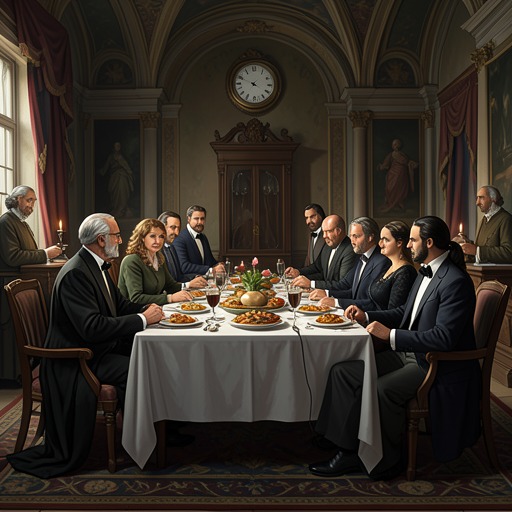
The Guests and the New House
Relatives and prominent townspeople gather for dinner in the new house. They discuss business, politics, food, and the city’s old families, while the contrast between the Buddenbrooks’ settled prosperity and the decline of the former owners, [Ratenkamp & Co.](entity:organization-recall-organization-ratenkamp-co-48a2af11bc48), gives their celebration a quiet warning.
The dinner’s ceremonial ease also reveals the importance of reputation and social belonging. The firm’s success is treated as a family achievement, but the evening’s talk of commercial failure makes clear how vulnerable such achievements can be.
October 1835
Gotthold’s Inheritance Claim
After the guests leave, the consul gives his father a third urgent letter from his estranged elder son, Gotthold, who demands compensation for his share of the new house. Gotthold argues that his father has treated him unjustly because he married against the family’s wishes and entered the linen trade.
The consul weighs family reconciliation against the firm’s financial interests. He ultimately advises his father not to pay, fearing that a settlement would invite further claims and weaken the capital he expects to inherit as sole owner.
14 April 1838
The Birth of Clara
Elisabeth gives birth to a daughter, Clara. The consul records the event in the family chronicle with a long prayer of thanksgiving, continuing a practice that treats births, illnesses, and business history alike as evidence of divine providence.
As the grandparents and children gather around the newborn, the chronicle connects the latest generation to the family’s accumulated past. The record will later become a source of authority and identity for Tony, and finally an object of anguished significance for Hanno.
Early 1840s
Tony’s Country Summers
As a child, Tony spends summers at her maternal grandparents’ country villa beyond the [Burg Gate](entity:location-recall-location-burg-gate-d58c9c52ae4c). The lavish household, servants, garden, and chocolate breakfasts delight her and strengthen her sense that the Kröger family’s elegance is a standard by which other people should be judged.
There she meets Julie Hagenström, whose family is rising in business but remains unwelcome to the old established families. Tony’s childhood pride in her family’s standing becomes attached to a lasting hostility toward the Hagenströms.
Tony’s childhood
The Lemon Bun Incident
On the way to school, [Hermann Hagenström](entity:character-recall-character-hermann-hagenstr-m-7687d390da9f) offers Tony a lemon bun filled with goose breast in exchange for a kiss. When he tries to take one, she slaps him, and Julie rushes out to scratch Tony and tear off her hat.
The quarrel ends their childhood friendship and gives Tony a personal grievance to add to her family’s commercial and social resentment of the Hagenströms. Her proud sense of status is already shaping how she interprets even small encounters.
Early 1840s
Christian’s Schoolroom Comedy
Christian entertains his family and classmates with imitations of their teachers, while Thomas takes his future place in the firm for granted. The brothers display sharply different gifts: Thomas is steady and practical, Christian theatrical, observant, and easily diverted.
Their father’s response to a small clothing-bill scheme by the boys is to raise their allowances rather than punish them. The episode lightly exposes the family’s indulgence of its heirs and foreshadows the gulf between Thomas’s discipline and Christian’s drifting habits.
During the brothers’ school years
Christian’s Peach Anxiety
At dinner, Christian becomes terrified that he might swallow a peach pit and choke. Although he has not swallowed it, his fear unsettles the family and lingers in his mind long after the meal.
The incident is an early sign of Christian’s intense attention to bodily sensations and imagined dangers. What others treat as passing discomfort will become a defining part of his adult life and a source of increasing friction with his more controlled brother.
About 1841
Antoinette’s Death
After a brief, rapidly worsening illness, Antoinette dies in the family home. Her husband sits silently beside her, recalling the distance of his life and repeating that everything is “curious,” rather than giving way to grief.
Her death ends the senior generation’s domestic partnership and leaves Johann increasingly detached from business. The loss also clears the way for him to transfer the firm to his son, Jean, and makes the continuing exclusion of Gotthold more conspicuous.
Spring 1841
Johann’s Retirement
Soon after his wife’s death, Johann Buddenbrook senior announces that he is retiring and transfers the firm, with its assets and liabilities, to Jean as sole proprietor. He withdraws from the office and sinks into apathy.
As he dies, he urges Thomas to help his father and tells Christian to make something of himself, but never mentions Gotthold. Gotthold arrives too late to see him alive, renews his claim, and eventually renounces it rather than leave with hatred toward his father.
Easter 1842
Thomas Joins the Firm
At sixteen, Thomas leaves school and begins work in the family business. His father introduces him to the clerks and takes him through the warehouses, presenting him as a colleague rather than merely a son.
Thomas’s entry into the firm turns inherited duty into a personal vocation. He works with the seriousness of his father, while the family’s expenses and the losses following Johann’s death make restoring the firm’s fortunes an urgent task.
Early 1840s
The Butler Debate
Elisabeth asks her husband to hire a butler, arguing that the large house and frequent guests demand more household help. Jean responds by laying out the family’s finances and warning that its capital is less secure than appearances suggest.
He eventually agrees to hire a butler anyway. The exchange shows the marriage’s balance between Elisabeth’s expectations of elegant living and Jean’s anxiety about preserving the firm’s resources.
About 1843
Tony Enters Boarding School
Alarmed by Tony’s pranks, vanity, and clandestine notes to a schoolmate, her parents send her to [Fräulein Weichbrodt’s boarding school](entity:organization-recall-organization-7fb812683435). Tony quickly forms close friendships with [Armgard von Schilling](entity:character-recall-character-03aed9c0c5e6) and [Gerda Arnoldsen](entity:character-recall-character-5768a4bf70fa) and imagines an elegant future for herself.
She declares that she will marry a wealthy merchant to honour her family and its firm. The declaration shows how thoroughly she has absorbed the Buddenbrooks’ expectations, even as her romantic imagination and desire for social distinction begin to shape her own idea of happiness.
Summer 1845
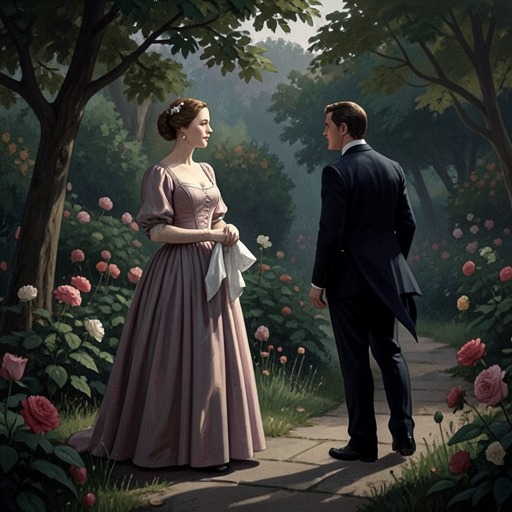
Grünlich’s First Visit
Bendix Grünlich visits the Buddenbrook family in their garden. He praises each person and their interests with practiced flattery, but Tony recognizes how carefully he tells her parents what they want to hear and privately judges him ridiculous.
Jean and Elisabeth, by contrast, regard Grünlich as respectable, pious, and commercially promising. The mismatch between Tony’s distrust and her parents’ approval sets up the marriage decision that will define her early adult life.
Summer 1845
Grünlich’s Proposal
Grünlich formally asks for Tony’s hand. She bursts into tears and cannot understand why a man she has mocked believes she should marry him; her mother urges her to consider the advantageous match, while her father refuses to reject it outright.
Tony’s bewilderment gradually gives way to a sense of duty and personal importance. She is being asked to choose not simply a husband but a path that her family presents as necessary to the honour and future of the Buddenbrook name.
Late July 1845
Tony Meets Morten
To escape the pressure surrounding Grünlich, Tony travels to [Travemünde](entity:location-recall-location-travem-nde-23fde63d76a8) and stays with the harbour pilot’s family. She meets their son Morten, a medical student whose candour, learning, and political ideals intrigue her.
Their conversations about freedom, social hierarchy, and the nobility give Tony a rare experience of being understood beyond the expectations of her family. The sea and the quiet resort become a refuge from the marriage negotiations at home.
Late summer 1845
Tony and Morten Fall in Love
As the season wanes, Tony tells Morten about Grünlich and admits that she refused his proposal. Morten asks whether she has ever loved anyone, and the two confess their affection for one another on the beach.
They promise to remember the summer and hope that Morten can ask for Tony’s hand once he becomes a doctor. Their intimacy is genuine, but it has no force against the family’s plans and the social obligations Tony has been taught to treat as destiny.
September 1845
Morten’s Father Ends the Romance
Grünlich visits Morten’s father and claims that Tony has already given him a promise. Diederich learns of Tony and Morten’s affection, calls his son a fool, and orders him back to [Göttingen](entity:location-recall-location-1f56d74cfd35) immediately.
Tony and Morten are separated without a proper farewell. Tony returns to [Lübeck](entity:location-recall-location-l-beck-c92d763f5ad1) heartbroken, but comforts herself by preserving Morten’s ideas about freedom as a private treasure that no family decision can take away.
22 September 1845
Tony Enters the Family Chronicle
Back in the family home, Tony reads the [Buddenbrook family chronicle](entity:object-recall-object-buddenbrook-family-chr-23f46e6d740b) and feels anew the weight of belonging to a chain of generations. In an impulsive, deliberate act, she writes that she is engaged to Bendix Grünlich.
The entry transforms a private decision into a family record and gives Tony the sense that she has done her duty. She does not thereby become convinced that Grünlich is the man she loves, but she accepts the role her family history has assigned her.
January 1846
The Grünlich Wedding
Tony marries Grünlich in a formal ceremony at the family home. Her family celebrates the wedding with a large gathering, and Jean quietly advises the groom about avoiding customs duties on imported lace during the journey to [Hamburg](entity:location-recall-location-da109bb5ffb9).
As the couple departs, Tony asks her father whether he is proud of her. Jean embraces her but cannot offer an answer that would undo the choice he helped arrange. The question foreshadows Tony’s later recognition of his responsibility for her unhappiness.
February 1846
Thomas Leaves for Amsterdam
Before travelling to Amsterdam for work, Thomas visits [Anna](entity:character-recall-character-anna-ea2421a71401), the flower-shop worker with whom he has had a private relationship. He tells her that he must go and that, in the future, he expects to take over the firm and make a respectable marriage.
Their farewell reveals a concealed emotional life beneath Thomas’s outward composure. He offers tenderness but no promise of marriage, choosing family succession and social respectability over a future with Anna.
Spring 1846
Tony’s Isolated Married Life
Living with Grünlich in [Eimsbüttel](entity:location-recall-location-3baaa533ff24), Tony writes home about the villa, her servants, and her hopes for a visit from her family. She soon becomes pregnant, while Grünlich discourages her from going into [Hamburg](entity:location-recall-location-da109bb5ffb9) or mixing freely in society.
Her bright letters cannot conceal her isolation or her dependence on her husband’s finances. The comfort of the household proves to be an appearance that rests on Grünlich’s credit and the reputation attached to the Buddenbrook name.
8 October 1846
Erika Is Born
Grünlich announces the birth of a daughter, Erika, to his parents-in-law. He describes his joy and reports that both mother and child are well.
Erika becomes Tony’s lasting bond to her first marriage. Her resemblance to Grünlich will repeatedly remind Tony of the life she endured and shape her hopes that her daughter may make a more successful match.
October 1848
The 1848 Street Unrest
As political unrest sweeps [Lübeck](entity:location-recall-location-l-beck-c92d763f5ad1), servants and townspeople speak of class and constitutional change. Trina, the cook, declares that a new order will someday put her on the sofa and her employer at work, and Elisabeth dismisses her.
Jean attends a city meeting despite his wife’s fears. His encounter with the crowd ends not in violence but in a confused, almost comic exchange about revolution and republican government, briefly easing the tension between the assembly and the workers.
October 1848
Leberecht Kröger’s Death
After the meeting, the elderly Leberecht Kröger rides home with Jean. A small stone thrown by children strikes him in the carriage, and he responds with a last, bitter cry of “[Rabble!](entity:expression-recall-expression-rabble-8cb09babf7c8)” before collapsing as he reaches his estate.
His death marks the passing of an old patrician world that has little power to withstand political change. The family’s reaction is also shaped by the public humiliation and disorder of the revolutionary day.
January 1850
Grünlich’s Insolvency
In [Hamburg](entity:location-recall-location-da109bb5ffb9), Tony argues with Grünlich over household expenses and discovers that he will not provide the governess or carriage she wants. Kesselmeyer arrives, exposes Grünlich’s collapsing credit, and presses him to repay his debts.
Jean examines the ledgers and concludes that his son-in-law is both insolvent and culpable. Kesselmeyer then reveals that Grünlich used the proposed marriage and Tony’s dowry to obtain credit, making the Buddenbrook family’s reputation part of his fraudulent scheme.
January 1850
Tony Leaves Grünlich
Jean refuses to rescue Grünlich’s failing business but tells Tony that she and Erika need not share her husband’s ruin. Tony admits she never loved Grünlich, and when her father asks whether she wants him to save the firm at great cost, she refuses for the sake of the Buddenbrook business.
As Jean takes Tony and Erika away, Grünlich collapses into anger and confesses that he married her for her money. The marriage ends in betrayal, but Tony’s return home also deepens her bond with her father.
February 1850
The Divorce Is Recorded
The legal divorce is granted on the grounds that Grünlich cannot support his family. Tony proudly enters the dissolution in the family records beneath the engagement entry she had made years earlier.
She treats the divorce as a blot on the family chronicle that she must eventually erase through a second advantageous marriage. Her confidence and theatrical dignity help her manage the social stigma, but they cannot restore the life she expected to have.
August 1850
Thomas Returns from Pau
Thomas returns from treatment in Pau after a lung haemorrhage. His father’s business remains intact, but the family has been shaken by financial losses and the failures of relatives.
Thomas has become more polished and ambitious during his time abroad. His return brings new energy to the firm, while his reserved manner begins to set him apart from the impulsive, self-absorbed Christian.
Summer 1851
Christian Goes to Valparaiso
After a period of uncertainty in England, Christian leaves for [Valparaiso](entity:location-recall-location-078792aa7940), where he obtains a mercantile position. His father views the move as wanderlust but allows him to go rather than keep him from travelling.
Christian’s years abroad widen the gulf between him and Thomas. They give him a store of stories and impressions but do not make him more suited to business responsibility.
Late 1850
The Death of Madame Kröger
The death of Elisabeth’s mother brings the Buddenbrooks a substantial inheritance, strengthening the firm’s working capital. Justus Kröger also receives money and promptly retires from a business life marked by repeated setbacks.
The inheritance temporarily supports the Buddenbrooks, but its division among family members underlines the steady fragmentation of capital. The fortunes of both branches of the family are becoming less secure.
February 1856
Christian Comes Home
After eight years abroad, Christian returns to [Lübeck](entity:location-recall-location-l-beck-c92d763f5ad1) with a tropical suit, souvenirs, and a restless manner. At the family grave, he cannot endure Tony’s open display of grief, yet he repeatedly asks her for details of their father’s death.
His talk of theatre, performers, sensations, and physical discomfort reveals how little he has changed in the direction of practical life. Thomas watches him closely and sees that he cannot be trusted with the firm’s responsibilities.
Early 1856
Thomas Takes Christian into the Firm
At his mother’s request, Thomas gives Christian a position in the family firm, assigning him English correspondence and a representative role. Christian initially enjoys the routine but soon grows late, misses office hours, and spends much of his time at the Club.
Thomas’s irritation deepens because Christian treats work, respectability, and the family name as matters of little consequence. Their different temperaments turn into a sustained conflict that neither brother knows how to resolve.
May 1856
Gotthold’s Death
Gotthold dies suddenly of a heart attack. Thomas reaches his bedside in time to see the final convulsions and reflects that his uncle had lacked the ambition and imagination that Thomas believes are necessary to sustain a family firm.
The episode exposes the values governing Thomas’s own life: he regards the old firm and its public standing as a form of idealism, more worthy than private attachment. Soon afterward he assumes the Dutch consulate that had belonged to his father.
Summer 1856
Thomas’s Marriage to Gerda
In Amsterdam, Thomas meets [Gerda Arnoldsen](entity:character-recall-character-5768a4bf70fa) again and quickly decides that he must marry her. She accepts his proposal, and her considerable dowry will strengthen the firm as well as bring him a wife whom he regards as exceptional and artistically gifted.
Thomas is candid with his mother that love and financial advantage coexist in his decision. Their marriage brings new capital and social distinction, but Gerda’s deep commitment to music will later separate her from the practical world Thomas hopes to preserve.
Summer 1856
Clara’s Engagement
Pastor [Sievert Tiburtius](entity:character-recall-character-sievert-tiburtius-f1d5ca07c5c0), a guest in the Buddenbrook home, becomes attached to Clara. She accepts his proposal during a country walk, and Elisabeth agrees to the match after consulting Thomas.
Clara’s piety and serious disposition seem suited to a pastor’s household, while the marriage carries the family’s expectations into [Riga](entity:location-recall-location-d65ca907e874). Her future inheritance will later become the source of a bitter conflict between her mother and brother.
Spring 1857
Tony Meets Permaneder
[Alois Permaneder](entity:character-recall-character-alois-permaneder-73486b42f9ba), a Bavarian hops merchant Tony met during her visit to [Munich](entity:location-recall-location-d277927d86b1), comes to [Lübeck](entity:location-recall-location-l-beck-c92d763f5ad1) and is welcomed into the Buddenbrook home. His easy manner, dialect, and lack of northern formality make him an odd contrast to the family’s decorum, but Thomas finds him pleasant and commercially sound.
Tony and Permaneder are drawn together by shared memories of Munich. Their growing intimacy gives Tony a chance to imagine a second marriage, not as a grand match but as a way to resume a life among other people.
Summer 1857
Tony’s Second Engagement
During an excursion to the [Riesebusch Inn](entity:location-recall-location-42152b1a2025), Tony and Permaneder speak about her first marriage and the misfortune she has endured. She tells him she would need to know that a man was honest and kind before agreeing to marry again; he asks if she believes those qualities describe him.
Tony says yes, and they become engaged. Thomas’s inquiries establish that their combined resources will support a respectable, if not luxurious, life in [Munich](entity:location-recall-location-d277927d86b1), and Tony insists that Erika accompany them.
Late 1857
Tony Marries Permaneder
Tony and Permaneder marry quietly in St. Mary’s, with only close relatives present. The ceremony deliberately lacks the elaborate festivities of Tony’s first wedding, and the couple travels to [Munich](entity:location-recall-location-d277927d86b1) without a honeymoon.
Tony hopes that she will make Permaneder more ambitious and that the marriage will restore her position in the family and town. Her hope is already more practical than romantic, shaped by the failure of her earlier expectations.
Soon after the wedding
Permaneder Retires
Once Permaneder receives Tony’s dowry, he withdraws from the hops business and announces that he intends to live quietly on his income. He rents out part of the house and prefers evenings at the Hofbräuhaus to commercial ambition.
Tony is devastated: she had imagined their marriage would lead to renewed prosperity and standing, but Permaneder’s decision fixes them in a modest, unchanging life. She feels that he has failed to understand his duty to a Buddenbrook.
1859
Tony’s Baby Dies
Tony becomes pregnant again and eagerly plans an elegant reception for the child. The baby girl survives only a few minutes after birth, and Tony herself is left dangerously weak.
Her grief deepens her sense that every attempt to secure happiness ends in loss. Permaneder is shaken briefly, but soon returns to his customary routine, widening the emotional distance between them.
November 1859
The Munich Quarrel
Tony wakes at night to find Permaneder struggling drunkenly with their cook, Babette. After he calls Tony a degrading name during their quarrel, she leaves [Munich](entity:location-recall-location-d277927d86b1) with Erika and returns to her mother’s home in [Lübeck](entity:location-recall-location-l-beck-c92d763f5ad1).
The incident is the final break in a marriage that had already disappointed Tony for years. She tells her mother that she will never return, and her mother reluctantly recognizes that reconciliation cannot be forced.
1860
Tony Divorces Permaneder
Thomas tries to persuade Tony that the drunken encounter was a trivial lapse and that she should return to Permaneder. Tony insists that her real unhappiness lies in the entire life she has been forced to live in [Munich](entity:location-recall-location-d277927d86b1), where she feels alien and diminished.
Permaneder agrees to a divorce and offers to restore her dowry. Tony obtains a legal separation, records it in the family papers, and returns to her role as a divorced Buddenbrook, still hoping that another marriage might repair the family’s reputation.
Spring 1861
Hanno Is Born and Baptized
After years without an heir, Gerda gives birth to a son, Johann, whom the family calls Hanno. The birth is difficult, and both mother and child nearly die, but they survive; the child is baptized Justus, Johann, and Kaspar.
The family celebrates the boy as the future of the Buddenbrooks and the firm. Tony sees his arrival as the beginning of a new era, while Thomas places enormous hopes on him as a male heir who can continue the family name.
1861
Christian’s Business Fails
Christian arrives from [Hamburg](entity:location-recall-location-da109bb5ffb9) on the evening of Hanno’s baptism to tell Thomas that he cannot continue his business. His debts have grown despite earlier family assistance, and he wants money to settle them before returning to [London](entity:location-recall-location-1bfd335cdd1b) as an employee.
Thomas grants his brother’s request with little warmth. Christian’s repeated failure to maintain an independent career confirms Thomas’s belief that he cannot be trusted with the family firm, while Christian remains more absorbed in travel and personal sensation than in practical responsibility.
February 1862
James Möllendorpf Dies
The elderly senator James Mullenhof died after secretly eating pastries in a humble dwelling. This absurd death quickly spread through the entire city, but people's attention soon turned to the vacant senatorial seat
February 1862
Thomas Wins a Senate Seat
after a long debate and several rounds of voting, thomas was elected as a senator, defeating hagengren. tony had been anxiously waiting on the street, and upon learning the result, he rushed to tell his brother and viewed this victory as a confirmation of his family's status
Summer 1863 to 1864
Thomas Builds a New House
Thomas commissioned the construction of a grand new residence in Fischergrube, hoping to rejuvenate himself through the dramatic changes in his surroundings. Gerta looked forward to having a spacious music room, while Tony encouraged him to build the mansion with elegance. The mansion became an external symbol of the family's prestige
Summer 1863
Clara Leaves Her Inheritance
Clarissa was seriously ill in [Riga](entity:location-recall-location-d65ca907e874) and had no children. She therefore requested her mother to leave her inheritance to her husband, Sifert Tiberiutius. Elizabeth agreed to the dying woman's request and made the decision without telling Thomas, because she knew Thomas would oppose it
Summer 1863
Thomas and His Mother Quarrel
Thomas accused his mother of agreeing to give Clara's inheritance to Tiburtius without his consent, damaging the family's estate. He insulted his siblings and condemned the priest as someone who coveted property; Tony tried to calm the conflict. Thomas ultimately refused to challenge his mother's promise in court because he
1864–1866
Wars and Commercial Losses
During the war in the mid-1860s, [Lübeck](entity:location-recall-location-l-beck-c92d763f5ad1) was frequently occupied by armies. Hanni played in the family garden while the adult world was filled with military movements and political changes
April 1867
Erika Marries Weinschenk
Erica is engaged to Hugo Weinshenk. Weinshenk is an energetic manager at the municipal fire insurance company. Tony is happy that his daughter may marry someone advantageous, and Tony believes he lost such an opportunity himself
1867–1868
The Weinschenk Household
After marriage, Tony helped Erica settle into a refined home. Weinshenk worked diligently and was upright, but socially awkward, and was quite demanding at home; he hoped Erica would keep happy, and sometimes got angry over household chores. Tony wanted this marriage to succeed, so he downplayed these warnings
May 1868
The Pöppenrade Harvest Deal
Under pressure from Tony, Thomas considered buying the entire harvest of Ralph von Miebom, who was in financial trouble. He initially resisted, thinking the deal would be unfair and go against the family's cautious business tradition
June 1868
Hail Ruins the Harvest
The transaction had just been completed when hail destroyed the harvest in Poppenrad. Thomas realized he should have sold the grain immediately, but the loss was already incurred and could not be recovered
7 July 1868
The Firm’s Centennial
The family held a celebration to commemorate the 100th anniversary of the establishment of the business. Guests, flags, congratulations, and music gathered together, with a plaque featuring portraits of past owners. The inscription on the plaque reaffirmed the warnings from the ancestors: to only do business that allows
1868
Hanno Draws a Line
Hanno looked at the family genealogy book and, without realizing it, neatly drew two lines under his own name. His father asked why, and Hanno could only say that he thought there would be nothing else after that. These two lines unconsciously rejected the family's expectation that he would continue
1868–1869
Weinschenk Is Prosecuted
Hugo Weinshenk is accused of fraud. After learning that the fire would cause losses to the company, he still arranged reinsurance for the relevant policies. The case went to open trial, with Moritz Hagenstern as the prosecutor and a Berlin lawyer defending Weinshenk
Winter 1869
Tony Seeks Bail for Weinschenk
as the situation of the trial worsened, tony asked thomas to come up with 25,000 marks to pay the bail for weinshenk. she admitted that her confidence in his innocence had wavered, but insisted that even if he was guilty, his family
Early 1870
Weinschenk Is Convicted
Although the defense attorney's argument was eloquent and persuasive, Wiesenschke was still convicted and sentenced to three and a half years in prison. The townspeople soon forgot him, while the ladies of the Bundenbrock family claimed they had already seen through his bad character from the beginning
Autumn 1870
Elisabeth’s Fatal Illness
Elisabeth develops pneumonia, and her condition deteriorates despite the care of doctors and Sister Leandra. The old woman clings to life, watches her symptoms anxiously, and shows greater interest in physicians than in the family gathered around her.
As her breathing fails, she calls out to her dead husband and daughter and begs for something to help her sleep. The doctors refuse a narcotic, believing they must preserve life as long as possible; after a long struggle, she dies in the early morning.
The day after Elisabeth’s death
Christian Demands His Inheritance
During the division of Elisabeth’s possessions, Christian demands a share of the china, silver, and linens, saying that he wants them as keepsakes. He then reveals that he intends to marry [Aline Puvogel](entity:character-recall-character-aline-puvogel-b577f9b267cd) and provide for her children.
Thomas refuses to let Christian use the inheritance to establish the household he wants and invokes restrictions in their mother’s will. The brothers’ longstanding hostility erupts into a bitter personal quarrel, exposing the emotional injuries neither has ever resolved.
After Elisabeth’s death
Tony Pleads for the Old House
Tony learns that Thomas plans to sell the family home on [Meng Strasse](entity:location-recall-location-649555293027). She argues that the house has been her refuge through divorce, financial ruin, and scandal, but Thomas insists that it is expensive, dilapidated property and dead capital.
Tony eventually yields to his reasoning, though the prospect of losing the place where generations of Buddenbrooks lived leaves her grieving. The sale will make the family’s decline visible in the very house that once embodied its security.
Winter 1871–1872
The Old House Is Sold
[Siegismund Gosch](entity:character-recall-character-siegismund-gosch-13fec3a448e7) negotiates the sale of the [Meng Strasse](entity:location-recall-location-649555293027) house, and Thomas accepts his offer after prolonged bargaining. [Hermann Hagenström](entity:character-recall-character-hermann-hagenstr-m-7687d390da9f) becomes the eventual buyer and moves into the house with his family, preserving much of its interior while modernizing it and rebuilding the rear property.
Tony cannot bear to pass the house without weeping. The Hagenströms’ name beneath the ancestral motto makes the transfer feel to her like a public succession: the rising rival family now occupies the home that once represented Buddenbrook authority.
Early 1872
Gerda Moves to Linden Platz
With the old household broken up, Tony, Erika, and little Elisabeth move into a sunny apartment on Linden Platz. The remaining servants and family possessions are redistributed, while the former residence is converted for the Hagenströms’ use.
The change leaves Gerda and Hanno in the grand house on Fischer Grube, increasingly isolated from the family home that had once gathered several generations. The Buddenbrooks retain wealth and property, but lose the domestic centre of their history.
Early 1873
Hugo Weinschenk Disappears
After his release from prison, Weinschenk returns to Erika and their daughter but is too ashamed to face public life. He soon leaves for [London](entity:location-recall-location-1bfd335cdd1b), claiming he must establish a suitable home before sending for them.
He never sends for his family or returns. Erika remains with Tony, and the family’s hopes that her marriage will restore its standing end in another abandonment.
Early 1870s
Thomas and Gerda’s Marriage Under Rumour
As Thomas ages and Gerda remains strikingly unchanged, townspeople speculate that she is having an affair with Lieutenant [René Maria von Throta](entity:character-recall-character-ren-maria-von-throt-db7cf4ab023f). The lieutenant visits the house often to make music with her, while Thomas listens from his office and fears both the private meaning of their silences and the public gossip around them.
Thomas cannot name his anxiety as jealousy or accuse Gerda without turning suspicion into a scandal. Their marriage continues to rest on restraint and mutual understanding, but his fear exposes how isolated and uncertain he has become.
Summer 1874
Thomas’s Schopenhauer Revelation
In his garden, Thomas discovers and reads part of the second volume of Schopenhauer’s The World as Will and Representation. Its account of individuality, suffering, and release gives him an intense, nearly ecstatic conviction that death may dissolve the prison of the separate self and return him to a wider life.
The vision briefly frees him from fear, but he cannot sustain it. Business, civic duties, and anxiety about appearing eccentric reclaim his attention, and he returns the book to its place without reading further.
Late summer 1874
Thomas Makes His Will
After turning anxiously to questions of death and the afterlife, Thomas cannot find comfort in either inherited Christian doctrine or his brief metaphysical insight. He instead resolves to put his earthly affairs in order and summons a lawyer to draft his will.
Hanno stands guard outside the room and refuses to let anyone interrupt. The scene binds father and son in a final act of trust, even as Thomas’s will directs that the family firm be liquidated rather than passed on to the boy.
Autumn 1874
Thomas Goes to Travemünde
Doctors advise Thomas to rest by the sea, and he travels to [Travemünde](entity:location-recall-location-travem-nde-23fde63d76a8) with Christian. The weather is wet and bleak, and the brothers meet their old friend [Gosch](entity:character-recall-character-gosch-912040fdb8ea) at the resort.
Thomas has little appetite for conversation or business, while Christian continues to describe his ailments. The shore offers no real restoration, but it provides a setting for the brothers’ final encounters with the declining world around them.
Summer 1874
Hanno’s Sea Holiday
During his four-week stay at [Travemünde](entity:location-recall-location-travem-nde-23fde63d76a8), Hanno finds deep relief in the sea, the beach, and the quiet routines of the resort. He loves the sound of the waves and listens to the evening music, far from school, examinations, and the Hagenström boys who bully him.
The holiday does not strengthen him for the life his father expects. It leaves him still more sensitive and dreamlike, but gives him a private memory of the sea to which he can retreat when everyday life becomes unbearable.
1874–1875
The School’s Authoritarian World
At school, Hanno and Kai endure a strict, increasingly authoritarian institution in which obedience, grades, and career prospects matter more than curiosity or sympathy. Hanno falls behind in his work, dreads oral examinations, and struggles to withstand the demerit system.
Kai’s stories and companionship offer a small refuge, but the school’s harsh rituals confirm Hanno’s sense that he does not belong in the practical, competitive world demanded of him. He fears failure less than the spectacle and humiliation that accompany it.
Early 1875
Modersohn’s Lesson Collapses
During an unruly English lesson, students torment their gentle teacher, [Herr Modersohn](entity:character-recall-character-herr-modersohn-e82bdc349ef1), with noises, peas, and disruptions. The arrival of [Director Wulicke](entity:character-recall-character-director-wulicke-f4a513ad328e) abruptly silences the class and turns the teacher’s lesson into a public inspection.
Modersohn fails to control the students, and several receive demerits, including Hanno. The episode shows how little room the school allows for kindness or individual temperament, while Kai and Hanno recognize the cruelty of its hierarchy.
Winter 1875
Hanno Improvises at the Piano
After a day of school anxiety, Hanno closes the curtains in the salon and improvises alone at the piano. A simple musical fragment expands into a turbulent sequence of desire, fear, prayer, revolt, and ecstatic resolution.
The improvisation is the clearest expression of Hanno’s inner life, but it offers no practical escape from school or family expectations. Music gives him a language for feelings he cannot otherwise communicate, while also separating him further from the world his father wanted him to inherit.
1875–1876
The Family Firm Is Liquidated
Under the terms of Thomas’s will, Kistenmaker and Marcus begin liquidating the firm within a year. Their haste, indecision, and poor timing produce losses, and the estate proves worth far less than its initial valuation suggested.
The liquidation ends the business founded by the family’s ancestor and removes the last substantial institution through which the Buddenbrooks had expressed their identity. The family’s decline is now no longer a private fear but an observable fact.
Autumn 1876
Gerda Sells the Villa
Gerda sells the grand house on Fischer Grube and moves with Hanno and the servants to a smaller villa beyond the [Burg Gate](entity:location-recall-location-burg-gate-d58c9c52ae4c). Many of the old furnishings are left behind, and Ida Jungmann is dismissed after years of devoted service.
The move strips away another outward sign of Buddenbrook wealth and leaves Hanno without the caregiver who had been his closest source of comfort. Tony grieves the continuing losses, but tries to sustain hope in Hanno as the family’s remaining heir.
Winter 1876–1877
Hanno’s Difficult School Morning
After attending Lohengrin, Hanno sets his alarm for six so he can complete his homework, but dread and exhaustion keep him in bed. He reaches school late, having run through fog and cold with a painful tooth, an upset stomach, and a racing heart.
His friend Kai is there too, and the two face a day of lessons unprepared. Hanno is less frightened of failing than of the public humiliation and pressure attached to school, a pattern that makes each ordinary morning feel like a crisis.
Winter 1876–1877
Mantelsack’s Latin Examination
Hanno is called on to recite Ovid without having learned the passage. A classmate secretly holds open the book, and Hanno reads badly on purpose, hoping to reduce the shame of cheating; Mantelsack nevertheless gives him a satisfactory mark.
The unfair classroom order rewards performance rather than honesty or understanding. Hanno feels sickened by his own small success, while another student is exposed and condemned for using a translation, reinforcing Hanno’s sense that school’s moral rules are arbitrary.
Winter 1876–1877
Hanno’s Final Improvisation
In the salon, Hanno again sits alone at the piano and develops a short, yearning musical phrase into an extended, intense improvisation. It moves through conflict and prayer toward a triumphant but exhausted resolution.
The music gives form to the pressure and longing Hanno cannot express in daily life. Its elaborate emotional world contrasts with the narrow demands of school and the practical future his father once imagined for him.
Late 1876
Typhoid Takes Hanno
Hanno contracts typhoid, and his condition progresses through fever, delirium, and profound weakness. Doctors try baths, medicines, and nourishment, but the illness reaches its decisive crisis with little hope of recovery.
The boy who had been expected to continue the family line dies before adulthood. His death ends the Buddenbrooks’ direct male succession and confirms that the family’s decline has reached its final generation.
Autumn 1876
The Family’s Last Goodbye
After Hanno’s death, Gerda prepares to leave [Lübeck](entity:location-recall-location-l-beck-c92d763f5ad1) and return to Amsterdam, where she will live with her father and play music. Tony and the remaining family members gather to say goodbye, while [Sesame Weichbrodt](entity:character-recall-character-sesame-weichbrodt-1f45539271f2) insists that the dead will be seen again.
Tony breaks down, mourning Hanno and the many relatives who have vanished. Her grief is met by Sesame’s unwavering faith, and the novel closes with that defiant assurance against the evidence of family loss and death.