Candide's conscription into the Bulgarian army
CandideCandide’s conscription into the Bulgarian army turns apparent charity into coercion: hungry and freezing after his expulsion from the Castle of Thunder-ten-Tronckh, he accepts a meal and money from two recruiters, only to be fettered and taken to a regiment. There, military discipline is enforced through repeated blows, and his ordinary attempt to walk freely is treated as a capital offense. The episode makes the army’s language of assistance, heroism, and liberty collide with the bodily reality of forced service.
From Exile to Recruitment
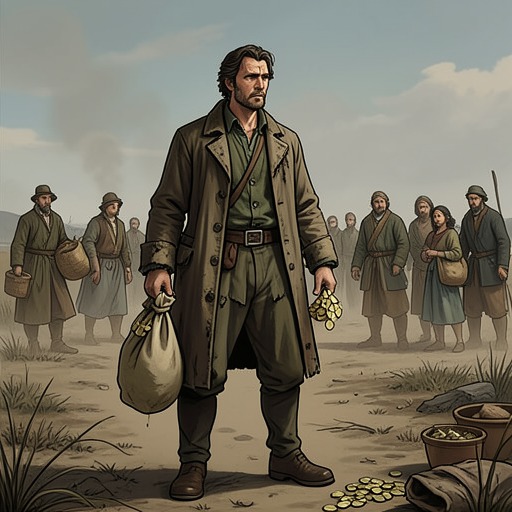
Driven from what the narration calls terrestrial paradise, Candide walks without knowing where to go, weeping and looking back toward the castle that holds the young woman he loves. He sleeps supperless in a snowy field between two furrows. The next day, benumbed, hungry, exhausted, and without money, he reaches the neighboring town of Waldberghofftrarbk-dikdorff and stops at an inn. His exposure and need set the conditions for the encounter: two men in blue notice his build and height, then approach with apparently courteous invitations.
Their offer is framed as benevolence. They tell Candide that men are born to help one another, pay his reckoning, and press a few crowns on him. When he offers to give them a note in return, they refuse it. The gesture seems to confirm the teaching of Pangloss, whom Candide recalls as having taught mutual assistance; Candide consequently interprets the encounter as evidence that all is for the best. The recruiters have found a way to make their target’s own optimistic assumptions smooth the path to his capture.
A Hero Made by Force
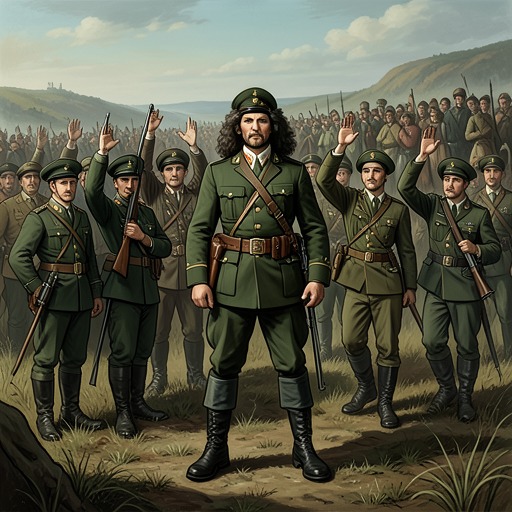
After the meal and drink, the men announce that Candide is now the help, support, defender, and hero of the Bulgarians, with fortune and glory assured. The announcement lasts only moments before they fetter him and carry him to the regiment. What had been presented as a voluntary bond of assistance becomes imprisonment, and the promised heroic identity is imposed rather than earned.
The regiment teaches him a sequence of movements: turning right and left, handling and returning the rammer, presenting, firing, and marching. His instruction is measured in blows. He receives thirty with a cudgel on the first day, twenty on the next, and ten on the following day, when his comrades regard him as a prodigy. The falling number records improvement, but it also exposes the institution’s measure of competence: Candide’s progress is counted in punishments endured, not in any choice to serve. He remains stupefied, unable to understand how this makes him a hero.
Liberty and the Punishment of Walking Away
One spring day Candide resolves to take a walk, believing that using one’s legs as one pleases belongs to human as well as animal life. He has gone two leagues when four men, each described as a six-foot hero, overtake him, bind him, and carry him to a dungeon. His simple movement away from the regiment is treated as an offense requiring a forced choice: thirty-six passes through the gauntlet or twelve bullets in the brain.
Candide says that human will is free and refuses both alternatives, but the choice is not genuinely his to make. He ultimately selects the whipping, invoking liberty as the reason for his decision. Because the regiment consists of two thousand men, the punishment totals four thousand strokes. The blows strip the skin from the back of his neck to his rump and lay bare his muscles and nerves. When the soldiers are about to begin a third round, Candide can endure no more and begs them to shoot him instead. The contrast is stark: the institution invokes choice while controlling every available outcome, and Candide’s appeal to liberty cannot stop the violence.
Pardon and the Return to Service
The King of the Bulgarians happens to pass as Candide is about to be shot and asks what crime he has committed. From what he learns, he understands Candide to be a young metaphysician, extremely ignorant of the world’s practical affairs, and grants him a pardon. The reprieve depends on the king’s interpretation of Candide’s ignorance, not on any end to the army’s coercive discipline.
An able surgeon treats Candide with emollients taught by Dioscorides. After three weeks, he has a little skin again and can march. The recovery restores him to the very activity from which the episode’s violence began: military movement. As soon as he is able to march, the King of the Bulgarians gives battle to the King of the Abares. Candide’s conscription thus leads directly from deceptive welcome to bodily punishment, a narrow reprieve, and renewed proximity to war.