Candide's journey to El Dorado and departure from the country
CandideCandide's journey to El Dorado and departure from the country form a decisive test of the optimism taught by Pangloss: the travelers discover a society that seems to have escaped many familiar sources of suffering, yet Candide still chooses to leave it. El Dorado offers wealth without ordinary money, public life without courts or prisons, and religion expressed through collective thanksgiving. But its apparent completeness cannot outweigh Candide's attachment to Cunegonde and his hope that its riches will let him recover her. The episode makes the utopian country both a striking contrast to the world beyond its mountains and a test of what its visitors believe they still lack.
The Journey and Discovery
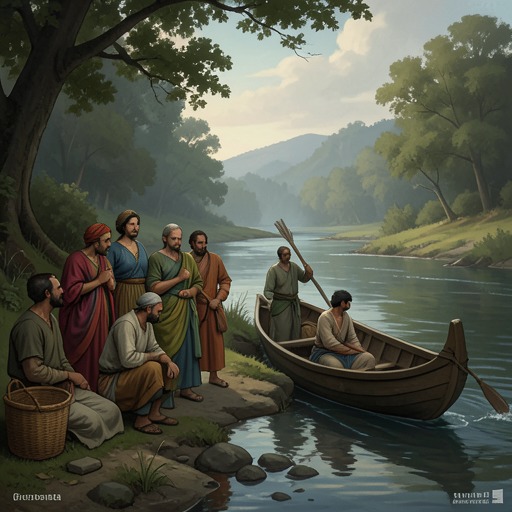
Before reaching El Dorado, Candide and Cacambo are worn down by a difficult journey toward Cayenne. They know only roughly which direction to take; rivers, precipices, robbers, and other obstacles obstruct their way, their horses die of fatigue, and their provisions run out. For a month they subsist on wild fruits before reaching a small river bordered by cocoa trees. Cacambo proposes using an empty canoe, filling it with cocoanuts, and trusting the current to lead them somewhere inhabited. Candide agrees, accepting the possibility of novelty even if the destination proves unpleasant.
The river carries them through changing stretches of bank before narrowing beneath immense rocks. After a dangerous passage lasting twenty-four hours, they emerge into daylight, but the canoe is wrecked against the rocks. They continue on foot, moving from rock to rock until they find a broad plain ringed by inaccessible mountains. The country is cultivated for pleasure as well as necessity, joining practical use with beauty. Carriages of unusual brilliance travel its roads, drawn by large red sheep; even the first village overturns the travelers' expectations, as children play quoits with pieces of gold, emerald, and ruby. Candide judges the country better than Westphalia, while Cacambo initially supposes the children must be royal sons. Their misreading of precious stones as ordinary playthings begins the episode's sustained reversal of European assumptions about wealth.
At an inn, the travelers discover that the stones they have gathered from the roads are not accepted as payment because they are merely pebbles by local standards. The landlord explains that guests need no money to dine: the government pays the establishments maintained for the convenience of commerce. He also tells them that they have been served poorly because the village is poor, though they would be welcomed elsewhere according to their station. Candide and Cacambo wonder whether this unknown country might be the place where all is well, while Candide acknowledges that things often went badly in Westphalia. El Dorado thus appears not as a conclusion reached through philosophical proof but as a society encountered through the travelers' astonishment at its everyday arrangements.
History, Religion, and Public Life
An elderly resident, who says he is 172 years old, receives the travelers in a house whose silver door, golden ceilings, and jewel-covered antechamber are described as signs of simplicity rather than extravagance. He recounts that he learned from his late father, a Master of the Horse to the King, about the revolutions of Peru. El Dorado is the ancient country of the Incas, whose princes left to conquer elsewhere and were eventually destroyed by the Spaniards. Other members of the ruling family remained, and, with the nation's consent, established a rule that inhabitants should not leave the kingdom. The elder presents that policy as the means by which their innocence and happiness were preserved. Inaccessible rocks and precipices have also sheltered the country from European powers whose desire for its riches would, he says, put its people at risk.
The account of religion further contrasts El Dorado with the travelers' experience of religious authority elsewhere. Its people have no competing religious sects, and the elder says they do not pray to God to request what they already have; instead, they continually give thanks. There are no separate priests: the King and heads of families sing morning canticles with thousands of musicians. Religious practice is presented as shared civic life rather than the jurisdiction of a distinct clerical institution. The episode does not make Candide a detached observer of this arrangement; his curiosity about religion continues, but the answers he receives show how unfamiliar the country's customs are to him.
The royal city gives the travelers another measure of El Dorado's public order. Its immense public buildings, columned marketplaces, and fountains supply spring water, rose water, and sugar-cane liqueurs to the squares. Candide asks to see the court of justice and parliament, only to learn that there are none because the inhabitants are strangers to lawsuits. They have no prisons either. What most pleases him is the palace of sciences, with a gallery two thousand feet long containing instruments for mathematics and physics. After seeing only a thousandth part of the city in an afternoon, he dines at the palace with the King, Cacambo, and several women. The King's wit survives translation for Candide as well as the material splendor does, adding sociability and learning to the inventory of the country's apparent advantages.
Why Candide Leaves
The travelers spend a month in El Dorado, and Candide recognizes how far its palace surpasses the castle where he was born. Yet his comparison immediately turns to absence: Cunegonde is not there. He also supposes that Cacambo may have a beloved in Europe and imagines that, by returning with twelve sheep loaded with the country's valuable stones, they could become richer than Europe's kings, escape the Inquisitors, and recover Cunegonde. Cacambo agrees with the prospect of travel and return. Their decision to leave is not caused by mistreatment in El Dorado; it arises from their ties to the world outside it and their belief that its wealth can alter their prospects there.
The King does not claim the right to detain them. He considers it tyrannical to keep strangers against their will, and says that the laws and customs of El Dorado permit them to go when they wish. At the same time, he warns that departure will be difficult: they cannot travel back up the river that brought them, and the surrounding mountains are ten thousand feet high, extremely broad, and steep as walls. There is no descent except by precipices. The King's respect for their freedom therefore does not remove the physical barriers imposed by the country's geography. He offers to have engineers construct a machine to carry them safely over the mountains, while explaining that no subject will accompany them because the inhabitants have vowed not to leave.
Candide and Cacambo ask for sheep carrying provisions and the country's pebbles and earth. The King laughs at their European valuation of what his people regard as yellow clay, but lets them take as much as they wish. Three thousand mathematicians build the lifting machine in fifteen days, at a cost of twenty million sterling in local specie. The travelers are supplied with two red riding sheep, twenty pack-sheep bearing provisions, thirty carrying curiosities, and fifty loaded with gold, diamonds, and precious stones. The King embraces them, and the mathematicians convey them over the mountains to safety. The painstaking scale of the departure turns their exit into a public spectacle: a country with no ordinary need for money equips its departing visitors with an extraordinary portable fortune.
The Fortune's Purpose and the Episode's Meaning
On the far side of the mountains, Candide's immediate aim is not to settle in another country or explore El Dorado's curiosities further. He wants to present the sheep to Cunegonde. He and Cacambo plan to journey toward Cayenne, embark from there, and decide afterward what kingdom they might purchase. El Dorado's gifts therefore become instruments of a hoped-for return to the European world, where wealth may secure access, safety, and reunion. Candide's departure also distinguishes material abundance from contentment: although he has spent a month in a place that meets needs without money and lacks institutions he associates with punishment and litigation, he chooses the uncertain effort of going back.
The journey's place in Candide's larger story sharpens this contrast. Pangloss's teaching had made the Baron's castle and its arrangements seem proof that everything was ordered for the best; El Dorado supplies a radically different society in which the ordinary signs of European rank and scarcity no longer operate in the same way. Yet the country's residents' settled happiness does not answer Candide's particular longing, and its law against emigration makes remaining there incompatible with the life he pursues. The narrator's swift passage from perilous river travel to a fabulously provisioned departure suits the philosophical tale's compressed, episodic movement. El Dorado does not settle the argument about whether the world is best; it exposes the distance between a society's apparent perfection and what its visitors continue to desire.