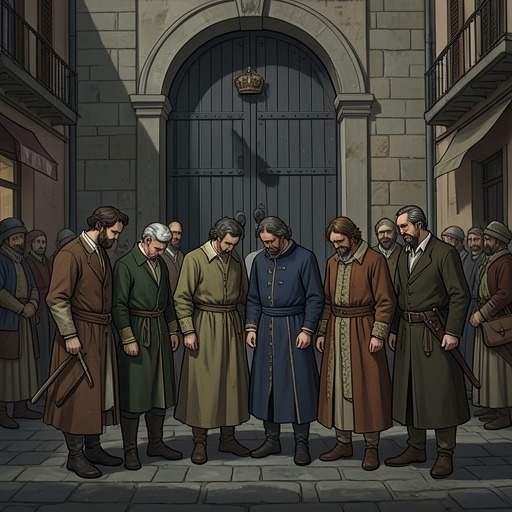
Carnival at Venice
CandideCarnival at Venice is the calendar setting for a supper that gathers six deposed kings and reunites Candide with Cacambo. Its importance lies in the sharp contrast between a public season of celebration and the guests’ histories of overthrow, confinement, and lost power; for Candide, however, the gathering becomes a passage toward Constantinople and the renewed hope of finding Cunegonde.
Setting and Occasion
The episode takes place during the Carnival at Venice. One evening, Candide and Martin are about to supper with foreigners lodging at the same inn when Cacambo appears and tells Candide to prepare to go with him. The chapter presents the meeting through this meal: Candide must sit down among the strangers while absorbing the news that his faithful agent has returned and is enslaved.
The Carnival supplies a shared occasion for people whose political fortunes have otherwise scattered them. Six strangers at the inn are revealed as dethroned kings, and four more displaced rulers arrive as the company rises from supper. The narrative gives no exact date for the gathering; its time is marked by the evening meal and the Carnival season.
Cacambo’s Return
Cacambo is waiting on one of the guests. He explains that he is a slave, that his master expects him to serve at table, and that a vessel is ready for departure after supper. His return brings Candide joy and astonishment, but the discovery of his servitude complicates the reunion even as it opens a route forward.
Candide sits down distracted between grief and gladness: he is delighted to see Cacambo again, shocked by his condition, and newly hopeful of recovering Cunegonde. Martin watches the scene without being moved in the same way. The difference between them is visible at the table: Candide experiences the news as a personal upheaval, while Martin remains unconcerned.
The Deposed Kings
The strangers’ identities turn the supper into a gathering of former rulers. Achmet III explains that he had been Grand Sultan, deposed his brother, and was later deposed in turn by his nephew. His viziers were beheaded, and he was condemned to end his days in the old Seraglio; his nephew, Sultan Mahmoud, permits him occasional travel for his health, which has brought him to Venice for the Carnival.
Ivan tells a different but likewise constrained history: he was once Emperor of all the Russias, was dethroned in his cradle, and grew up while his parents were imprisoned. He is allowed to travel only in the company of people acting as guards. The gathering therefore places former sovereigns beside one another not as active powers but as travelers whose movements remain limited by the political changes that removed them.
The conversation also makes misfortune tangible through Theodore of Corsica. When his poverty becomes apparent, the other five kings each give him twenty sequins for clothes and linen; Candide adds a diamond worth two thousand sequins. The exchange briefly reverses the expected hierarchy of the room: Candide, not one of the monarchs, gives the most valuable gift, prompting the others to wonder who this private person is.
Carnival and the Forward Plot
As the company rises, four more Serene Highnesses arrive, also stripped of their territories by war and in Venice for the Carnival. Candide pays them no attention. His thoughts are fixed on the voyage to Constantinople and on finding Cunegonde, so the spectacle of additional fallen rulers cannot detain him.
The Carnival supper thus serves both as a compressed portrait of political instability and as a hinge in Candide’s journey. It assembles rulers brought low by succession and war, while Cacambo’s return converts the meal into a departure point. The festive occasion gathers the displaced together for a moment; Candide, already looking beyond it, leaves his attention with the journey still to come.