Treasures of El Dorado
CandideThe Treasures of El Dorado are the portable wealth that Candide and Cacambo carry out of a country where Europeans’ ordinary measures of riches have little meaning. Their glittering cargo appears to offer a route back to Cunegonde and independence from European authorities, yet it becomes vulnerable to distance, animals’ exhaustion, and commercial fraud. In its passage from royal gift to dwindling caravan and stolen shipload, the treasure tests the promise that wealth can turn suffering into security.
The gift and its departure
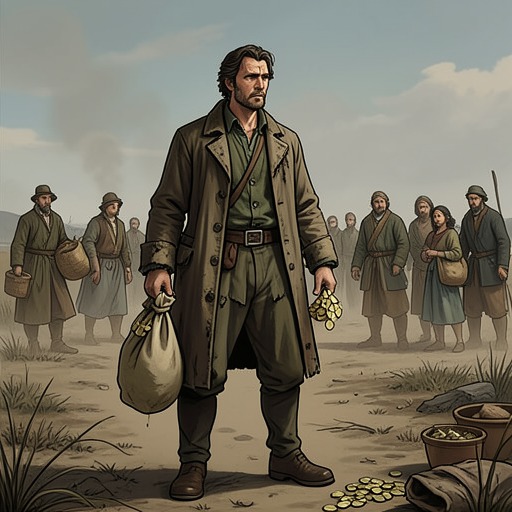
After spending a month in Eldorado, Candide and Cacambo choose to leave, although the King warns that departure will be difficult and his subjects are bound by a vow not to quit the kingdom. The travelers nevertheless ask for sheep carrying provisions, the country’s pebbles, and some of its earth. Their request treats Eldorado’s yellow material as useful wealth, while the King regards European fascination with it as puzzling and allows them to take as much as they wish.
The King orders engineers to build a machine to lift the travelers over the surrounding mountains. Three thousand mathematicians complete it in fifteen days, at a cost of twenty million sterling in the country’s specie. The departing party receives two great red sheep, saddled and bridled for riding beyond the mountains; twenty pack-sheep carry provisions, thirty carry curiosities, and fifty carry gold, diamonds, and precious stones. The King embraces the travelers, and the mathematicians escort them to safety. The extraordinary machinery and carefully divided loads make the departure a state-supported expedition, not merely a private escape.
Candide’s purpose gives the riches an immediate personal value: he wants to present his sheep to Cunegonde and believes the cargo could let him pay the Governor of Buenos Aires to secure her release. He and Cacambo also expect that, with the wealth, they can choose what kingdom to purchase. Eldorado’s riches thus enter the story not as an abstract inventory but as the means by which the travelers imagine recovering a lost relationship and gaining control over their destination.
Wealth tested by the journey
The first day of travel is joyful; the pair believe they possess more treasure than Asia, Europe, and Africa could gather. Candide cuts Cunegonde’s name into trees as they travel, linking the cargo’s promise to his continuing hope of reunion. But the transport proves precarious. On the second day, two sheep and their burdens disappear into a morass. Two more die from fatigue a few days later, seven or eight perish from hunger in a desert, and others fall down precipices. After a hundred days, only two sheep remain.
The losses change the meaning of the fortune without erasing its remaining value. Candide reflects on the perishability of worldly wealth and sets it against virtue and the prospect of seeing Cunegonde again. Cacambo, by contrast, points out that the two surviving sheep still carry more treasure than the King of Spain is likely to possess. The contrast is practical as well as philosophical: what once seemed immeasurable has been reduced to a small surviving portion, but that portion is still substantial enough to finance another attempt at reunion.
The Surinam encounter and the use of diamonds
Near Surinam, the travelers meet an enslaved man who explains that European sugar is produced through a system that has cost him his left leg and right hand. He connects the treatment of enslaved people to the sugar consumed in Europe and recalls that his mother had presented enslavement as a source of family fortune. His account makes visible a different movement of wealth from the Eldorado cargo: commodities can enrich distant consumers while the people producing them bear the cost. Candide weeps, calls the account a decisive refutation of Pangloss’s optimism, and enters Surinam in grief.
The treasure remains a means of action even after this encounter. When Candide learns that the Governor of Buenos Aires has made Cunegonde his favorite mistress, he entrusts Cacambo with five or six million in diamonds apiece and sends him to negotiate her release. Cacambo is to offer the Governor one million, or two if necessary, and is to remember the old woman as well. Candide chooses to wait elsewhere and plans to meet Cacambo at Venice. Their separation turns the diamonds into delegated purchasing power: Cacambo carries the wealth, while Candide relies on his judgment and loyalty to pursue the rescue.
Theft, ransom, and the limits of the fortune
Candide stays in Surinam, hires servants, and prepares for a long voyage with the two remaining sheep. A Dutch skipper offers passage. Candide sells two small diamonds, each worth more than the requested fare, and pays in advance; the sheep are put aboard, while Candide follows in a small boat. The skipper uses the opportunity to sail away without him. Candide watches the vessel disappear and recognizes the betrayal as characteristic of the old world. He has lost enough to make the fortunes of twenty monarchs, but his attempt to obtain redress brings further expense: the Dutch magistrate fines him ten thousand piastres for making a noise, then charges another ten thousand for hearing the complaint.
The treasure nevertheless retains enough value to support later rescues. When Candide encounters Pangloss and the Baron aboard a galley, he sells a diamond worth one hundred thousand sequins for fifty thousand and immediately pays their ransom. Pangloss responds with tears and gratitude; the Baron thanks Candide and promises repayment when possible. This exchange shows both the force and the limit of the cargo: a diamond can secure immediate freedom, but selling it at half its stated value and relying on a promise of future repayment are not signs of invulnerable wealth.
By the conclusion, the company’s chosen remedy for life’s difficulties is not a renewed pursuit of riches or a final philosophical proof. Candide declares that they must cultivate their garden, and Martin argues for work rather than disputation. The surviving role of the treasure is therefore double-edged: it can transport, provision, and ransom, yet cannot guarantee reunion, fair dealing, or lasting contentment. Its repeated losses prepare a contrast between wealth that travels through an unstable world and the limited, practical labor with which the companions finally try to make life tolerable.