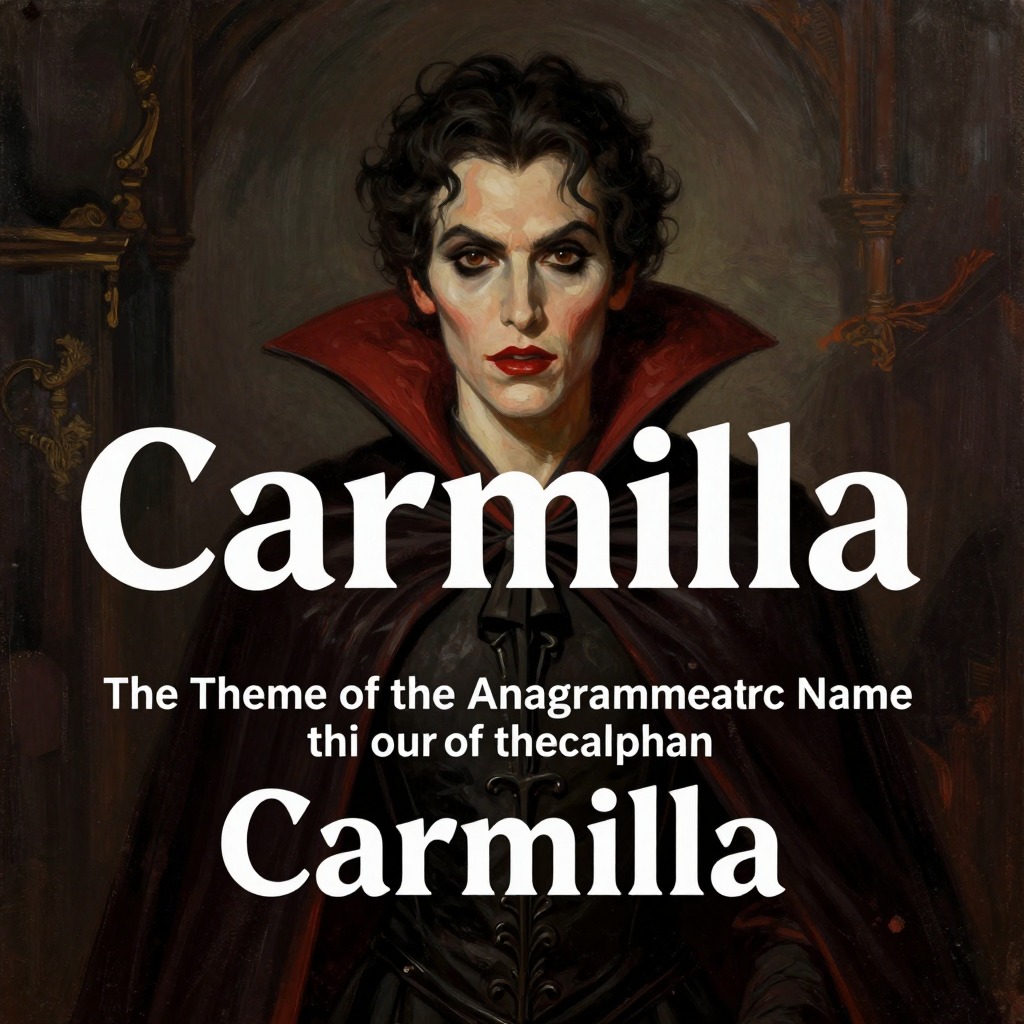
Anagrammatic Name Constraint
CarmillaThe vampire known as Mircalla, Countess Karnstein, operates under a peculiar and binding supernatural limitation: she can only adopt names that are exact anagrams of her original name. This constraint is not a casual preference but a fixed condition of her undead existence, one that the narrative explicitly identifies as a governing principle of her kind in certain situations.
Definition and Mechanism
The rule is stated directly in the conclusion of Laura's narrative: the vampire Mircalla "seemed to be limited to a name which, if not her real one, should at least reproduce, without the omission or addition of a single letter, those, as we say, anagrammatically, which compose it." This means that any alias she uses must contain exactly the same letters as "Mircalla" — no letter may be dropped and no new letter added. The constraint is presented as a special condition applying to her particular case, not necessarily to all vampires, but it is treated as an established and observable fact within the story's supernatural framework.
Demonstration Through Aliases
The narrative provides two clear demonstrations of this rule in action. When the vampire introduces herself to Laura and her family, she uses the name "Carmilla." Later, when she appears to General Spielsdorf and his ward Bertha Rheinfeldt at the masked ball, she calls herself "Millarca." Both names are perfect anagrams of "Mircalla": each contains the same eight letters — M, I, R, C, A, L, L, A — rearranged into a different sequence. The text explicitly confirms this connection, stating simply: "Carmilla did this; so did Millarca." The anagrammatic relationship is thus not a subtle hint but a deliberate, verifiable pattern that the story itself points out.
Significance and Narrative Function
The anagrammatic constraint serves multiple purposes within the story. On a practical level, it provides a means of identification: once the pattern is recognized, the various appearances of the vampire across different times and locations can be linked to a single entity. The name "Mircalla" appears on the portrait dated 1698, and the same anagrammatic principle connects the "Carmilla" who visits Laura's schloss with the "Millarca" who preyed upon Bertha Rheinfeldt. Thematically, the rule reinforces the idea that the vampire, despite her apparent freedom and mobility, is bound by rigid, almost legalistic supernatural laws. Her identity is fixed at a fundamental level — the letters of her name are immutable — even as she shifts her outward persona. This constraint also echoes the broader Gothic theme of inescapable fate: the vampire cannot invent a new name; she can only permute the one she already has, forever circling back to the same essential self.
Connection to Baron Vordenburg's Lore
The revelation of the anagrammatic constraint comes through the scholarly work of Baron Vordenburg, whose "curious lore" is credited with enabling the discovery of Mircalla's long-concealed tomb. The Baron's extensive research into vampirism, drawing on a "voluminous digest of all the judicial cases" and a library of esoteric texts, has allowed him to extract "a system of principles that appear to govern — some always, and others occasionally only — the condition of the vampire." The anagrammatic name limitation is presented as one of these principles, a piece of specialized knowledge that the Baron's ancestor, the Moravian nobleman who originally loved Mircalla, had also understood. This ancestor, having discovered Mircalla's vampirism, had deliberately obscured her tomb to protect her from "posthumous execution," and his papers — including the tracings and notes that eventually guided Baron Vordenburg — preserved the knowledge of her identity and its anagrammatic signature. The constraint thus functions as a key piece of evidence in the hunt, linking the vampire's present-day activities to her historical origin and enabling the final confrontation at the Chapel of Karnstein.