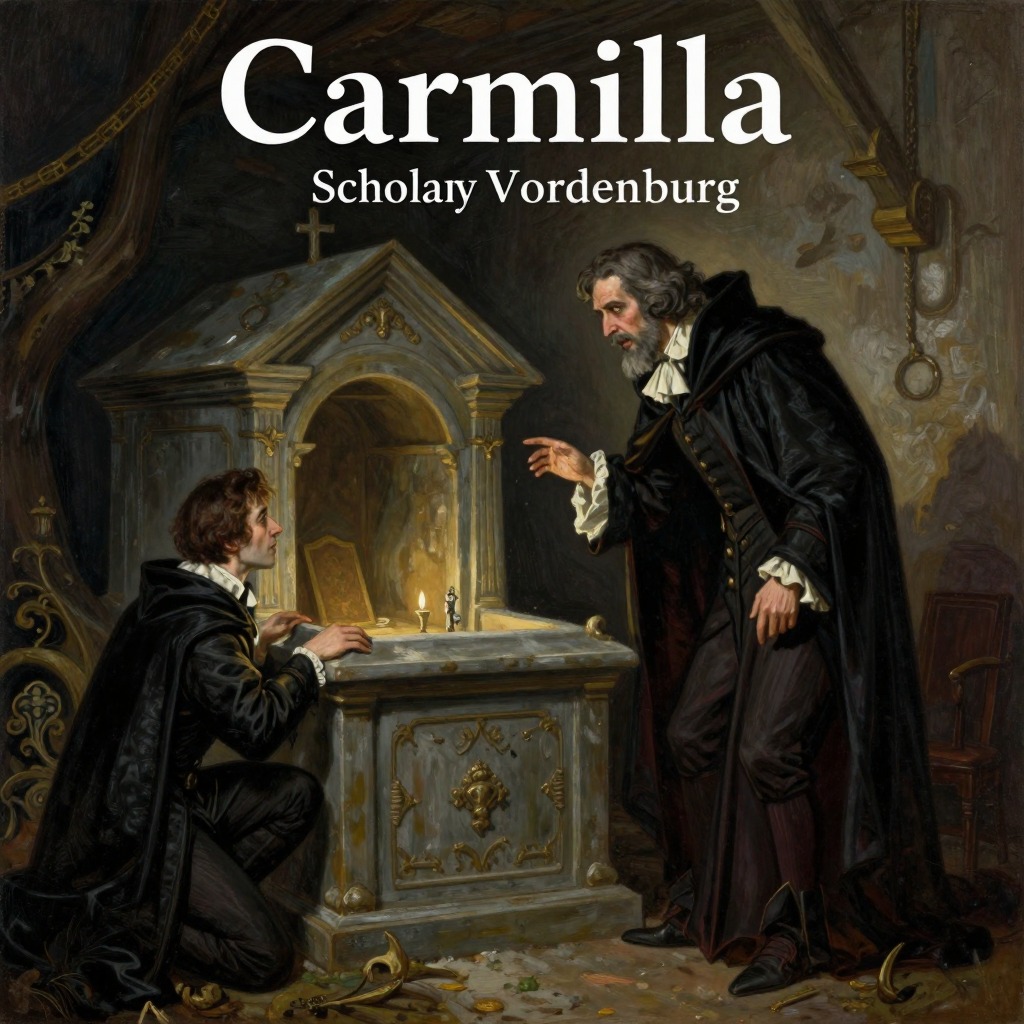
Vampire Daily Grave Return
CarmillaThe Vampire Daily Grave Return is the central physiological law governing the undead in Sheridan Le Fanu's Carmilla, establishing the creature's existence as an amphibious cycle between the grave and the living world. The vampire's daily renewal of slumber in the tomb is the mechanism that sustains its waking vigor, and its return to the coffin is accomplished without displacing the clay or leaving any trace of disturbance in the state of the coffin or the cerements—a phenomenon the narrative admits is utterly inexplicable. This rule, articulated by the learned Baron Vordenburg, forms the structural backbone of the story's supernatural logic and directly enables the climactic discovery and destruction of the vampire Mircalla, Countess Karnstein.
Definition and Mechanism
The vampire's existence is defined by a rigid daily rhythm: it must return to its grave for a period of slumber each day, and this sleep is the source of its strength. The narrative describes this as an "amphibious existence" sustained by "daily renewed slumber in the grave." The creature's "horrible lust for living blood" supplies the vigor of its waking existence, but the grave is the necessary anchor. The text emphasizes that how vampires escape from their graves and return to them "without displacing the clay or leaving any trace of disturbance in the state of the coffin or the cerements, has always been admitted to be utterly inexplicable." This inexplicability underscores the supernatural nature of the condition, placing it beyond natural law.
Connection to the Vampire's Pursuit of Victims
The daily grave return is intimately linked to the vampire's predatory behavior. The creature is prone to being fascinated with an engrossing vehemence, resembling the passion of love, by particular persons. In pursuit of these victims, it will exercise inexhaustible patience and stratagem, for access to a particular object may be obstructed in a hundred ways. It will never desist until it has satiated its passion and drained the very life of its coveted victim. However, in these cases, it will husband and protract its murderous enjoyment with the refinement of an epicure, heightening it by the gradual approaches of an artful courtship. This suggests that the daily return to the grave imposes a rhythm that allows the vampire to prolong its predation, returning night after night to feed on a single victim, as Carmilla does with Laura.
Narrative Significance: The Key to Discovery and Destruction
The rule of the daily grave return is what makes the vampire vulnerable to discovery and destruction. Because the vampire must return to its coffin each day, its tomb becomes a fixed location that can be identified and violated. This is precisely what occurs in the climax of the story. Baron Vordenburg, through his ancestor's papers, is able to locate the long-concealed tomb of Mircalla, Countess Karnstein, in the Chapel of Karnstein. The formal proceedings take place the next day: the grave is opened, and the body is found with all the admitted signs of vampirism—a faint but appreciable respiration, a corresponding action of the heart, perfectly flexible limbs, elastic flesh, and a leaden coffin floating with blood in which the body lay immersed to a depth of seven inches. The body is then raised, a sharp stake driven through the heart, the head struck off, and the remains reduced to ashes, which are thrown upon the river. The narrative concludes that "that territory has never since been plagued by the visits of a vampire," directly linking the successful execution to the discovery of the grave, which was only possible because of the vampire's daily return.
Thematic Implications: The Amphibious Cycle
The daily grave return establishes a thematic duality at the heart of the vampire's nature. It is neither fully alive nor fully dead, but exists in a suspended, amphibious state. This cycle mirrors the story's broader preoccupation with boundaries—between life and death, sleep and waking, love and predation. The vampire's need to return to the grave each day also suggests a kind of imprisonment, a compulsion that binds it to its tomb even as it roams free at night. This rule, articulated by Baron Vordenburg, who devoted himself to the minute and laborious investigation of the marvelously authenticated tradition of vampirism, provides the rational framework within which the supernatural horror of the story operates, transforming a folkloric monster into a creature governed by a discernible, if inexplicable, law.