Imperial Commission report
CarmillaThe Imperial Commission report is the official documentary record of the legal proceedings that culminated in the destruction of the vampire Mircalla, Countess Karnstein. It is the document from which Laura, the narrator, summarizes the final shocking scene of the novel, and its existence as a formal, signed, and witnessed judicial paper provides a veneer of empirical authority to the otherwise incredible events. The report stands as the ultimate proof within the story's frame that the supernatural was confronted not by superstition alone but by the full apparatus of imperial law and medicine.
Contents and Verification
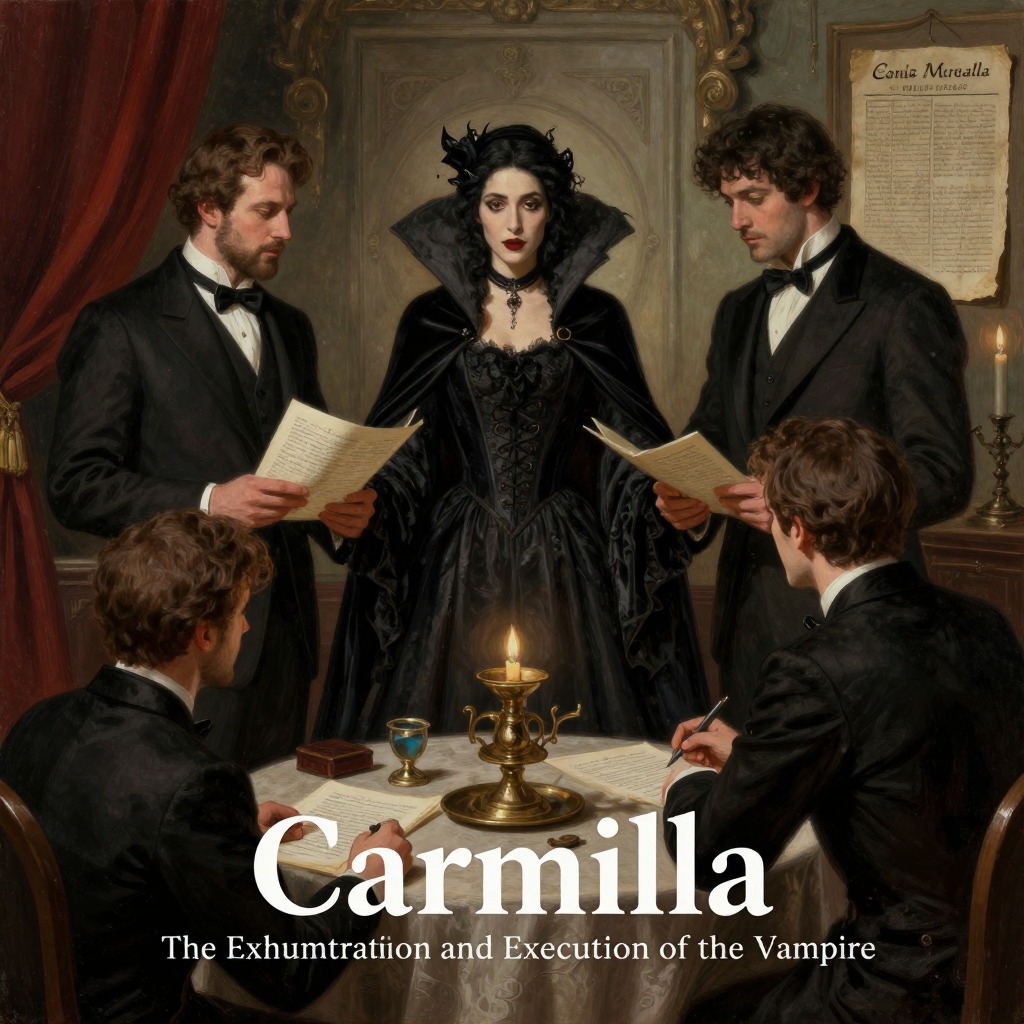
The report contains the signatures of all who were present at the proceedings, attached in verification of the statement. Laura explicitly states that it is from this official paper that she has summarized her account of the last shocking scene. The document thus functions as a source text within the narrative, lending the weight of bureaucratic documentation to a tale of vampirism. Laura's father retains a copy of this report, which he keeps after the events.
The Scene It Records
According to the report, the grave of the Countess Mircalla was opened in the Chapel of Karnstein. The features, though a hundred and fifty years had passed since her funeral, were tinted with the warmth of life; her eyes were open, and no cadaverous smell exhaled from the coffin. The two medical men present attested to a faint but appreciable respiration and a corresponding action of the heart. The limbs were perfectly flexible, the flesh elastic, and the leaden coffin floated with blood in which, to a depth of seven inches, the body lay immersed. These were all the admitted signs and proofs of vampirism. The body was raised, and a sharp stake was driven through the heart of the vampire, who uttered a piercing shriek at the moment, in all respects such as might escape from a living person in the last agony. Then the head was struck off, and a torrent of blood flowed from the severed neck. The body and head were placed on a pile of wood and reduced to ashes, which were thrown upon the river and borne away. The territory has never since been plagued by the visits of a vampire.
Narrative Significance
The Imperial Commission report serves as the story's final, unassailable evidence that the vampire was real and that its destruction was carried out according to law. It transforms the personal, subjective horror experienced by Laura and General Spielsdorf into a matter of public record, certified by medical men and signed witnesses. The report's dry, procedural language—recording respiration, heart action, and the depth of blood in the coffin—stands in stark contrast to the emotional and psychological terror that pervades Laura's narrative. By anchoring the supernatural climax in a legal document, the novel attempts to reconcile its Gothic horror with the rationalism of the nineteenth century, offering the reader a form of closure that is both horrifying and officially sanctioned.